

Voice leading is the practice of moving each melodic line in a chord progression as smoothly and independently as possible. The single rule to apply first, every time: keep any note the two chords share (the common tone) in the same voice, and move every other voice by the shortest distance available, ideally a step. Master that one habit and most of what follows in this guide will feel like refinement, not new information.
TL;DR:
- Most effective voice leading involves maintaining common tones in the same voice and moving other voices by the shortest possible interval, usually a step.
- Avoiding parallel perfect fifths and octaves is crucial because they cause lines to blend, reducing independence and clarity in the music.
- In four-part writing, doubling the root in triads is standard, while the fifth or third can be doubled, with careful handling of tendency tones like the leading tone.
- Guide tones, the third and seventh, are key to smooth jazz and pop progressions, often moving by half or whole step to maintain harmonic clarity.
- Slow, focused practice of two-chord and guide-tone progressions across all keys improves internalization of voice-leading principles more effectively than irregular or hurried sessions.
Table of Contents
- What Are the Core Rules of Voice Leading?
- What Are the Rules for Four-Part (SATB) Writing?
- How Do Guide Tones Work in Jazz and Pop Voice Leading?
- Piano, Guitar, and Arranging Techniques for Smoother Voice Leading
- What Are the Most Common Voice-Leading Mistakes?
- How Should You Practice Voice Leading?
- How Has Voice Leading Changed Across Musical Eras?
- How Does Voice Leading Show Up in Blues, Rock, and Film Scoring?
- What Can You Learn From Voice Leading in Famous Compositions?
- How Do You Handle Voice Leading Through Chromaticism and Modulation?
- What Role Do Dissonance and Non-Chord Tones Play in Voice Leading?
- Why Voice Leading Matters Beyond the Choir Room
- An Alternative Way to Audition Voice-Leading Ideas Fast
- Sources
- FAQ
What Are the Core Rules of Voice Leading?
Every voice leading rule traces back to one goal: each individual line should sound singable and clear, not just correct on paper. When a bass moves a fourth and the melody leaps a sixth at the same moment, the ear loses track of which line is which. When both lines glide by step, the harmony changes but each part still feels like a coherent melody.
The essential rules, in the order most teachers introduce them:
- Hold common tones. If two chords share a pitch, keep it in the same voice instead of jumping to a different one.
- Favor stepwise motion. When a voice has to move, a second is almost always better than a leap.
- Cap leaps at a third. Wikipedia's summary of voice leading notes that good part writing typically restricts individual voices to repeated notes, stepwise motion, or leaps no larger than a third.
- Avoid parallel perfect fifths and octaves. Two voices moving in the same direction by the same perfect interval fuse into a single sound instead of two independent ones.
- Watch hidden (direct) fifths and octaves, especially between the outer voices, when the upper voice leaps into a perfect interval.
- Keep the upper three voices within an octave of each other, and give the bass more room to roam.
That fifths-and-octaves prohibition is not an arbitrary tradition. Research summarized in MIT Press's Voice Leading: The Science Behind a Musical Art ties these rules to auditory perception: parallel perfect intervals make two lines blend into one perceived stream, which is exactly what part writing is trying to prevent. Doubling matters for the same reason. In root-position triads, doubling the root keeps the harmony stable; doubling the third or fifth is fine occasionally, but doubling a tendency tone like the leading tone tends to create awkward parallel motion when it resolves.
What Are the Rules for Four-Part (SATB) Writing?
Four-part chorale writing is where voice leading rules get tested in real time, because you have four lines competing for the same handful of good options. The standard setup assigns soprano, alto, and tenor to the upper three voices, kept within an octave of one another, while the bass carries the harmonic foundation and can leap more freely.
A practical sequence for working through any four-part progression:
- Set the bass line first, since it defines the harmony and often moves by leap between chord roots.
- Place the soprano melody, checking that it moves mostly by step or small leap.
- Fill alto and tenor with the remaining chord tones, prioritizing whichever note keeps each voice closest to its previous pitch.
- Double the root in root-position triads unless voice leading strongly favors doubling the third; West Virginia University's four-part writing guidance treats root doubling as the default and flags leading-tone doubling as a common error to avoid.
- Resolve tendency tones properly. The leading tone pulls up to the tonic; the seventh of a dominant seventh chord pulls down.
- Decide on the fifth in seventh chords. When four voices need to cover a four-note seventh chord and voice leading gets cramped, the fifth is usually the first note dropped, not the root or the seventh.
Picture a I to V progression in C major: the soprano holds G as a common tone, the bass leaps from C up to G, and the inner voices shift by step to complete each triad. Nothing moves further than it has to.
How Do Guide Tones Work in Jazz and Pop Voice Leading?
Guide tones are the third and seventh of a chord, and they carry the harmonic identity that tells your ear whether you're hearing a major seventh, a dominant, or a minor chord. In jazz and pop writing, tracking just those two notes across a progression often gives you smoother voice leading than trying to move every chord tone at once.
The clearest demonstration is a ii to V to I progression. Take Dm7 to G7 to Cmaj7: the seventh of Dm7 (C) resolves down by step to become the third of G7 (B), and the seventh of G7 (F) resolves down by step to become the third of Cmaj7 (E). Research on guide-tone space published in Music Theory Online documents this seventh-to-third resolution as one of the most efficient voice-leading paths through common jazz harmony, since it moves the defining notes of each chord by a half step or whole step rather than by leap.
- Sing or play just the guide-tone line through a progression before adding anything else.
- Build shell voicings (root, third, seventh, or just third and seventh) to isolate that motion on an instrument.
- Once the line feels smooth, add extensions and color tones around it.
Pro Tip: Practice guide-tone lines with a metronome at a slow tempo before you touch the root or any extensions. Once the third and seventh move cleanly on their own, everything else you stack on top will sound more connected.
Contemporary practice relaxes some classical restrictions here. Parallel fifths between inner voices barely register in a thick jazz voicing, and voice crossing is common in comping, because the ear is tracking harmonic color and guide-tone motion more than four discrete melodic lines.
Piano, Guitar, and Arranging Techniques for Smoother Voice Leading
Voice leading works differently depending on what you're playing it on, but the underlying goal stays the same on every instrument: minimize unnecessary motion.
- On piano, start with guide tones, then build outward. Play just the third and seventh of each chord in a progression, keep your hand as still as possible, and only add the root and extensions once that inner motion feels connected. Shell voicings exist precisely so you can check this without extra notes getting in the way.
- On guitar, choose chord shapes that share fingers or open strings between changes. A voicing that forces your whole hand to relocate for a chord change one step away is usually not the most efficient option. Favor shapes where the moving notes are the ones that actually need to move.
- When arranging for a group, use drop-2 or spread voicings to control spacing without losing inner-voice clarity. These systems let you spread a chord across a wider range while keeping the same underlying voice movement, which is how horn and string arrangers avoid muddy, cluster-heavy harmony. Excerpts from Pease and Pullig's writing on modern jazz voicings frame drop voicings as a way to incorporate tensions while preserving that connective spacing.
- Practice at a slow tempo with voices isolated. Play the bass alone, then the guide tones alone, then combine them. Speed hides sloppy voice leading; slowing down exposes exactly where a line jumps around unnecessarily.
What Are the Most Common Voice-Leading Mistakes?
Most voice-leading problems fall into a short list of repeat offenders, and once you know what to listen for, they get easy to catch.
- Parallel fifths or octaves between two voices. Play the two outer voices alone; if they move in the same direction by the same perfect interval, that's the culprit.
- Hidden consecutives, where an inner voice leaps into a perfect fifth or octave with the bass. Usually fixable by changing which chord tone that inner voice takes.
- Voice crossing that confuses the ear, as opposed to brief, intentional crossing in jazz comping where it barely registers.
- Leaps larger than a third with no melodic justification. If a voice has to leap, check whether a different chord-tone assignment lets it move by step instead.
- Doubling a tendency tone like the leading tone, which often forces awkward parallel motion when it resolves.
When a progression just "feels off," walk through each voice individually from start to finish before blaming the harmony. Nine times out of ten, one line is doing something the others aren't.
How Should You Practice Voice Leading?
Voice leading is a physical skill as much as a theoretical one. Reading the rules will only take you so far; your ear and your hands need repetition.
- Beginner drill: two-chord connections. Take any two triads a step or third apart, hold the common tone, and move the remaining voices by step. Transpose the same pair through several keys until it's automatic.
- Intermediate drill: guide-tone mapping. Run a ii to V to I progression through all twelve keys with a metronome, playing only the third and seventh of each chord. This is the same seventh-to-third motion documented in guide-tone space research, and drilling it across keys builds real fluency instead of memorized shapes.
- Arranging assignment: build one drop-2 and one spread voicing for the same four-chord progression, then play just the inner voices of each and compare how much they move.
- Audit your own writing. Export a MIDI file, slow the playback down, and solo each voice to check whether a line is leaping around more than it should. Slow playback catches problems your ear glosses over at full speed.
Consistency beats intensity here. Ten focused minutes a day on guide-tone lines will change how you hear harmony faster than an occasional two-hour session.
How Has Voice Leading Changed Across Musical Eras?
Voice leading conventions didn't arrive fully formed. They evolved as harmony itself got more complex, and each era's style reveals what composers were willing to sacrifice for expressive power.
Renaissance polyphony, especially the vocal music of composers like Palestrina, treated voice leading almost as the entire compositional problem: independent lines, careful dissonance treatment, and a near-total avoidance of parallel perfect intervals, because the music was built from counterpoint first and harmony second. Baroque composers, working with figured bass and functional harmony, kept those same prohibitions but layered in stronger tonal direction, chains of suspensions, and more chromatic voice leading in minor keys. Bach's chorales became the textbook model for exactly the SATB conventions outlined earlier.
Classical-era composers loosened the texture. Homophonic writing, with a clear melody over supporting harmony, meant voice leading rules still applied but mattered less moment to moment, since the ear was following one dominant line. Romantic composers pushed chromaticism hard enough that strict rule-following sometimes gave way to voice leading built around smooth chromatic motion rather than diatonic steps. Wagner's use of chromatic voice leading to delay and complicate resolution is the clearest example of rules bending in service of harmonic tension.
Modern and contemporary practice, including jazz and film scoring, treats these classical rules as defaults rather than laws. Parallel motion, once forbidden, became a deliberate color choice in impressionist and minimalist writing. The through-line across five centuries is remarkably stable: whatever the style, composers keep returning to common tones and stepwise motion as the default, and treat everything else as a calculated exception.
How Does Voice Leading Show Up in Blues, Rock, and Film Scoring?
Voice leading rules didn't stay locked inside classical part writing or jazz comping. They show up, sometimes disguised, in styles that never talk about them explicitly.
Blues guitar and piano lean on small, targeted voice movements constantly. A shuffle turnaround often works because one or two notes slide by a half step while the rest of the voicing holds still, which is common-tone voice leading by another name. Rock guitar arranging does something similar with power chords: a chord change that keeps the same root movement but shifts the top note by a step feels connected in a way that a full re-fingered chord shape does not, even without anyone naming it "voice leading" in the rehearsal room.
Film scoring leans on voice leading for a specific emotional effect: the slow, chromatic inner-voice shift under a sustained chord. That technique, often built from smooth half-step motion in the strings under a static melody, creates tension or dread without changing the surface harmony dramatically. It works for the same perceptual reason cited in research on voice leading and auditory perception: a small, controlled motion in one voice draws focused attention, while a large, sudden shift feels like a scene change. Composers scoring suspense sequences use this constantly, letting one inner line crawl chromatically while the rest of the orchestration holds steady.
What Can You Learn From Voice Leading in Famous Compositions?
Studying a piece you already know well is often the fastest way to internalize a voice-leading habit that reading rules alone won't teach.
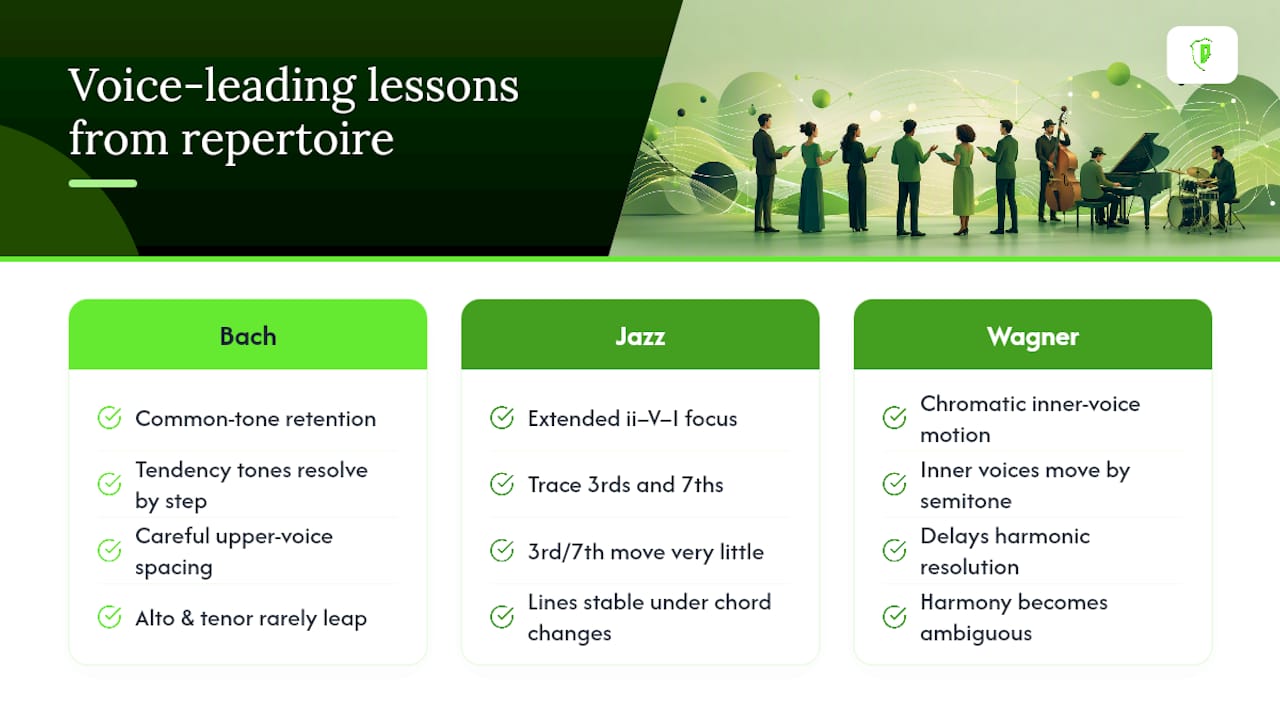
Bach's four-part chorales remain the standard teaching model for a reason: nearly every phrase demonstrates common-tone retention, stepwise resolution of tendency tones, and careful spacing between the upper three voices, all inside a few measures. Pull up any chorale harmonization and trace just the alto and tenor lines. They rarely leap, and when they do, the leap is almost always followed by a step in the opposite direction, a pattern voice leading teachers call "leap then step back."
On the jazz side, tunes built on extended ii to V to I motion, like much of the standard repertoire pianists study, reward the same kind of line tracing. Following just the third and seventh through a full chorus reveals how little those two notes actually move, even as the chord symbols overhead look like they're changing constantly.
In orchestral and film music, Wagner's chromatic voice leading in works like Tristan und Isolde remains a reference point for how far inner-voice motion can be pushed before harmony itself becomes ambiguous. The famous opening chord resolves not through a clean root movement but through single chromatic steps in the inner voices, delaying resolution long enough to become one of the most analyzed passages in Western music. Whatever the style, the pattern repeats: the pieces that get studied for their harmony almost always turn out to have exceptionally disciplined inner-voice movement underneath.
How Do You Handle Voice Leading Through Chromaticism and Modulation?
Chromatic passages and key changes put more pressure on voice leading than diatonic progressions do, because there are more notes competing for the same handful of good resolution paths.
The most reliable technique is finding the pivot: a common tone or a chromatically altered note that belongs to both the old key and the new one, then treating that note the same way you'd treat any shared tone between two diatonic chords. Secondary dominants and borrowed chords work the same way. A chord like V7 of V still resolves its guide tones (the third and seventh) by step or half step into the target chord, even though the chord itself sits outside the original key.
Chromatic mediant relationships, where two major or minor chords a third apart share no traditional function but do share a common tone, lean on that shared note as the anchor while everything else shifts chromatically around it. This is the same principle Wagner exploited: even radical harmonic motion can sound connected if at least one voice holds still or moves by the smallest possible interval while the harmony underneath changes dramatically.
For direct modulation without a pivot chord, the smoothest results usually come from choosing the new key's chord voicing that keeps the outgoing melody note in the same voice, then letting the other voices readjust from there. It's the same common-tone-first instinct from basic voice leading, just applied under more pressure.
What Role Do Dissonance and Non-Chord Tones Play in Voice Leading?
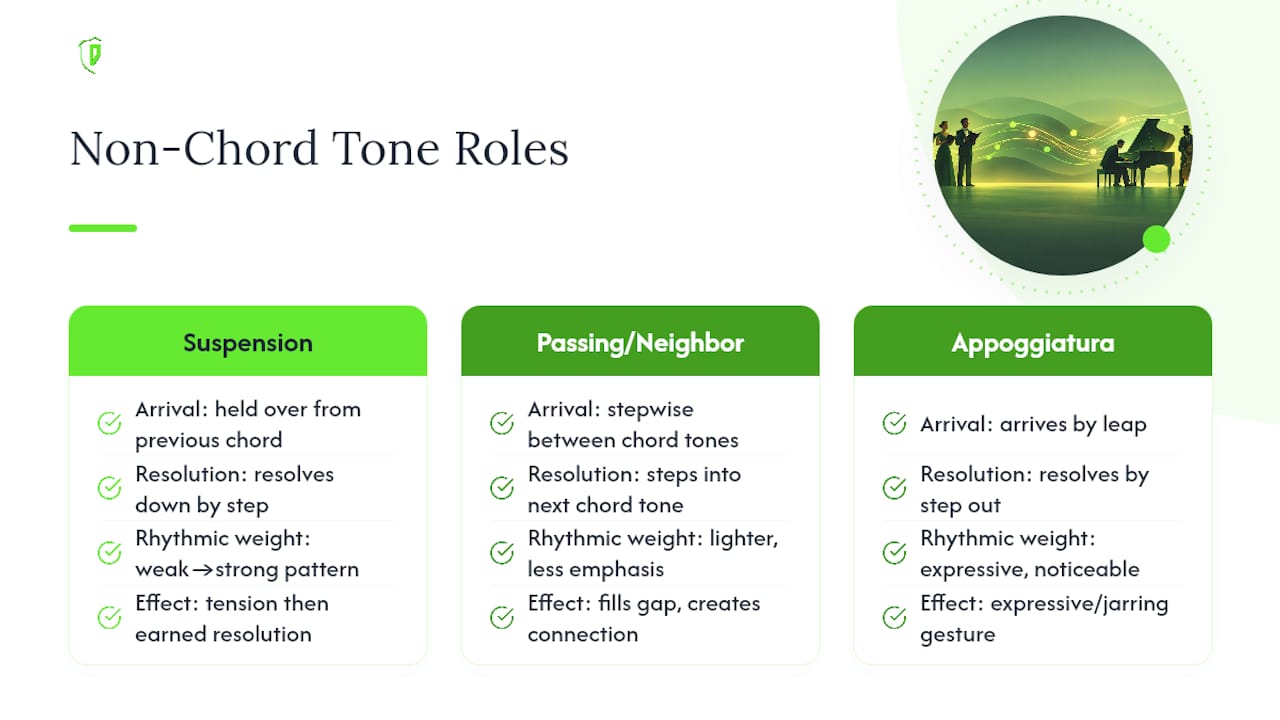
Dissonance in tonal music almost always arrives and leaves through voice leading, not through an isolated harmonic event. A passing tone, a suspension, or a neighbor tone creates tension specifically because the voice carrying it moves by step into the dissonance and then resolves by step out of it.
Suspensions are the clearest case: a note held over from the previous chord becomes dissonant against the new harmony, then resolves down by step, almost always on a weak-to-strong metrical pattern that makes the resolution feel earned rather than random. That resolution motion is voice leading doing its job at the smallest possible scale, one note settling into place.
Non-chord tones like passing tones and neighbor tones work the same way but with less rhythmic weight. They fill the stepwise gap between two chord tones, which reinforces the entire premise of voice leading rather than working against it. A melody that jumps from one chord tone straight to another sounds angular; the same melody with a passing tone filling the gap sounds connected, even though the underlying harmony hasn't changed at all.
Appoggiaturas break this pattern deliberately. They arrive by leap instead of by step, which is exactly what makes them sound expressive and slightly jarring, before resolving by step like every other non-chord tone. Understanding that pattern, leap in, step out, explains why appoggiaturas read as emotional gestures rather than mistakes. Dissonance, in other words, isn't the opposite of good voice leading. It's voice leading with a delay built in.
Why Voice Leading Matters Beyond the Choir Room
Voice leading isn't a rule set for choral music alone. It's what keeps a dense mix from turning into mud, which matters just as much in a home studio as in a cathedral. Clean inner-voice motion gives every part room to breathe, something worth remembering alongside general mixing techniques. Experienced arrangers break these rules on purpose for color, but they know exactly what they're breaking. Learn the rule first, then trust your ear to know when to bend it.
— Vigilantie
An Alternative Way to Audition Voice-Leading Ideas Fast
Working out competing voice-leading options by hand takes real time, especially when you're testing several ways to connect the same two chords. The DeputIE gives you a visual sequencer and chord progression workspace where you can try different voicings side by side and hear the results immediately, without redrawing a staff every time you want to test a new inner-voice path.

It's built around music theory rather than automated generation, so you're still making every harmonic decision. The software just removes the friction of testing them. Lay out a progression in the chord tool, try a few voicing options, and export whatever you land on straight to MIDI for your DAW using the MIDI export and chord workspace features. It's a faster way to iterate, not a substitute for training your ear. If you want to try it, plans start with a monthly option at $19.99 per month or an annual option at $129.99 per year, both through the DeputIE product page, and a free trial lets you test the chord and voicing tools on your own progressions before committing.
Sources
- Voice leading — Wikipedia
- Four-part writing guidance — West Virginia University course notes
- Guide-tone space — Music Theory Online (MTO)
- Voice Leading: The Science Behind a Musical Art — MIT Press / Oxford Academic
FAQ
What makes good voice leading?
Good voice leading keeps each melodic line moving smoothly, favoring repeated common tones, stepwise motion, or leaps no larger than a third, according to Wikipedia's overview of the practice. It also avoids parallel perfect fifths and octaves, since those intervals make independent lines blend into one.
What are the three rules of voice leading?
The three most cited rules are: keep common tones in the same voice, move remaining voices the shortest distance possible, and avoid parallel perfect fifths and octaves. Most other conventions, like doubling and spacing guidelines, extend from these three core ideas.
What is a leading voice?
"Leading voice" usually refers to a tendency tone, a note like the leading tone of a scale that has a strong pull toward a specific resolution, typically the tonic a half step above it. In four-part writing, resolving these tendency tones correctly is one of the core voice leading rules.
Can you double the fifth in voice leading?
Yes, doubling the fifth of a triad is acceptable, though doubling the root is generally the preferred default in four-part writing. Four-part writing conventions treat root doubling as standard practice and flag doubling a tendency tone, like the leading tone, as the choice to avoid instead.