
A time signature tells you how many beats are in each measure and which note value gets the beat. Read the top number as the count per bar and the bottom as the note that equals one beat: 4 means quarter note, 8 means eighth note. Once you know that, you can glance at 4/4, 3/4, or 6/8 and start tapping along almost immediately.
TL;DR:
- Most common meters like 4/4 and 3/4 have distinct strong and weak beat patterns that influence the groove and backbeat placement.
- Compound meters such as 6/8 are characterized by grouping eighth notes into threes, creating a rocking, lilting feel with two primary beats per measure.
- Differentiating between 3/4 and 6/8 relies on observing grouping in notation (beams) and feeling three equal pulses versus two longer, accented groups.
- Odd meters like 5/8 or 7/8 are best understood by breaking the measure into familiar groupings of twos and threes, not counting continuously.
- Practicing with metronomes, clapping exercises, and visual tools helps internalize meter feel, leading to more accurate rhythmic interpretation and musical expression.
Table of Contents
- How do you read a time signature?
- Simple versus compound meters: what changes and why
- Counting and feeling 4/4, 3/4, and 6/8
- How to tell if a passage is in 3/4 or 6/8
- Making sense of odd and mixed meters like 5/8 and 7/8
- A step-by-step practice routine for reading and feeling meter
- Practicing meter visually with The DeputIE
- Why feel should lead the math, not follow it
- Turn meter practice into finished music with DeputIE
- Sources
- FAQ
How do you read a time signature?
A time signature sits right after the clef and key signature at the start of a piece, and it stays in effect until a new one appears. According to LibreTexts/02%3A_Rhythm_and_Meter/2.05%3A_Time_Signature), it indicates how many of a given note value fit into each measure, and every measure has to contain notes adding up to that exact total.
The top number tells you how many beats (or, in some cases, divisions) occur per measure. The bottom number tells you which note value counts as one of those beats. Here is the mapping you will see over and over:
- 1 means a whole note gets the beat, which may be seen only in specialized notation.
- 2 means a half note gets the beat.
- 4 means a quarter note gets the beat, the most common choice in popular and classical music.
- 8 means an eighth note gets the beat, common in compound meters like 6/8.
- 16 means a sixteenth note gets the beat, usually seen in fast or heavily subdivided passages.
One point trips up a lot of beginners: a time signature looks like a fraction but does not behave like one. You never simplify 4/4 down to 1/1 or 6/8 down to 3/4, because the bottom number specifies a note value, not a ratio, as Open Music Theory explains. Changing the bottom number changes what note gets counted, which changes how the music feels even if the math looks similar.
You will also run into two symbols instead of numbers. A large "C" stands for common time, which is just another way of writing 4/4. A "C" with a vertical slash through it means cut time, or 2/2, where the half note gets the beat instead of the quarter, giving the music a broader, faster-feeling pulse even at the same tempo marking.
Quick rules worth memorizing: the top number is always the count, the bottom number is always the note value, and the numbers stack vertically rather than sitting on a slanted fraction line. If you see 6, 9, or 12 on top, pause before assuming a normal quarter-note pulse. That number is your first clue that something different is going on, which brings us to the next distinction.

Simple versus compound meters: what changes and why
The fastest way to sort a time signature is to look at the top number and ask whether it divides evenly by two or by three. Simple meters use a top number of 2, 3, or 4, meaning each beat splits naturally into two smaller parts. Compound meters use a top number that is a multiple of three, typically 6, 9, or 12, meaning each beat splits naturally into three smaller parts, according to Open Music Theory.
Here is the trick for compound meters: divide the top number by three to find the actual number of beats per measure. In 6/8, dividing 6 by 3 gives you two beats, and each beat is a dotted quarter note rather than a plain eighth note. In 9/8, dividing by three gives three dotted-quarter beats, and in 12/8, you get four. The bottom number still says "8," but you are not counting eight separate beats. You are counting fewer, longer beats that each contain three eighth notes.
Notation gives you visual shortcuts once you know what to look for.
- Compound meters usually beam eighth notes in groups of three, which signals a dotted-quarter pulse.
- Simple meters beam eighth notes in groups of two, matching a quarter-note pulse.
- A dotted note as the stated beat unit (dotted quarter, dotted eighth) almost always signals compound meter.
Tempo has nothing to do with this classification. As OpenLearn points out, subdivision into two-part or three-part groups defines simple versus compound meter, not how fast the piece moves. A slow 6/8 ballad and a fast 6/8 jig are both compound, and both compound and simple meters can be played at any tempo.
Pro Tip: If you are stuck deciding, clap the steady eighth notes and listen to how your ear wants to group them. Three claps feeling like one unit points to compound; two claps feeling like one unit points to simple.

Counting and feeling 4/4, 3/4, and 6/8
Knowing the numbers is only half the job. The other half is feeling where the strong and weak beats land, because that pattern is what gives music its groove.
In 4/4, you count "1, 2, 3, 4," but the beats are not equal in weight. Beat 1 carries the strongest accent, beat 3 carries a secondary accent, and beats 2 and 4 sit lighter, producing a strong-weak-medium-weak hierarchy that gives the meter its characteristic pulse, a pattern described in rhythm lessons from MasterClass. If you are clapping along to a song in 4/4, clapping on beats 2 and 4 (the backbeat) is the classic choice in rock, pop, and blues, since it plays against the strongest beats rather than doubling them.
In 3/4, you count "1, 2, 3" with the accent almost always landing on beat 1. This is the waltz feel, three even quarter-note beats per measure, with beats 2 and 3 noticeably lighter than beat 1. There is no backbeat tradition here the way there is in 4/4. The pulse rocks forward on one strong downbeat per bar.
In 6/8, counting all six eighth notes ("1, 2, 3, 4, 5, 6") misses the point. Instead, count it as two dotted-quarter beats: "ONE-and-a, TWO-and-a." The first syllable of each group carries the weight, and the two groups create a rocking, lilting feel rather than a marching one, a distinction Open Music Theory emphasizes when teaching compound meter. If you clap along, you clap twice per bar, not six times.
A short routine to internalize all three:
- Set a metronome to a slow, comfortable tempo and count 4/4 out loud, clapping on beats 2 and 4.
- Switch to 3/4 at the same tempo and clap only on beat 1, letting beats 2 and 3 pass silently.
- Switch to 6/8 and count "ONE-and-a, TWO-and-a" out loud, clapping on "ONE" and "TWO" only.
- Repeat the cycle three times without stopping the metronome, moving straight from one meter to the next.
Doing this daily for even a few minutes trains your body to feel the difference between duple, triple, and compound pulses before you ever have to think about the numbers.
How to tell if a passage is in 3/4 or 6/8
This is the confusion that trips up almost every beginner, because 3/4 and 6/8 can contain the exact same number of eighth notes per measure: six. The difference is entirely in how those six eighth notes get grouped.
In 3/4, the six eighth notes split into three equal pairs, one pair per quarter-note beat. In 6/8, the same six eighth notes split into two equal groups of three, one group per dotted-quarter beat. Same raw material, different organization, and that organization changes where the strong pulse lands.
Notation gives you a fast answer without counting anything:
- Beams grouped in twos across the measure point to 3/4.
- Beams grouped in threes point to 6/8.
- A time signature with an 8 on the bottom and a multiple of three on top (6, 9, 12) is compound by definition.
Listening gives you a second check. In 3/4, you should feel three roughly equal pulses per bar. In 6/8, you should feel two pulses, each one noticeably longer and each containing a subtle internal lift on its middle note.
Try this micro-exercise: clap six even eighth notes at a steady tempo, no accents. Now regroup them by accenting every third clap, which gives you the 3/4 feel of three pairs. Then regroup again by accenting only the first and fourth clap, which gives you the 6/8 feel of two triplet-like groups. Doing this back to back makes the distinction physical instead of theoretical, and once you have felt it, you rarely mix the two up again.
Making sense of odd and mixed meters like 5/8 and 7/8
Time signatures like 5/8, 7/8, and 11/8 look intimidating on paper, but the fix is the same trick that works for compound meters: stop counting one long string of numbers and start grouping.
Berklee's guidance on odd meters recommends superimposing familiar groupings of twos and threes over the steady pulse rather than trying to calculate the meter mathematically, according to Berklee College of Music. A measure of 7/8, for example, almost never gets counted as a flat "1-2-3-4-5-6-7." Instead, it gets broken into something like 2+2+3 or 3+2+2, and each group gets a light internal accent. A measure of 5/8 typically breaks into 2+3 or 3+2. The math never changes, but the feel does depending on which grouping the composer intended.
- 7/8 commonly splits as 2+2+3 (light, light, slightly emphasized) or 3+2+2, depending on the melodic phrase.
- 5/8 commonly splits as 3+2 or 2+3, again driven by where the tune naturally lands.
- 11/8 often breaks into smaller familiar chunks, such as 2+2+2+2+3, borrowing the same logic at a larger scale.
Counting strategies vary by preference. Some players count the raw numbers ("1-2, 1-2, 1-2-3") to keep the groups audible while still tracking the total. Others use spoken syllables tied to the grouping itself, almost like a rhythmic mnemonic, which keeps the body moving instead of the brain calculating. Teachers across the board tend to agree that grouping and listening should lead, with counting reinforcing what you already feel rather than replacing it, a point Berklee makes directly.
You hear these meters more often than you might expect. Progressive rock and jazz fusion lean on 7/8 and 11/8 for a sense of forward motion that never quite settles. Balkan and other folk traditions use additive meters like 7/8 or 9/8 as a normal, danceable pulse rather than an experimental effect. Film scores reach for odd meters when a scene needs tension without an obvious rhythmic anchor.
Pro Tip: Instead of counting an odd meter as one unbroken sequence, tap your foot only on the first note of each group. Your foot pattern becomes the meter's fingerprint, and the numbers stop mattering as much.
A step-by-step practice routine for reading and feeling meter
Reading about time signatures only gets you so far. The following routine turns the ideas above into a repeatable habit, and a short session done consistently beats a long session done once, an approach reflected in LibreTexts's emphasis on brief, repeatable drills over long theoretical study.
- Warm up with a metronome. Pick a slow tempo, around 60 beats per minute, and simply clap on every beat for one minute without changing meter.
- Sight-read a simple line. Grab any piece of sheet music in 4/4 or 3/4 and clap the rhythm while saying the counts out loud, checking that your claps land where the notation says they should.
- Run a grouping drill for odd meters. Take a measure of 7/8, mark it 2+2+3 in pencil, and clap the accents only on the first note of each group until the pattern feels automatic.
- Practice a switching-meter drill. Alternate between 4/4 and 6/8 every four bars, forcing yourself to feel the shift from duple to compound pulse without losing tempo.
- Slow everything down when it breaks. If a passage falls apart, cut the tempo in half, nail it there, then bring it back up gradually rather than muscling through mistakes.
- Add a backing track or loop. Playing along with a steady groove exposes timing problems that clapping alone will not, and looping a tricky bar a dozen times builds confidence faster than playing the whole piece top to bottom.
None of these steps require special equipment beyond a metronome and a piece of music you care about. What matters is repetition on the specific meter that trips you up, not generic rhythm practice.
Practicing meter visually with The DeputIE
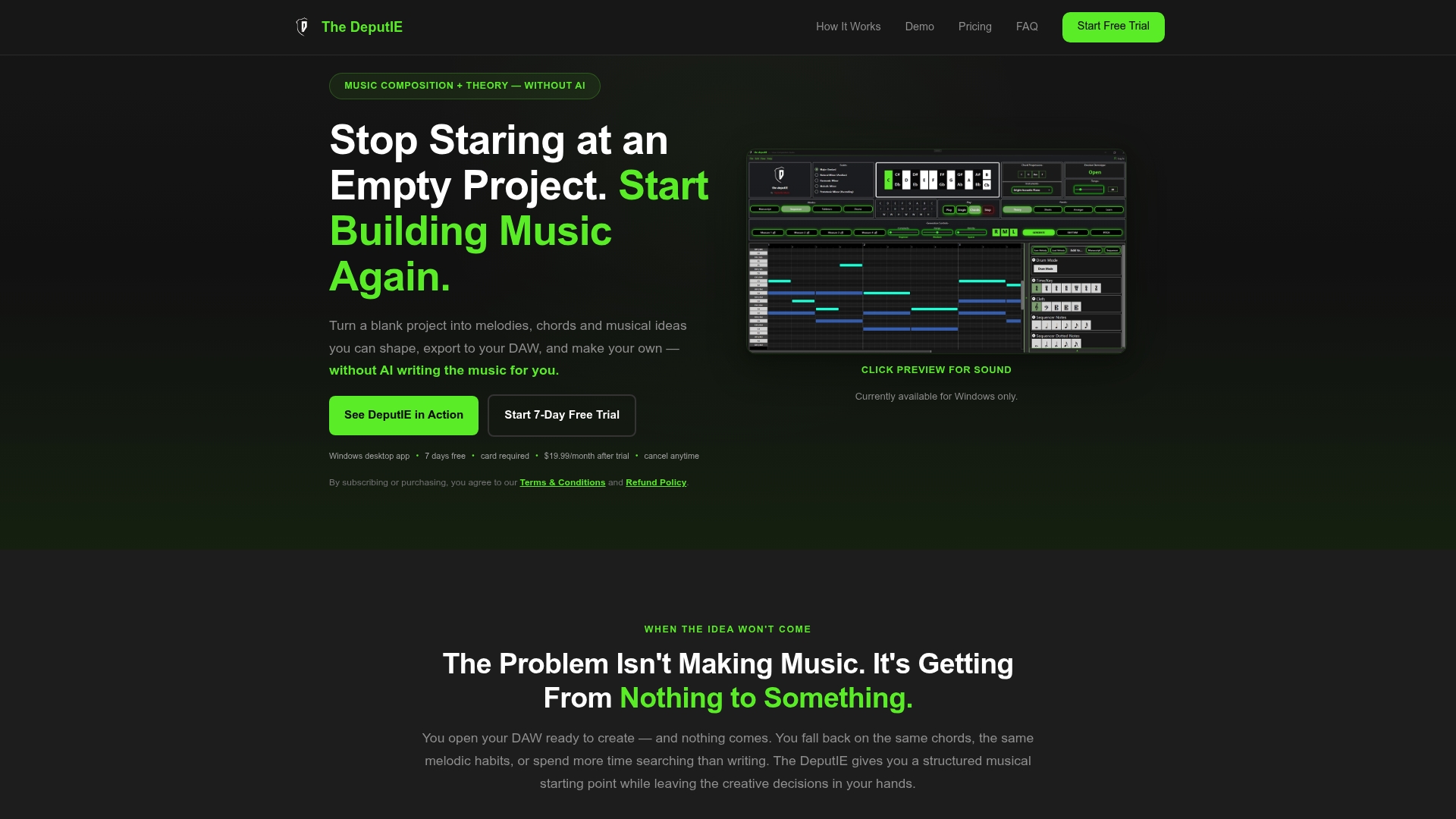
Clapping and counting build the feel, but seeing the grouping while you hear it can shorten the gap between theory and instinct. A composition tool includes a visual sequencer and dedicated workspaces that lay out beats and subdivisions on screen as you build a part, which gives you a visual anchor for grouping alongside the audio.
A realistic workflow looks like this: sketch a phrase in 6/8 using the visual sequencer, watch how the tool lays out the two dotted-quarter groups, then slow down playback to confirm the accents land where you expect. Once the grouping feels right, export the part as MIDI and drop it into your digital audio workstation to keep building the arrangement. Because DeputIE keeps its tools rooted in music theory rather than generating parts for you, you stay in control of how the meter actually gets played, which matters when you are training your ear rather than just producing a finished track.
Readers who want the specifics on how the workspaces are laid out can check the DeputIE user manual for a walkthrough of each tool.
Why feel should lead the math, not follow it
Most beginners treat time signatures as an arithmetic problem: divide here, multiply there, land on the right count. That approach works on paper and falls apart the moment you try to play with other musicians, because meter is something you feel in your body before you ever explain it in numbers.
I'd rather see a new player clap along to a song and get the grouping right by instinct than recite the correct definition of compound meter and still stumble over a 6/8 groove. Let the melody and the bass line tell you where the pulse lands. If a tune rocks in twos, it is probably compound. If it marches in threes, it is probably simple triple. The numbers on the page confirm what your ear already suspects.
Progress here is rarely linear. You will feel confident in 4/4, get thrown by your first real 7/8 passage, and need a week of slow, deliberate grouping drills before it clicks. That is normal, and it is exactly how the feel gets built.
— Vigilantie
Turn meter practice into finished music with DeputIE
Understanding a time signature is one thing. Turning that understanding into a part you actually like is another, and that is where DeputIE's visual sequencer and theory-guided workspaces earn their place in your routine, letting you see a meter's grouping while you build a melody or chord progression around it.
Once a phrase feels right, export it as MIDI and carry it straight into your DAW for arranging, mixing, or further writing. You can start with the DeputIE Monthly or Annual plan after trying the free trial, or read the user manual first if you want to see the workspaces before you commit.
Sources
For deeper study, Open Music Theory covers simple and compound meter in detail, Berklee College of Music offers practical guidance on odd meters, and LibreTexts breaks down notation basics for beginners. Wikipedia also offers a broad overview of meter types if you want the full taxonomy.
- Simple meter and time signatures – Open Music Theory
- Working with the Math | Berklee College of Music
FAQ
What is a 6/8 time signature?
A 6/8 time signature is a compound meter counted as two dotted-quarter beats per measure rather than six even eighth notes, following the pattern "ONE-and-a, TWO-and-a." Each dotted-quarter beat contains three eighth notes, which is what gives 6/8 its rocking, lilting feel compared to a straight duple meter, as Open Music Theory explains.
Are you supposed to clap on 1 and 3 or 2 and 4?
In most popular music written in 4/4, clapping on beats 2 and 4 (the backbeat) is the common choice, since it plays against the naturally strongest beats, 1 and 3. That strong-weak-medium-weak hierarchy in 4/4 is what gives the meter its characteristic pulse, a pattern outlined in rhythm lessons from MasterClass.
Is a 3/4 time signature rare?
No, 3/4 is one of the most familiar simple meters and shows up constantly in waltzes, ballads, and folk music, with three even quarter-note beats per measure and the accent landing on beat 1. It is far more common than compound or odd meters like 6/8, 7/8, or 11/8.
How can you tell if a song is in 3/4 or 6/8?
Both meters can contain the same six eighth notes per measure, but 3/4 groups them into three equal pairs while 6/8 groups them into two groups of three. Listen for three equal pulses (3/4) versus two longer pulses with a subtle lift in the middle (6/8), and check the notation for beaming in twos versus beaming in threes, a distinction covered in Open Music Theory.