
A secondary dominant is the dominant chord, V or V7, of a diatonic chord other than the tonic, written with slash notation like V/ii or V/V. It "tonicizes" that target chord for a beat or two, borrowing an out-of-key note that acts as a temporary leading tone. The fastest way to spot one on a page: look for a major or dominant seventh chord with an accidental that doesn't belong to the key, then check whether it resolves down a fifth.
TL;DR:
- A secondary dominant briefly tonicizes a non-tonic chord by borrowing an out-of-key note that resolves down a fifth to the target chord.
- They are built by selecting the target chord, then a perfect fifth above its root to form a major or dominant seventh chord, with accidentals indicating the borrowed note.
- Spotting secondary dominants involves identifying an out-of-key note in a dominant or major chord that resolves upward by half step into the target root.
- They frequently appear in jazz, classical, and popular music, such as Paul McCartney's "Yesterday" and Beethoven's harmonic progressions.
- Correct analysis relies on confirming that the altered note resolves up into the target and that the overall motion is down a fifth, not a full modulation.
Table of Contents
- What Are Secondary Dominants, and How Does the Notation Work?
- How Do You Build and Spell a Secondary Dominant?
- How Do You Spot and Resolve Secondary Dominants Correctly?
- What Are Extended Dominant Chains, and How Do You Use Them?
- Where Can You Hear Secondary Dominants in Real Songs?
- What Mistakes Do Musicians Make With Secondary Dominants?
- How Should You Practice Identifying and Writing Secondary Dominants?
- An Editor's Take on Applied Dominants
- Audition Your Secondary-Dominant Ideas Before You Commit Them
- Sources
- FAQ
What Are Secondary Dominants, and How Does the Notation Work?
A secondary dominant, sometimes called an applied dominant, is a chord borrowed from the harmonic language of a key you're not actually in. Instead of resolving to the tonic like a normal V chord, it resolves to some other diatonic chord in the progression, briefly making that chord feel like a new tonal center. Music theorists call this tonicization: a short chromatic detour that colors one chord without derailing the whole key. The Music Theory for the 21st-Century Classroom project defines it exactly this way, as a dominant seventh or major triad altered to function as the dominant of a non-tonic diatonic chord.
The notation reads like a fraction: V/V means "the dominant of the dominant," spoken as "five of five." V/ii means "five of two," the dominant that resolves into the ii chord. In Open Music Theory's framework, applied chords aren't limited to major triads and dominant sevenths. Diminished sevenths (viiº7/x) work the same way, though this article focuses on the dominant-function versions since they're what you'll encounter constantly.
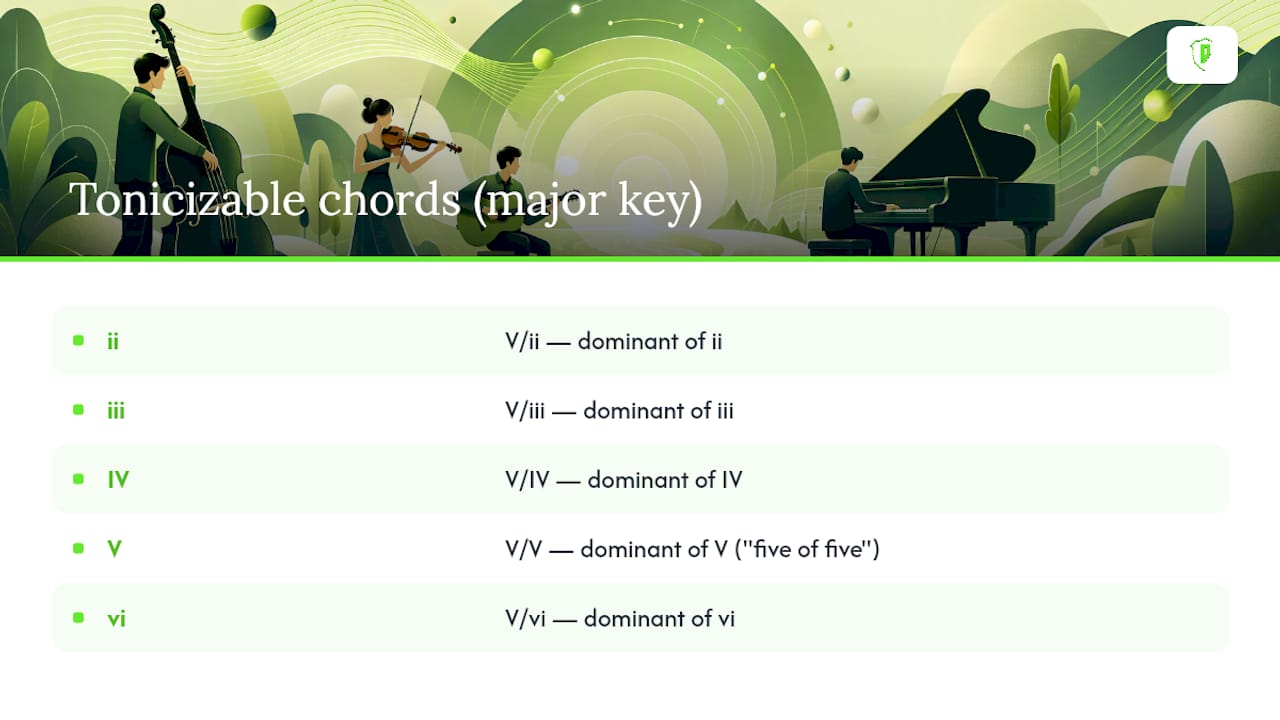
In a major key, you can tonicize ii, iii, IV, V, and vi. The vii° chord gets excluded because it's already diminished and unstable. It has no gravitational pull worth borrowing. Minor keys work similarly but pull from the natural, harmonic, and melodic minor scales, which widens the available palette.
One line separates tonicization from real modulation: duration and cadence. A single V/V that resolves in half a measure is tonicization. A V/V followed by a full cadence in the new key, sustained across several measures, is modulation.
How Do You Build and Spell a Secondary Dominant?
The construction recipe is mechanical once you know it. Pick your target chord, count up a perfect fifth from its root, then build a major triad or dominant seventh on that note. Whatever notes fall outside your home key become the accidentals that flag the chord as secondary.
Working in C major makes this concrete. To tonicize ii (D minor), go up a fifth from D to A, then build A7: A, C#, E, G. The C# is your tell, since C major has no sharps. That A7 resolves down a fifth into Dm, completing V/ii. To tonicize V (G major) itself, go up a fifth from G to D, then build D7: D, F#, A, C. The F# is the giveaway, and it resolves to G.
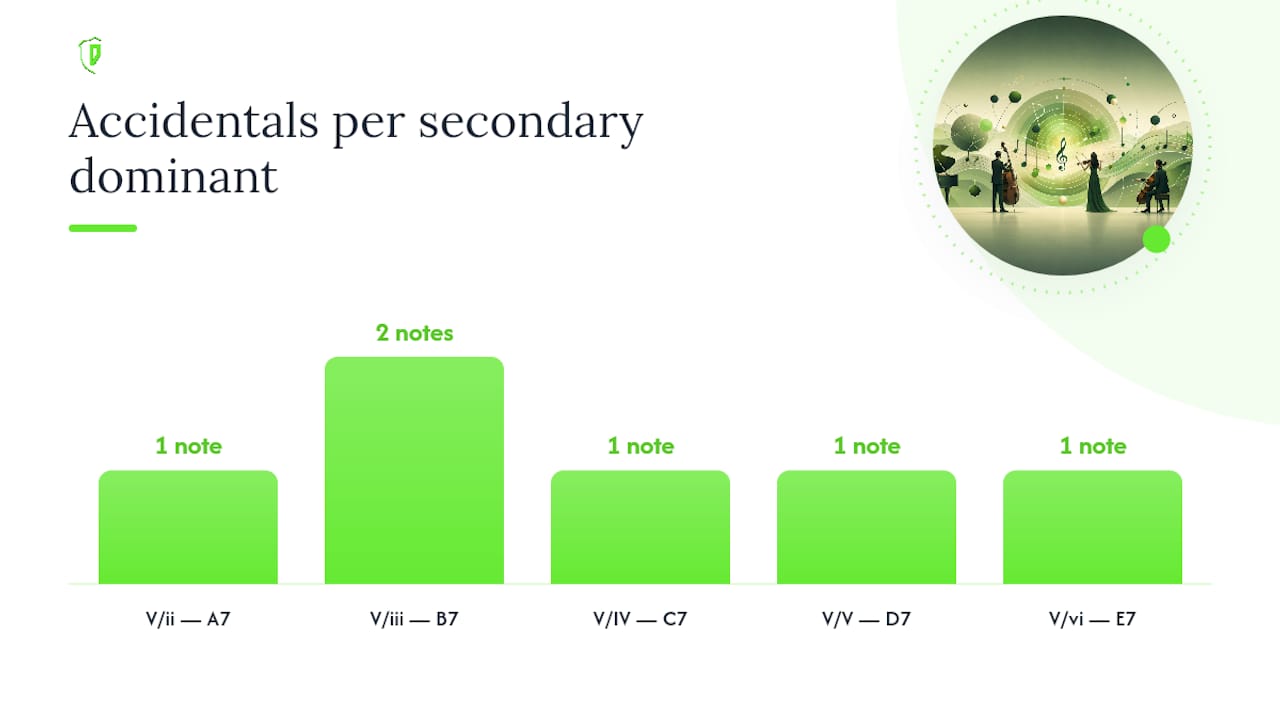
The unusual case in the set is V/IV. In C major, IV is F, so its dominant would be built on C, the tonic. That gives you a chord very similar to the tonic triad except for one flatted note. Guitarists and pianists often miss this one because it hides in plain sight, disguised as a familiar shape with a single altered tone.
Here's the reference table for major-key secondary dominants in C major, including the parallel minor targets:
| Symbol | Spelled chord (C major) | Outside note(s) |
|---|---|---|
| V/ii | A7 (A, C#, E, G) | C# |
| V/iii | B7 (B, D#, F#, A) | D#, F# |
| V/IV | C7 (C, E, G, B♭) | B♭ |
| V/V | D7 (D, F#, A, C) | F# |
| V/vi | E7 (E, G#, B, D) | G# |
Every one of these targets resolves down a perfect fifth, the same motion that defines an ordinary V to I. That consistency is what makes the system learnable instead of a pile of exceptions.
How Do You Spot and Resolve Secondary Dominants Correctly?
Your eyes and ears are looking for the same clue: a note that doesn't belong to the key, attached to a chord that otherwise looks like a normal major or dominant seventh. That foreign note is functioning as a secondary leading tone, and it wants to move up by half step into the root of the chord it's tonicizing.
Voice-leading for secondary dominants follows the same physics as any dominant seventh chord. University-level theory materials lay out the core rules plainly:
- The seventh of the chord resolves down by step into the third of the target chord.
- The secondary leading tone (the altered note) resolves up by half step into the root of the target chord.
- Keep any common tones stationary between the two chords rather than jumping them around.
- Watch inner voices for "frustrated" motion, where a voice can't resolve as expected because another voice already occupies that pitch. When that happens, let the voice move to the nearest available chord tone instead of leaping.
A standard resolution: A7 (V/ii) moving to Dm in C major. The C# rises to D, the G falls to F, and the shared A stays put. An irregular but common variant: the seventh resolves down while the chord itself moves deceptively, landing on a different scale step than expected, which composers use deliberately for surprise.
To analyze a suspect chord fast, run through this order: identify any note outside the key signature, check what chord follows it, confirm the root motion is down a fifth, then label it V/x based on the target.
Pro Tip: Sing just the accidental note against the chord it resolves to. If your ear wants it to pull upward into the next chord's root, you've confirmed it's acting as a secondary leading tone, not a random chromatic passing note.
What Are Extended Dominant Chains, and How Do You Use Them?
An extended dominant chain strings several secondary dominants together, each one resolving into the next along the circle of fifths before finally landing on the real tonic. The textbook example is E7 to A7 to D7 to G7 to C, where every chord is the dominant of the one that follows it, and only the last chord is diatonic to the home key.
Chains like this show up constantly in jazz turnarounds, ragtime, and plenty of pop songwriting. Toby Rush's advanced harmony materials note that the chain follows a predictable circle-of-fifths path, but the voice-leading between links still needs attention or the passage turns jagged.
Keep chains smooth with a few habits:
- Preserve common tones between adjacent chords whenever the spelling allows it.
- Move each chord's tendency tones (the seventh and the leading tone) by step rather than by leap.
- Resist the urge to chain more than three or four dominants in a row. The trick loses its punch through repetition, and the ear stops registering each resolution as meaningful.
- Watch for moments where the chain threatens to pull the listener's sense of key away entirely. If that's not your intent, anchor back to the tonic sooner.
Where Can You Hear Secondary Dominants in Real Songs?
You don't need a textbook example to internalize this. The repertoire catalog at Music Theory for the 21st-Century Classroom lists both classical and popular instances worth transcribing by ear.
- Paul McCartney's "Yesterday" uses an A7 as V/vi in F major. The C# inside that A7 is the tell, and it resolves into D minor, the vi chord, giving the bridge its melancholy lift.
- Classic country songwriting, in the vein of Hank Williams and Dolly Parton, frequently leans on V/V turnarounds right before a chorus lands, a quick D7 to G motion in the key of C being a common shape.
- Beethoven's instrumental writing includes documented instances of V7/IV, tonicizing the subdominant briefly before returning home, a favorite device for adding weight to a phrase's midpoint.
- Jazz standards routinely chain applied dominants through turnarounds, the E7 to A7 to D7 to G7 pattern mentioned earlier being one of the most recognizable.
For practice material, public-domain scores of Beethoven sonatas and lead sheets for pre-1960s standards are widely available and make excellent transcription targets.
What Mistakes Do Musicians Make With Secondary Dominants?
The most common error is labeling a chord as diatonic just because it fits the general sound of the key, without checking where it actually resolves. Always test resolution first. If a major or dominant seventh chord moves down a fifth into a diatonic chord, it's almost certainly applied, regardless of how it "feels" on first listen.
Confusing tonicization with modulation trips up plenty of intermediate students. The fix is to check for cadential confirmation. A brief V/x that resolves and moves on is tonicization. A full cadence sustained over several measures in the new key signals modulation.
Minor keys add ambiguity because the raised and lowered scale degrees already introduce chromaticism, which can mask or mimic a secondary dominant. Chromatic mediant chords cause similar confusion. The reliable test/03%3A_Harmony/3.08%3A_Applied_Chords) is the same one from earlier: if the chord resolves down a fifth to a diatonic chord, it's an applied dominant, not a chromatic mediant.
Pro Tip: When smoothing voice-leading, prepare the seventh as a held note from the previous chord whenever you can. It reads as intentional dissonance rather than an accident, and it makes the eventual downward resolution feel inevitable instead of abrupt.
How Should You Practice Identifying and Writing Secondary Dominants?
Ear training and writing drills reinforce each other here, so alternate between them.
- Play through a progression and stop on any chord with an out-of-key note. Sing just that note and notice whether it wants to pull upward.
- Transcribe a short clip from a pop or jazz recording and mark every V/x you find, confirming each by checking the resolution.
- Take a plain four-chord progression and insert one secondary dominant, then smooth the voice-leading between it and its neighbors.
- Audition your chain of chords in a piano-roll or chord-progression workspace before committing it to a full arrangement.
An Editor's Take on Applied Dominants
Secondary dominants earn their place in a working musician's vocabulary because they're cheap drama. One altered note, one fifth-motion resolution, and a familiar progression suddenly has forward pull. Composers who skip them tend to write harmonically flat music without knowing why.
— Vigilantie
Audition Your Secondary-Dominant Ideas Before You Commit Them
Working out a V/ii chain by ear at the keyboard, then second-guessing the spelling, wastes real composing time. The DeputIE gives you a chord-progression workspace and visual sequencer built around music theory, so you can drop in an applied dominant, hear it resolve, and adjust the voicing without losing track of the key you started in.
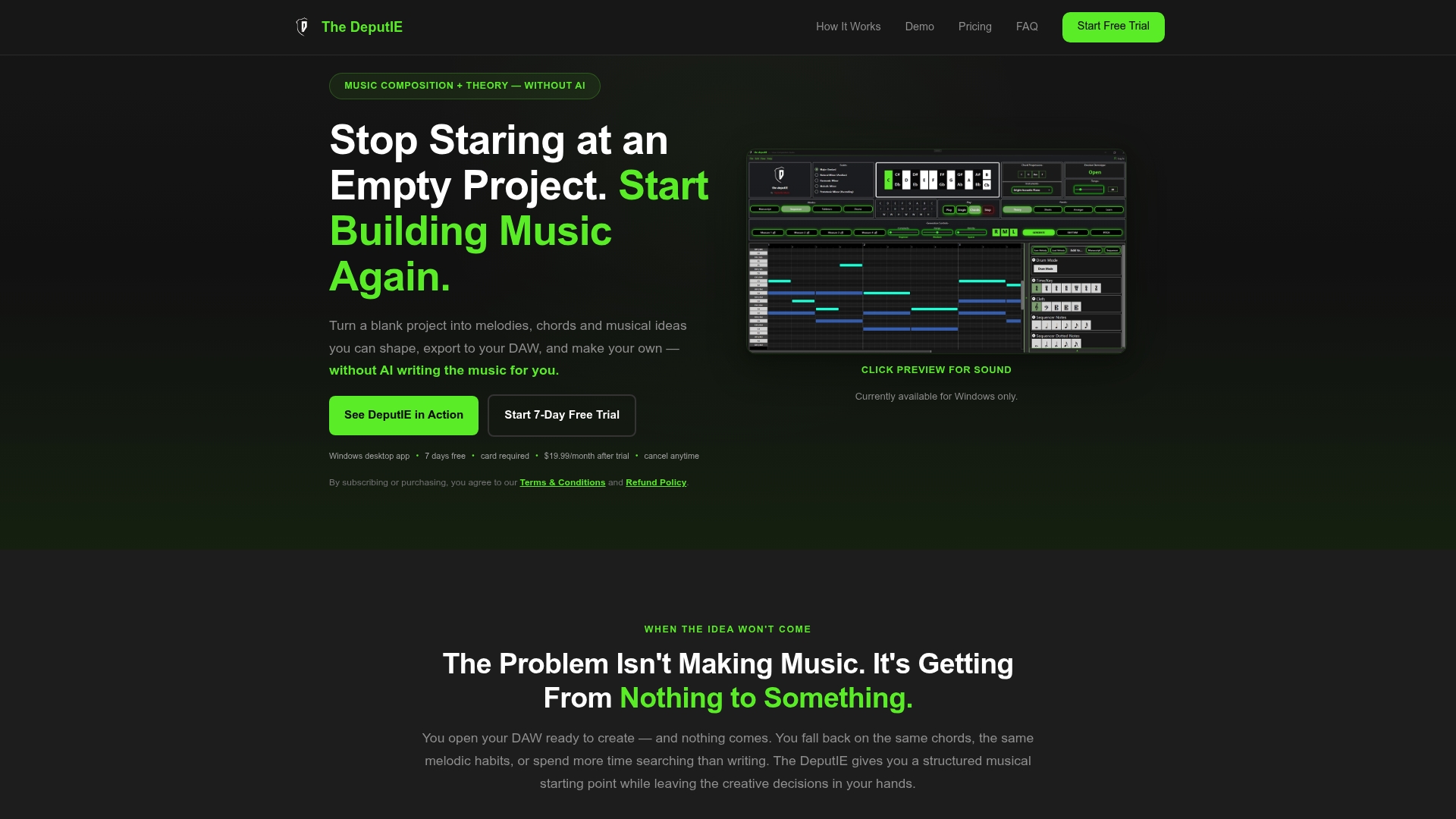
Once a chain of secondary dominants sounds right, export it as MIDI straight into your existing DAW for full arranging, orchestration, or mixing. The DeputIE user manual walks through the chord tools and MIDI export step by step, and a 7-day free trial lets you test the workflow on your own progression before you subscribe.
Sources
- Secondary Dominants in Major and Minor — Music Theory for the 21st-Century Classroom
- Applied chords – OPEN MUSIC THEORY
FAQ
What Are Some Examples of Secondary Dominants?
Common examples include V/ii (A7 to Dm in C major), V/V (D7 to G), and V/vi (E7 to Am). Paul McCartney's "Yesterday" contains a well-known V/vi in its bridge.
How Do You Resolve Secondary Dominants?
Resolve the seventh down by step into the third of the target chord, and resolve the secondary leading tone up by half step into the target's root, keeping any shared notes stationary between the two chords.
Are Secondary Dominants Always Seventh Chords?
No. A secondary dominant can be a plain major triad or a dominant seventh chord; the seventh adds a stronger pull toward resolution but isn't required for the chord to function as an applied dominant.
Did Bach Use Secondary Dominants?
Baroque composers, including Bach, used tonicization techniques constantly, though the formal term and slash notation came later through modern theory pedagogy. Documented classical instances, including Beethoven's V7/IV, confirm the device predates its current name by centuries.