
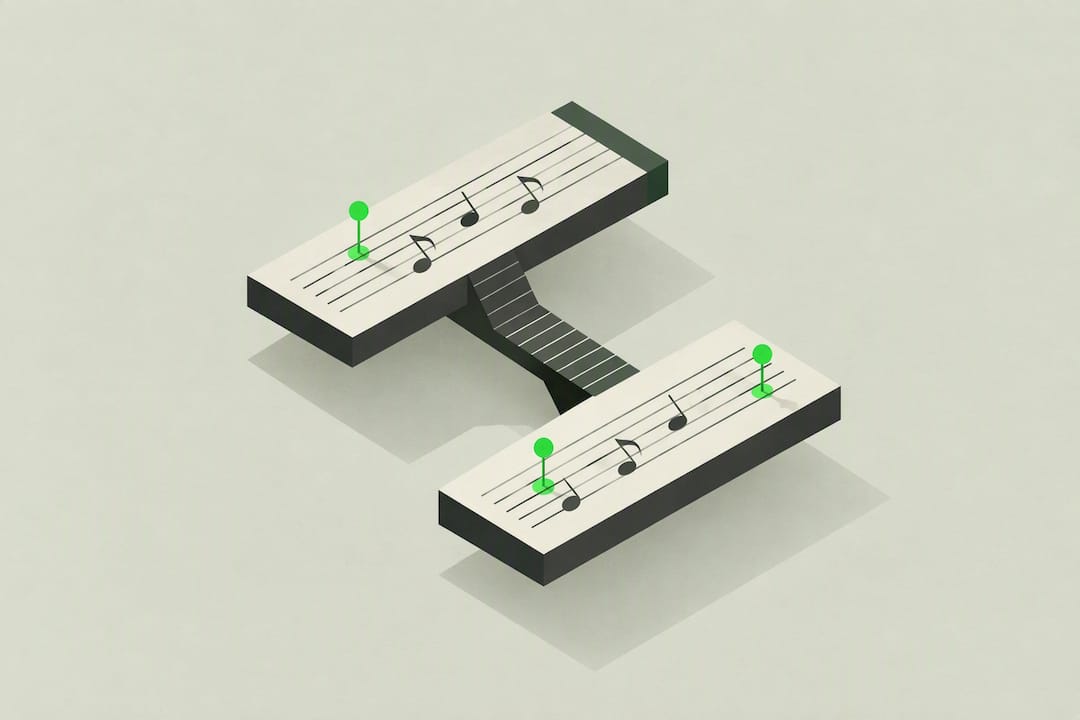
Music notation is a written language that tells you which pitches to play, how long to hold them, and how to shape them. Beginners should learn four things first: the staff and its clefs, note values, and time and key signatures. Master those, and you can decode most beginner sheet music within a few weeks of short, regular practice.
TL;DR:
- Most beginners can decode note positions and rhythms within a few weeks of consistent practice, but true sight-reading fluency takes several months.
- Learning core anchors like middle C, the G in treble clef, and the F in bass clef significantly speeds up note identification across both staves.
- Recognizing step and skip patterns allows reading passages by relative motion, reducing the need to identify every note individually.
- Key signatures follow fixed sharp and flat sequences, making it easier to identify accidentals and their implied notes quickly.
- Practice should focus on separating pitch recognition and rhythm, using short daily sessions to build fluency faster without burning out.
Table of Contents
- Understanding Music Notation Basics: The Staff and Pitch
- Clefs Explained: Treble and Bass, and How to Tell Them Apart
- The Grand Staff and Why Middle C Is Your Anchor
- Note Positions and the Musical Alphabet: Reading by Step and Skip
- Ledger Lines: Notes That Live Outside the Staff
- Note Durations and Rests: How Long Each Sound Lasts
- Time Signatures: Reading the Two Stacked Numbers
- Key Signatures and Accidentals: Sharps, Flats, and Naturals
- Ties, Slurs, and Articulation: Shaping How Notes Sound
- Dynamics and Tempo: Reading Volume and Speed
- How to Practice Notation Without Burning Out
- Why Learning to Read Music Actually Changes How You Play
- Turn What You Just Learned Into Real Compositions
- Sources
- FAQ
Understanding Music Notation Basics: The Staff and Pitch
The staff (sometimes spelled "stave") is five horizontal lines and four spaces stacked on top of each other, counted from the bottom up. Every line and every space represents a specific pitch, and the higher a note sits on the staff, the higher it sounds. That vertical logic is the entire foundation of Western notation, and once it clicks, everything else on the page starts to make sense.
Each line and space gets a letter name from the musical alphabet, A through G, and which letters land where depends on the clef sitting at the far left of the staff. You don't need to memorize all nine positions on day one. Start smaller:
- Pick one clef and learn its five line names first.
- Then learn its four space names.
- Find middle C and use it as your home base.
- Practice pointing to a random staff position and naming it out loud, not just in your head.
A simple mnemonic sentence for each line or space set makes this stick faster than raw repetition ever will.
Clefs Explained: Treble and Bass, and How to Tell Them Apart
A clef is the symbol at the start of every staff that assigns real pitch names to the lines and spaces. Without one, a staff is just five blank lines with no meaning at all.
The treble clef, also called the G clef, curls around the second line from the bottom to mark it as G. Its lines from bottom to top spell E, G, B, D, F, and its spaces spell F, A, C, E. Most people remember the lines with "Every Good Boy Deserves Fudge" and the spaces simply spell the word "FACE," a pairing that has taught generations of piano and violin players their note positions.
The bass clef, or F clef, has two dots that straddle the fourth line, marking it as F. Its lines read G, B, D, F, A from bottom to top, and its spaces read A, C, E, G. Right hand on piano, guitar, violin, and most wind instruments read treble. Left hand on piano, plus bass guitar, cello, and trombone, read bass.
Pro Tip: Find the clef's namesake line first (the G line in treble, the F line in bass), then count up or down the alphabet from there instead of trying to recall all seven letters from memory.
The Grand Staff and Why Middle C Is Your Anchor
Piano music stacks a treble staff on top of a bass staff and connects them with a brace, forming what's called the grand staff. That connection matters because piano players read both hands at once, and the two staves need a shared reference point to line up.
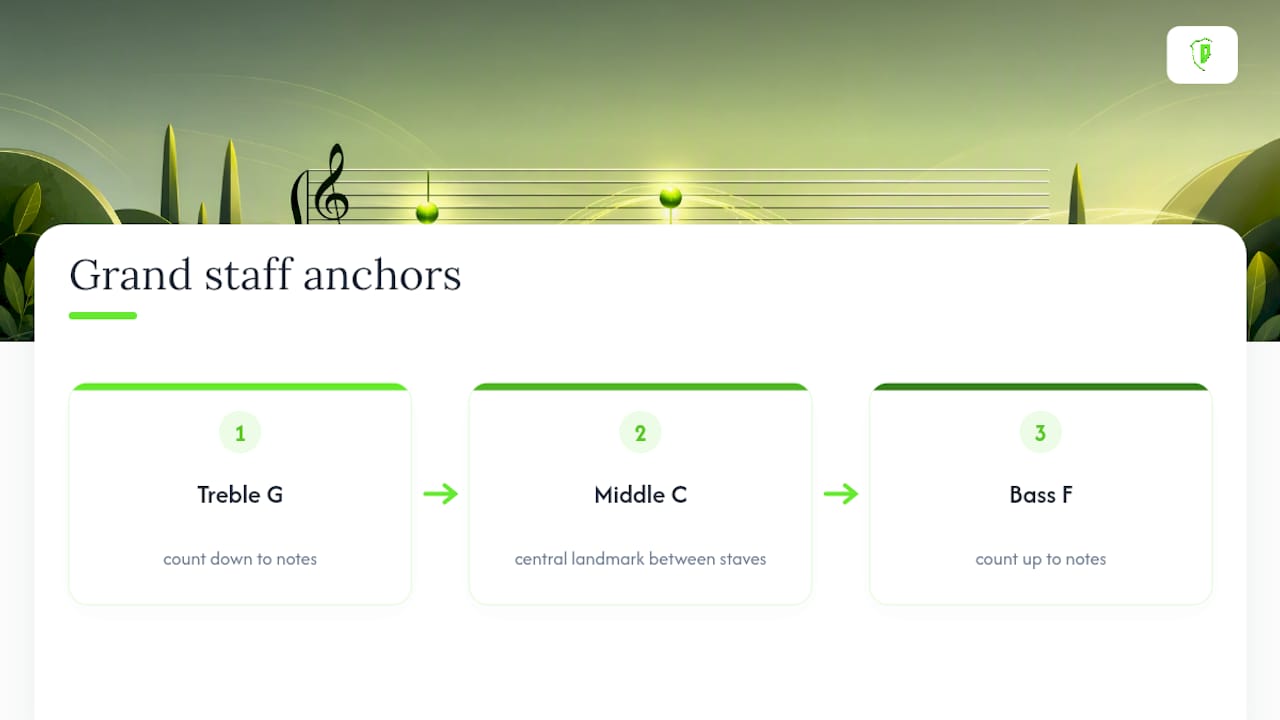
That reference point is middle C, sitting on a single short line hovering right between the two staves. It's neither fully inside the treble staff nor the bass staff, which is exactly why it works as a landmark. Instead of memorizing every position separately, learn three anchors: middle C, the G marked by the treble clef, and the F marked by the bass clef. Count up or down from whichever anchor sits closest to the note you're trying to read, and you'll place notes faster than flipping through a memorized chart.
Note Positions and the Musical Alphabet: Reading by Step and Skip
Music only uses seven letters, A through G, and then the pattern repeats one octave higher or lower. Once you know a staff's letters at a few key spots, you don't need to memorize every remaining position individually.
Two visual patterns do most of the work:
- A step moves from a line to the very next space, or a space to the very next line, going one letter at a time.
- A skip moves from one line to the next line, or one space to the next space, skipping a letter in between.
Once you recognize a step from a skip on sight, you can read a passage by locating the first note and then tracking the shape the notes make relative to it, rather than naming every note in isolation. Trained readers actually process this relative motion, called reading by interval, far more than they consciously read individual letter names, and it's a big part of why experienced sight readers move so much faster than beginners stuck on letter-by-letter decoding.
Ledger Lines: Notes That Live Outside the Staff
Ledger lines are the short extra lines that appear above or below the staff when a note's pitch is too high or too low to fit on the five printed lines. They're just an extension of the same line-space pattern, drawn only as needed for that one note.
Middle C is the textbook example: it sits on a single ledger line floating between the treble and bass staves. Rather than memorizing what every ledger line position is called, keep extending the alphabet pattern outward from the staff's nearest edge. If the top line of the treble staff is F, the next space up is G, the next ledger line is A, and so on. The pattern never breaks, it just keeps climbing or descending.
Note Durations and Rests: How Long Each Sound Lasts
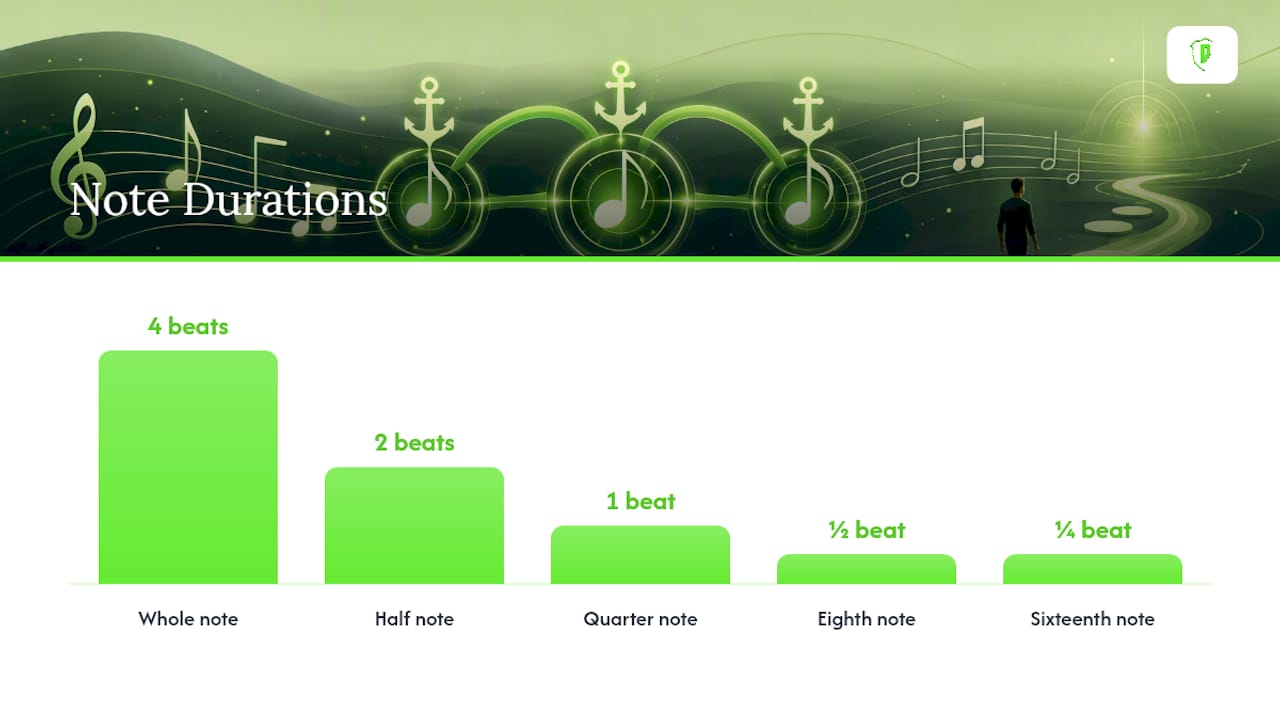
Note shapes tell you how long to hold a pitch, and the whole system is built on a simple halving pattern: each common duration is exactly half the length of the one above it, from whole notes down to sixteenths.
In 4/4 time, here's how the values break down:
- Whole note — 4 beats
- Half note — 2 beats
- Quarter note — 1 beat
- Eighth note — half a beat
- Sixteenth note — a quarter of a beat
That halving relationship holds across the whole note-duration system, which is what makes it learnable instead of arbitrary. A dot placed after any note adds half of that note's original value again, so a dotted quarter note equals a quarter plus an eighth, or one and a half beats total. A tie is a curved line connecting two notes of the same pitch, and it means you hold through both durations as one continuous sound, even across a barline.
Rests mirror every note value with their own symbols. A whole rest, half rest, quarter rest, and so on tell you exactly how long to stay silent, and shorter durations get flags or beams connecting their stems so a string of eighth or sixteenth notes is visually easy to group at a glance.
Time Signatures: Reading the Two Stacked Numbers
The two numbers at the start of a piece define its meter. The top number tells you how many beats fill each measure, and the bottom number tells you which note value counts as a single beat.
The bottom number is always a power of two, and it decodes in a fixed way: a 4 means the quarter note gets the beat, an 8 means the eighth note gets the beat, and a 2 means the half note gets the beat.
- 4/4 — four quarter-note beats per measure, counted "1, 2, 3, 4"
- 3/4 — three quarter-note beats per measure, the waltz feel, counted "1, 2, 3"
- 6/8 — six eighth-note beats per measure, usually felt as two groups of three
That last one points to a bigger distinction: simple time signatures divide each beat into two parts, while compound time signatures like 6/8 divide each beat into three. Barlines mark off each measure visually, and repeat signs (two dots before a thick double bar) tell you to play a section again before moving forward.
Key Signatures and Accidentals: Sharps, Flats, and Naturals
A key signature sits right after the clef, and it's a cluster of sharp or flat symbols that apply to every instance of those specific lines or spaces for the rest of the piece, until a new key signature appears or the piece ends.
Accidentals are sharps, flats, or naturals written directly next to an individual note, and they override the key signature for the remainder of that one measure only. A natural symbol specifically cancels out a sharp or flat, temporarily restoring the note's plain, unaltered pitch.
Recognizing key signatures gets much faster once you know the order sharps and flats always follow:
- Sharps are added in this order: F, C, G, D, A, E, B
- Flats are added in the exact reverse order: B, E, A, D, G, C, F
That fixed sequence means a key signature with three sharps will always be F, C, and G specifically, never some other combination.
Ties, Slurs, and Articulation: Shaping How Notes Sound
A tie connects two notes of the identical pitch and simply adds their durations together into one sustained sound. A slur looks similar, a curved line over several notes, but it connects notes of different pitches and tells the performer to play them smoothly connected, with no separation between them.
Articulation marks layer expression on top of duration. A staccato dot shortens a note and adds separation. An accent mark (>) tells you to hit that note harder than its neighbors. A tenuto line means hold the note for its full value, sometimes leaning into it slightly. A fermata, a curved mark with a dot underneath, tells you to hold that note or rest well beyond its written value, at the performer's discretion. All of these interact with the dynamics on the page, so the same quarter note can sound dramatically different depending on which mark sits above it.
Dynamics and Tempo: Reading Volume and Speed
Dynamic markings tell you how loud or soft to play, running from pp (pianissimo, very soft) through p, mp, mf, f, up to ff (fortissimo, very loud). A widening hairpin symbol means crescendo, get gradually louder, while a narrowing one means decrescendo, get gradually softer.
Tempo can appear as a raw BPM number, like 120 beats per minute, or as an Italian word like Adagio (slow), Andante (walking pace), or Allegro (fast and lively). Either way, tempo tells you how quickly those note durations you learned earlier actually get played out loud. Practicing with a metronome set to the marked tempo is one of the fastest ways to connect a note's written shape to how it should actually sound in real time.
How to Practice Notation Without Burning Out
Progress comes from sequencing, not raw hours. Try this order:
- Learn your anchor notes first. Middle C, the treble clef's G, and the bass clef's F give you three fixed points to count from instead of memorizing every position on both staves.
- Separate pitch from rhythm. Clap or tap a rhythm pattern on its own before you try to also read the pitches, then combine the two once each feels automatic on its own.
- Practice in short daily bursts. Ten focused minutes a day beats one long weekend session, and it builds the kind of fluency that eventually lets you sight-read instead of decode.
Pro Tip: Isolating pitch and rhythm training separately is one of the biggest speed boosts for beginners, since trying to coordinate both at once is usually the single biggest barrier to early progress.
Why Learning to Read Music Actually Changes How You Play
Notation is worth the early friction because it unlocks everything else. You can pull real repertoire off a page instead of relying on memorized patterns, and you can sketch your own compositions in a form other musicians can actually read. Fluency compounds too: every hour spent reading makes the next piece faster to learn, which multiplies how much repertoire and how many collaborators become available to you. Structured practice matters more than talent here, and pairing that practice with a tool built around music theory, rather than one that writes the music for you, keeps you the one making the creative decisions.
— Vigilantie
Turn What You Just Learned Into Real Compositions
Vigilantiemusic built the DeputIE for exactly the gap between knowing notation and actually writing something with it. Once you can read a staff, a clef, and a time signature, the DeputIE gives you structured workspaces, a visual sequencer, and chord progression tools rooted in the same theory you just learned, so you stay the one making the creative calls instead of handing that over to an algorithm.
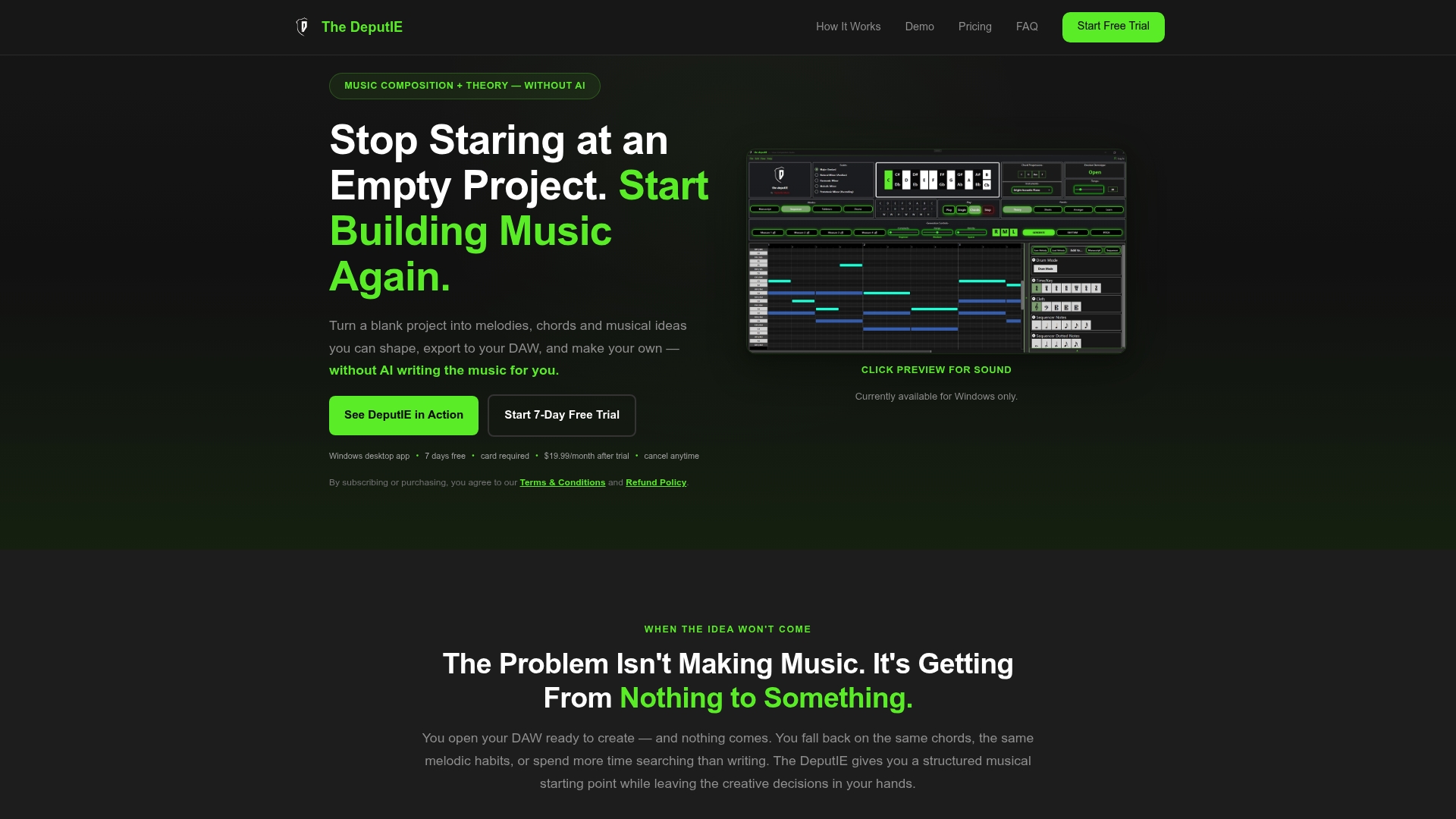
You can sketch melodies, build progressions, and lay out manuscript notation directly inside the software, then export everything as MIDI straight into your existing DAW. If you're also curious about how notation sketches feed into a full production pipeline, this production automation guide is worth a look. The DeputIE is available on a Monthly plan at $19.99 per month or an Annual plan at $129.99 per year, and the user manual walks through every workspace in detail. Start a trial and put your new notation skills straight to work.
Sources
- Music basics — Lumen Learning (Music appreciation/theory lesson)
- Piano
- Germanna
- Clefs — Roger Williams University (Pressbooks)
FAQ
What Are the Four Most Important Music Notation Basics to Learn First?
Start with the staff and clefs, note durations, and time and key signatures, since those four elements let you decode pitch, rhythm, and structure on almost any beginner piece. Everything else, like articulation and dynamics, layers on top of those basics once they feel automatic.
How Long Does It Take to Learn to Read Music?
Most beginners can learn basic note names and simple rhythms within a few weeks of short, consistent practice, but real sight-reading fluency usually takes several months of steady work. Separating pitch practice from rhythm practice tends to speed up that timeline noticeably.
What's the Difference Between a Tie and a Slur?
A tie connects two notes of the exact same pitch and adds their durations into one sustained sound, while a slur connects notes of different pitches and tells you to play them smoothly, without separation. Both use a similar curved line, so context and the notes underneath are what tell them apart.
Does DeputIE Teach Music Notation, or Just Composition Tools?
The DeputIE is composition software built around structured, theory-guided workspaces rather than a notation tutorial, but its manuscript notation tools give you a practical space to apply what you've learned. Pricing runs $19.99 per month or $129.99 per year, with details in the user manual.
Why Do Musicians Use Mnemonics Like "Every Good Boy Deserves Fudge"?
Mnemonics turn an abstract line of five letters into a memorable sentence, which is faster to recall under pressure than raw memorization. Landmark notes like middle C work the same way, giving you a fixed reference point to count from instead of memorizing every staff position individually.