
A musical mode is a seven-note scale pattern paired with its own set of characteristic melodic and harmonic behaviors. The seven diatonic modes are Ionian, Dorian, Phrygian, Lydian, Mixolydian, Aeolian, and Locrian, and each one bends a familiar scale into a distinct emotional shade. Learn to hear and build them, and you unlock the sounds behind jazz vamps, rock riffs, folk melodies, and film scores alike.
TL;DR:
- Learning a mode's characteristic note and interval formula is essential for hearing and improvising within its distinctive sound.
- Modal chord progressions often rely on simple loops and characteristic notes, avoiding traditional dominant resolutions to preserve modal color.
- Transposing modes is most efficient by focusing on their interval patterns rather than relying solely on memorized scale shapes.
- Using music software to audition modal vamps and progressions helps deepen practical understanding and application of modal concepts.
- Melodic minor derived modes expand jazz improvisation options, offering more stable alternatives to traditional Locrian and incorporating hybrid scale approaches.
Table of Contents
- What Modes In Music Actually Mean
- The Seven Diatonic Modes: A Working Reference
- How to Build and Transpose Any Mode
- Modal Harmony: Chords, Progressions, and Cadences
- Applying Modes to Real Composition and Improvisation
- Beyond the Seven: Melodic Minor Modes and Hybrid Colors
- Why Interval Thinking Beats Rote Memorization
- Try Modal Ideas Inside The DeputIE
- Sources
What Modes In Music Actually Mean
A mode is not the same thing as a key, and it is not quite the same thing as a scale either, even though the three terms get tossed around interchangeably in guitar forums and theory classrooms. A scale is just an ordered set of notes. A key tells you which note functions as home base within a tonal system built on major or minor harmony. A mode is a specific scale pattern combined with a built-in melodic personality, defined by which scale degree acts as the tonic and which note gives the pattern its distinctive flavor.
Here is the historical wrinkle that trips people up: the names Dorian, Phrygian, Lydian, and the rest come from ancient Greek music theory, but the actual scale patterns we use today are a medieval European invention. Church musicians in the Gregorian chant tradition adapted and renamed Greek concepts starting around the ninth century, building an eight-mode system for organizing plainchant melodies. By the Renaissance, theorist Heinrich Glarean had expanded that into the twelve-mode system that eventually settled into the seven-mode framework guitarists and pianists use now. The names survived; the actual musical content changed considerably along the way.
What makes a mode audible as itself, rather than just a rearranged major or minor scale, is its characteristic note. Every mode has one interval that sets it apart from its nearest tonal relative, and that single note carries the emotional weight of the entire mode:
- Dorian stands out for its raised 6th degree compared to natural minor, giving it a bittersweet, jazzy lift.
- Phrygian carries a lowered 2nd degree, producing the dark, flamenco-adjacent sound heard in metal and Spanish folk music.
- Lydian features a raised 4th degree, creating the dreamy, floating quality composers reach for in film scoring.
- Mixolydian has a lowered 7th degree, giving it a bluesy, unresolved pull that never quite wants to land on the tonic the way major does.
Modern composers still lean on these colors precisely because modes predate the major and minor system that eventually dominated Western tonal harmony, which means they offer an escape route from the gravitational pull of conventional cadences.
The Seven Diatonic Modes: A Working Reference
Every diatonic mode is built from the same seven notes as a major scale. Rotate the starting point and you generate a different mode, each with its own interval formula, its own characteristic note, and its own harmonic personality. The seven diatonic modes are seven-note patterns constructed from five whole steps and two half steps arranged in different orders, and getting comfortable with that rotation logic is the single most useful shortcut in modal theory.
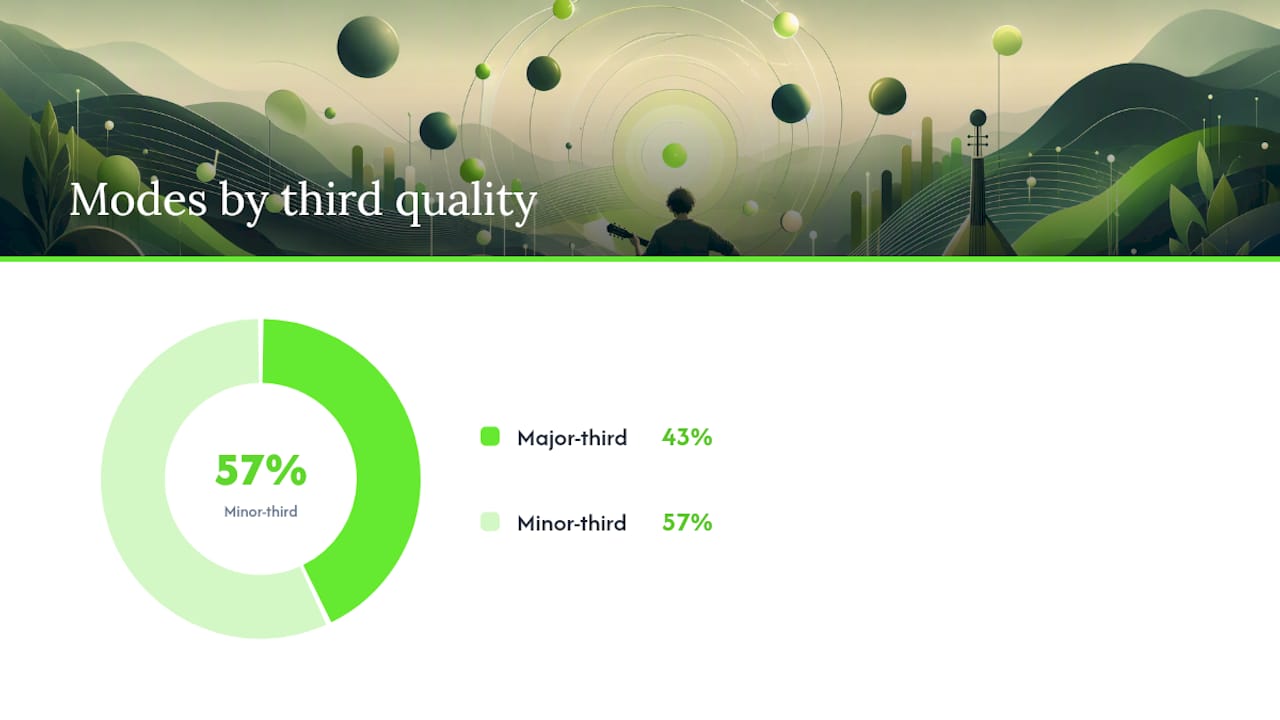
Modes split naturally into two families based on the quality of their third degree. Ionian, Lydian, and Mixolydian all carry a major third and belong to what theorists call the major-mode family, while Dorian, Phrygian, Aeolian, and Locrian carry a minor third and belong to the minor-mode family. Locrian is the outlier in both groups: it is the only mode with a diminished fifth, which is why it rarely functions as a stable tonal center in real compositions.
The table below lays out the interval formula for each mode, its defining characteristic tone, and where you are likely to hear it in the wild.
These interval sequences derive directly from rotating the major scale), starting the pattern on each successive degree. Start on the first degree and you get Ionian. Start on the second and you get Dorian. Keep rotating and you cycle through all seven.
A few of these deserve more than a table row. Dorian sits at the emotional midpoint between major and minor, which is exactly why it shows up constantly in modal jazz and Celtic fiddle tunes. It reads as minor but never fully sad, because that raised 6th keeps pulling it toward brightness. Mixolydian is arguably the most rock-friendly mode of the bunch. Drop the 7th of a major scale and you get a scale that wants to groove rather than resolve, which explains its dominance in blues-rock and jam-band vocabulary.
Lydian gets outsized attention relative to how rarely it appears, mostly because film composers love what that raised 4th does to a major scale. It turns an ordinary major tonality into something that feels suspended, wondrous, slightly unresolved in a pleasant way. Phrygian, on the other hand, carries real tension. That lowered 2nd creates a half-step relationship right above the tonic, which is the same interval that gives flamenco and certain metal riffs their unmistakable menace.
Aeolian is simply the natural minor scale wearing a Greek name, and it needs no special introduction since it already underpins most minor-key pop and rock writing. Locrian, by contrast, is the mode nobody quite trusts as a home base. Its diminished fifth destabilizes the tonic chord itself, so composers tend to use Locrian coloring in passing rather than building entire pieces around it.
Some traditions treat these modes as their default vocabulary rather than an occasional flavor. Irish traditional music and flamenco guitar both lean on Mixolydian, Dorian, or Phrygian structures as a matter of course, not as a deliberate stylistic choice. That is worth remembering when modal chord progressions feel like a modern jazz invention. They are often just folk music formalized.
How to Build and Transpose Any Mode
The fastest way to internalize modes is the all-white-key method on a piano. Play only the white keys starting on D and you get D Dorian. Start on E and you get E Phrygian. Start on F and you get F Lydian. Because the white keys already form a C major scale, starting anywhere else on that same set of notes automatically produces a different mode, with zero accidentals required.

That trick works beautifully for hearing modes in their "home" position, but it breaks down the moment you need G Dorian or B Mixolydian. That is where interval formulas take over as your permanent, transposable tool. A mode's formula tells you the exact whole-step and half-step pattern regardless of starting pitch, so you can build any mode on any note without relying on white keys at all.
Here is a step-by-step method for constructing a mode in any key, on any instrument:
- Pick your tonic note. Say you want G Mixolydian.
- Write out the interval formula for that mode: Mixolydian is W-W-H-W-W-H-W.
- Apply the formula starting on your tonic. From G: whole step to A, whole step to B, half step to C, whole step to D, whole step to E, half step to F, whole step back to G.
- Check your work against the parent major scale. G Mixolydian uses the same seven notes as C major, just starting and ending on G. If your notes match the C major key signature, you built it correctly.
- Identify the characteristic note. Here it is F natural instead of F sharp, the lowered 7th that defines Mixolydian's sound.
Guitarists often shortcut this process by thinking in terms of the parent major scale's key signature, then shifting the tonal center without changing the fretboard shape. If you already know a G major scale shape, sliding your root note awareness to the 5th scale degree within that same shape gives you D Mixolydian for free. This is the same logic experienced improvisers use when they think in interval alterations from a reference scale rather than memorizing seven separate fingerings from scratch.
Pro Tip: Instead of memorizing seven modes as seven unrelated scales, memorize them as alterations to two references: major and natural minor. Dorian is natural minor with a raised 6th. Lydian is major with a raised 4th. Locrian is natural minor with a lowered 2nd and 5th. This cuts your mental workload roughly in half and makes transposition almost automatic.
Modal Harmony: Chords, Progressions, and Cadences
Modes generate their own diatonic triads, and those triads are what actually make modal harmony sound different from standard major or minor key writing. Build a triad on each degree of D Dorian and you get D minor, E minor, F major, G major, A minor, B diminished, and C major. That B diminished chord on the sixth degree is a direct consequence of Dorian's raised 6th, and it shows up nowhere in the natural minor version of that same key center.
Locrian's triads are the strangest of the bunch, because the tonic chord itself is diminished. A i° chord has almost no gravitational pull as a resting point, which is exactly why Locrian rarely anchors a real composition the way the other six modes do. Composers who want a genuinely Locrian passage usually treat it as a brief color rather than a home key.
For improvisers, chord-scale matching turns this same triad logic into a practical soloing tool. Over a static Dm7 chord, playing D Dorian gives you access to that characteristic raised 6th (B natural) without clashing against the underlying harmony. Over a G7 chord that is not resolving anywhere, G Mixolydian supplies the lowered 7th that already lives inside the chord itself.
A handful of progressions reliably lock listeners into a specific mode rather than letting their ear drift back to standard major or minor:
- i to IV (Dorian): Dm7 to G7, looped repeatedly, is the backbone of Miles Davis's "So What" and dozens of modal jazz tunes that followed it.
- I to bVII (Mixolydian): G to F, looped, is the exact engine behind countless blues-rock and jam-band vamps.
- i to bII (Phrygian): Em to F major, alternating, produces the flamenco-adjacent tension guitarists reach for in minor-key metal writing.
- I to II (Lydian): C to D major, alternating, highlights the raised 4th without ever resolving to a conventional V chord.
- i to bVI to bVII (Aeolian): Am to F to G is standard natural minor territory, useful mainly as a contrast case against the other six.
The seven diatonic modes split cleanly by the quality of their third: three carry a major third, four carry a minor third, and that single fact predicts most of the chord qualities you will encounter across all seven progressions above.
Here is the caution worth taking seriously: dominant seventh chords and conventional V to I cadences are tonal gravity wells. Drop a G7 to C resolution into the middle of a Mixolydian vamp and you have just pulled the listener's ear straight back into functional major-key harmony, erasing the modal color you built. Pedagogical guidance on this point is consistent: emphasize the tonic and the characteristic note and avoid harmonic moves that imply a strong dominant-to-tonic resolution if you want the mode to stay audible as itself.
Applying Modes to Real Composition and Improvisation
Modal fluency comes from practice routines that isolate a mode's characteristic note rather than drilling the scale as an abstract shape. Three routines cover most of what you need, and instrument-agnostic phrasing means they work equally well on guitar, piano, bass, or any wind instrument.
- Scalar patterns anchored on the tonic. Play the mode up and down, but always resolve phrases back to the tonic rather than wandering. This trains your ear to hear the mode as a complete tonal world, not just a sequence of notes.
- Intervallic motifs built on the characteristic note. Take Dorian's raised 6th or Lydian's raised 4th and build a short two- or three-note motif around it, then transpose that motif through the scale. This is how the mode's personality gets baked into your melodic vocabulary instead of staying a theory fact.
- Tonic and characteristic-note emphasis in cadences. Rather than resolving melodic phrases with scale degree 7 to 1 the way tonal major does, experienced modal players often land on scale degree 2 to 1, which avoids implying the dominant pull that would otherwise drag the mode back toward conventional tonality.
Composition benefits from a related but distinct set of tools. Modal vamping means looping a single chord or a two-chord pattern rather than moving through a functional progression, letting the mode's color sit undisturbed. Modal interchange, sometimes called modal mixing, means briefly borrowing a chord from a parallel mode to add color without abandoning the underlying key. A rock song in E Aeolian that briefly touches a C major chord borrowed from E Mixolydian is a common example. Modal modulation goes a step further, shifting the entire tonal center from one mode to a different mode built on a new tonic, which is how some film cues shift from a warm Lydian passage into a darker Phrygian one without changing key signature dramatically.
Genre gives you the fastest entry point into all of this. Modal jazz built entire compositions around static vamps rather than chord changes, which is precisely why Miles Davis and his contemporaries turned to Dorian and Mixolydian so often; a single chord held for eight or sixteen bars gives a soloist room to explore a mode's full character. Rock guitarists reach for Mixolydian constantly because that lowered 7th matches the sound of a dominant seventh chord riff without needing any chord changes at all. Folk melodies across Celtic and Appalachian traditions lean heavily on Dorian and Aeolian because those two modes were already embedded in centuries of oral tradition before anyone wrote them down. Film composers reach for Lydian specifically because its raised 4th creates the suspended, wonder-struck quality that a straightforward major scale simply cannot produce.
Pro Tip: When practicing modal improvisation, resist the urge to play over a ii-V-I progression as your test bed. That progression is inherently tonal and will pull every mode back toward conventional major or minor sound. Test your modal vocabulary over a single static chord instead, looped for at least a minute, and listen for whether the characteristic note is actually shaping your phrasing.
Beyond the Seven: Melodic Minor Modes and Hybrid Colors
The seven diatonic modes are the foundation, but they are not the ceiling. Jazz improvisers routinely draw on modes derived from the melodic minor scale, which unlocks a second full set of seven colors distinct from anything in the major-scale system.
- Lydian dominant (the fourth mode of melodic minor) combines a raised 4th with a lowered 7th, giving you a major-sounding scale with genuine harmonic tension built in.
- Altered scale (the seventh mode of melodic minor) stacks nearly every available alteration against a dominant chord, making it a staple choice for jazz players soloing over altered V7 chords.
- Half-diminished scale (the sixth mode of melodic minor, sometimes called Locrian ♮2) supplies a smoother option than standard Locrian for navigating minor ii-V-i progressions.
These melodic minor derived modes are essential vocabulary for advanced jazz improvisation, and they solve a real problem: standard diatonic Locrian is often too harmonically unstable for practical use over a half-diminished chord, while its melodic-minor cousin resolves that instability without sacrificing color.
Composers also build hybrid scales by splicing two modal segments together deliberately. A common example fuses the lower half of Lydian with the upper half of Mixolydian, producing the Lydian dominant scale through a different construction path than the melodic minor derivation above. This kind of segment combination shows up regularly in fusion and film scoring, where composers want a scale that carries both Lydian's floating quality and Mixolydian's grounded pull within a single line.
A smaller category worth knowing by name: modes of limited transposition, a term coined by composer Olivier Messiaen for scales like the whole-tone and octatonic scales that repeat their interval pattern after only a few transpositions instead of the full twelve. These show up less as harmonic frameworks and more as textural devices, useful when a composer wants a specific timbral color rather than a functional tonal center.
Why Interval Thinking Beats Rote Memorization
Most modal instruction still teaches rotation first: memorize seven scale shapes, one starting on each degree of the major scale, and call it a day. That approach gets you through a theory exam. It rarely gets you playing anything that sounds genuinely modal, because rotation alone does not teach you which note actually matters.
Interval-first learning flips that order. Learn that Dorian is minor with a raised 6th, that Lydian is major with a raised 4th, and every mode becomes an alteration you can hear and target rather than a shape you memorize by rote. That single mental shift is what separates a player who can name all seven modes from a player who can actually make a listener feel the difference between Dorian and Aeolian in sixteen bars.
Practice closes the rest of the gap, but practice needs a workspace that keeps theory and sound connected in real time. A tool that lets you audition a chord progression's modal color instantly, without stopping to work out voicings by hand, shortens the distance between understanding a mode on paper and actually writing with it.
— Vigilantie
Try Modal Ideas Inside The DeputIE
Everything covered here, from Dorian vamps to Lydian chord color, gets easier to hear once you can audition it instead of just calculating it. Music composition software with visual sequencers and chord progression tools built around real music theory lets you lay out a modal vamp, swap the underlying chord quality, and hear the characteristic note do its work immediately.

Map the practice routines from this guide directly onto the software: build a Dm7 to G7 loop in the chord progression tool to test Dorian color, or sketch a Lydian-flavored melody in the visual sequencer and export the result as MIDI straight into your existing DAW. The manual walks through each workspace in detail if you want a guided starting point. Start your free trial on The DeputIE's product page and put a mode to work in your next composition today.
Sources
For deeper technical grounding, the Wikipedia entry on musical modes covers historical development and interval derivation in detail. Berklee Online's breakdown clarifies the major and minor mode families. Learn Jazz Standards offers practical jazz-specific application, and classical-music.com surveys modal usage across genres.