
Melodic phrasing is the way a musician groups and shapes notes into a coherent musical idea, the same way a sentence groups words into a coherent thought. It matters because a phrase with clear shape, breathing room, and intentional emphasis communicates something a string of correct notes never does. Below you'll find the theory behind phrase structure and contour, plus listening targets and exercises to practice it directly.
TL;DR:
- Most phrases end with a rest, cadence, or a shift in melodic contour, signaling their conclusion and helping listeners identify musical idea boundaries.
- Contour types such as ascending, descending, arch, wave, and static shape the melody's direction and can be combined with conjunct or disjunct motion for variety.
- Phrases in music typically appear as antecedent and consequent pairs, with cadences ranging from full authentic to softer plagal and deceptive types that create different levels of closure.
- Effective phrasing involves shaping notes through dynamics, timing, and articulation, which performers interpret individually based on musical intention.
- Using visual tools to sketch contours and test phrase ideas can accelerate learning by providing immediate auditory feedback and clarifying musical shapes.
Table of Contents
- What Is a Melodic Phrase?
- Melodic Contour and Motion: The Shapes That Give Phrases Direction
- How Do Antecedent and Consequent Phrases Work Together?
- What Expressive Tools Shape How a Phrase Is Played?
- Listening Guide: Where to Hear Contour and Phrasing in Action
- Practice Routines to Build Phrasing Skill
- Common Phrasing Mistakes and How to Fix Them
- Why Visual, Theory-Rooted Tools Speed Up Phrasing Practice
- Sketch Phrases Faster With The DeputIE
- Sources
- FAQ
What Is a Melodic Phrase?
A melodic phrase is a group of notes that expresses a definite musical idea, usually closing with a cadence or a slight pause, much like a grammatical phrase. Think of a melody as a sentence: individual notes are words, phrases are clauses, and the whole piece is the paragraph. Musicians who treat scales as vocabulary rather than raw material for aimless runs tend to write and play more memorable lines, because meaning comes from ordering and pacing, not just correct pitches.
Spotting where one phrase ends and another begins takes active listening, but a few signals repeat constantly across genres:
- A rest or breath in the melodic line, whether written or implied
- A harmonic cadence, especially one landing on the tonic or a strong dominant resolution
- A shift in melodic contour, where the line changes direction after building momentum
- A drop in rhythmic density, as if the music is exhaling
Vocal music makes this easiest to hear, since singers physically need to breathe. Instrumentalists have to build that same punctuation on purpose.
Melodic Contour and Motion: The Shapes That Give Phrases Direction
Melodic contour is the shape created by the rise and fall of pitches across a phrase, and it is one of the most useful tools for describing a melody without naming a single note. Fiveable's AP Music Theory materials identify contour as a primary descriptive tool because it works both aurally and visually, which is exactly why it shows up on exam sight-singing and dictation tasks.
The common contour types include:
- Ascending — the line climbs, often building tension toward a peak
- Descending — the line falls, often signaling release or resolution
- Arch — the line rises then falls, the most common shape for a single climactic phrase
- Wave — the line rises and falls repeatedly, useful for sustained energy over a longer passage
- Static — the line hovers around a narrow pitch range, creating stillness or tension by refusing to move
Contour is a separate idea from motion. Motion describes the size of the steps between notes: conjunct motion moves by seconds (smooth, singable), while disjunct motion leaps by larger intervals (dramatic, attention grabbing). A phrase can have an ascending contour built almost entirely from disjunct leaps, or a wave contour made of nothing but conjunct steps. Composers frequently combine steps and leaps and mix opposite motions inside one phrase specifically because pure conjunct motion can feel bland over time, and pure disjunct motion can feel exhausting.
A practical ear-training habit: before you try to nail every pitch of a melody you're learning by ear, sketch the contour first, a rough up-down line on paper. That scaffold makes accurate dictation far easier once you go back for exact intervals.
How Do Antecedent and Consequent Phrases Work Together?
Phrases rarely stand alone. In music theory, they commonly appear in antecedent and consequent pairs, a structure often described as call and response. The antecedent phrase functions like a musical question, typically ending on a weaker cadence that leaves the ear expecting more. The consequent phrase answers it, usually resolving to the tonic and giving the listener a sense of completion.
Cadence strength is what makes this pairing work. A few common types, ranked roughly by how final they sound:
- Authentic cadence — dominant to tonic, the strongest possible close
- Half cadence — ends on the dominant, sounds unfinished by design (common for antecedents)
- Plagal cadence — subdominant to tonic, softer than authentic, often heard as an "amen" close
- Deceptive cadence — sets up a resolution then dodges it, useful for extending tension
Composers also use elision, where one phrase's ending overlaps with the next phrase's beginning, and this overlap blurs the punctuation on purpose to keep a melody flowing instead of stopping and restarting. It's the musical equivalent of a run-on sentence that somehow still reads clearly, and skilled songwriters use it to avoid melodies that feel chopped into rigid blocks.
What Expressive Tools Shape How a Phrase Is Played?
Notation only gets you partway there. Musical phrasing is the method by which a performer shapes a sequence of notes using tone, tempo, dynamics, articulation, and inflection to create expression and emotional nuance, and two musicians reading identical sheet music will phrase it in noticeably different ways.
Your primary toolkit breaks down into three categories:
- Dynamics and articulation — swelling into a phrase's peak and tapering out of it, using legato to connect notes smoothly or staccato to separate them, and placing accents on the notes that carry the most meaning
- Timing — rubato (stretching or compressing tempo for expressive effect) and micro-timing (playing a note fractionally early or late relative to the beat) both shift where the listener's attention lands inside a phrase
- Instrument- and voice-specific techniques — vibrato added near a sustained peak note, breath placement in vocal and wind phrasing, and bow pressure or picking dynamics on strings
Because phrasing is genuinely an interpretive act, there's no single correct way to shape a given phrase. The goal is intention: know why you're swelling into beat three, rather than doing it because it's a habit.
Pro Tip: Record yourself playing the same four-bar phrase three different ways, once flat with no dynamic shaping, once with a clear dynamic arch, and once with added rubato at the peak. Play all three back and notice which one you actually believe.
Listening Guide: Where to Hear Contour and Phrasing in Action
Training your ear on real music beats theory alone every time. Try these listening targets, each chosen because it makes one phrasing concept unmistakable:
- A rising verse melody in a pop song — listen for an ascending contour that keeps building until it resolves at the chorus; mark exactly where the phrase breaks for breath.
- A folk ballad's opening line — trace an arch contour, rising through the middle of the phrase and settling back down by the cadence.
- A descending instrumental run at the end of a solo — notice how a falling contour signals resolution even without a strong harmonic cadence underneath it.
- A repetitive dance or electronic hook — listen for a wave contour that oscillates within a narrow range, built for sustained energy rather than a single climax.
Since phrases align with lyrics in vocal music but exist independently in instrumental passages, cross-check your ear by picking one song with lyrics and one purely instrumental piece. While listening, hum or trace the contour with your hand in the air, then sketch it as a simple line on paper immediately after. That sketch becomes your reference for comparing phrase shapes across songs.
Practice Routines to Build Phrasing Skill
Phrasing improves fastest when you separate the skill into distinct drills rather than trying to fix everything at once. Work through these in order:
- Ear-training drill (10 minutes): Pick a short melody you don't know. Sketch its contour on paper before identifying a single exact pitch, then go back and fill in intervals. Repeat with three different songs across a week.
- Composition drill (20 minutes): Write a four-bar antecedent phrase ending on a half cadence, then write a matching four-bar consequent that resolves to the tonic. Rewrite the pair twice, changing the contour from arch to wave.
- Performance drill (15 minutes): Take one phrase you already know and record it three times: flat, with dynamic shaping, and with rubato added at the peak. Compare all three back to back.
- Weekly checkpoint: By the end of each week, you should have one new contour sketch, one new antecedent/consequent pair, and one recorded comparison saved for reference.
| Week | Focus | Checkpoint |
|---|---|---|
| 1 | Contour sketching by ear | Three songs sketched and labeled by contour type |
| 2 | Antecedent/consequent writing | Two original phrase pairs, one arch and one wave |
| 3 | Dynamic and rubato shaping | Three recorded versions of the same phrase compared |
| 4 | Full integration | One original melody combining all three drills |
Common Phrasing Mistakes and How to Fix Them
The most common mistake is treating a scale like a warm-up exercise instead of a sentence. Notes played in mechanical, evenly spaced runs rarely say anything, because nothing in the line signals which note matters most.
A few other frequent problems and their fixes:
- No space between phrases — add a real rest or breath; a melody with zero gaps reads as one long run-on idea
- Flat, unchanging dynamics — pick one note per phrase to treat as the peak and shape everything around it
- Over-ornamentation — strip decorative notes out first, confirm the plain phrase makes sense, then add ornaments back sparingly
- Ignoring contour entirely — sketch the shape before you play or write a single pitch, so you know where the line is headed
Pro Tip: If a phrase feels lifeless, play it once with every note at the exact same volume, then play it again exaggerating the dynamic contrast far beyond what feels natural. The real answer usually sits between those two extremes.
Why Visual, Theory-Rooted Tools Speed Up Phrasing Practice
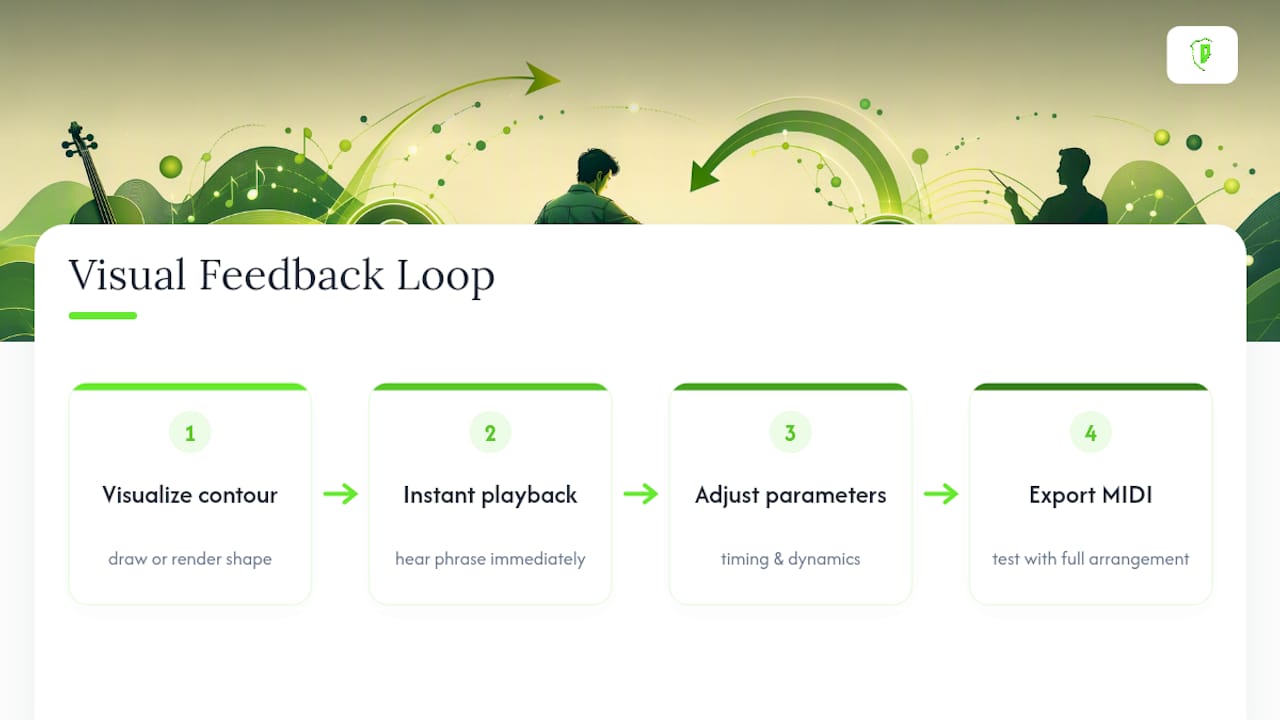
Sketching contour on paper works, but seeing a phrase's shape rendered visually and hearing it back instantly closes the feedback loop faster. That's the real advantage of a structured composition workspace: you test an antecedent's contour, adjust timing or dynamics, and export the result as MIDI to hear it against a real arrangement rather than imagining how it might sound.
Guided visual tools don't replace ear training or theory. They shorten the distance between an idea in your head and a phrase you can actually evaluate, which is where most creative momentum gets lost.
— Vigilantie
Sketch Phrases Faster With The DeputIE
Vigilantiemusic built The DeputIE as the alternative to starting every phrase idea from a blank staff and hoping it holds together. Its visual sequencer lets you draw a contour directly and hear it immediately, its chord progression tools let you test an antecedent against different harmonic backdrops, and MIDI export sends the finished phrase straight to your DAW for the dynamics and rubato work covered above.
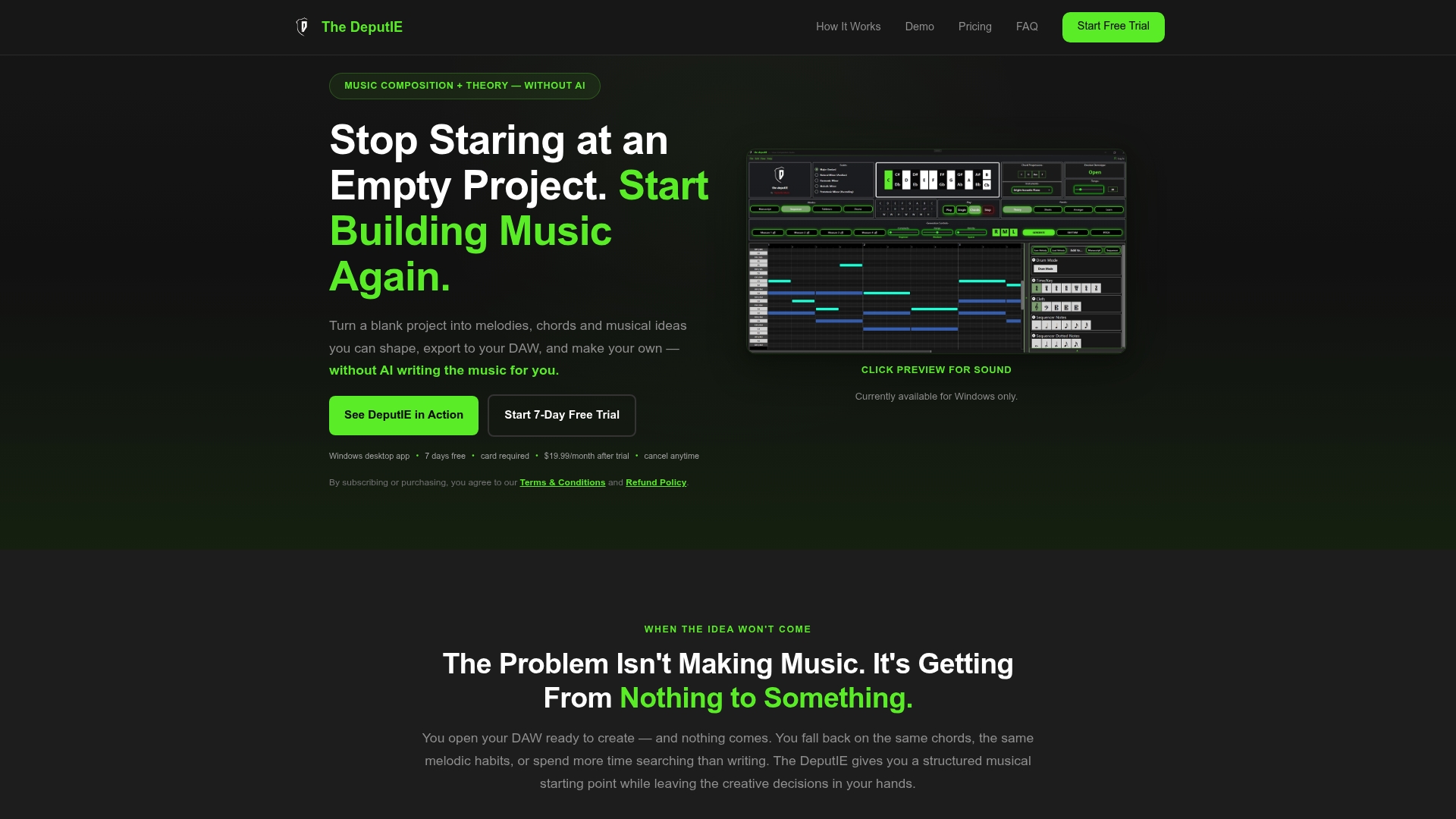
If you've been sketching contours on paper and writing antecedent/consequent pairs by hand, this is the same workflow with instant playback and no rewriting from scratch every time you change your mind. Read the user manual for a walkthrough of the sequencer and export process, or start a trial on the DeputIE plans page and sketch your next phrase today.
Sources
For deeper study beyond this guide, these sources cover the definitions and exam-level detail referenced throughout:
- What is music phrasing & why is it important | Hoffman Academy
- Melodic contour — Fiveable AP Music Theory
- Musical phrasing — Wikipedia
FAQ
What Is a Melodic Phrase?
A melodic phrase is a group of notes that express a definite musical idea, usually ending with a cadence or a brief pause, functioning much like a grammatical phrase. It's the smallest complete musical thought a listener can follow from start to finish.
What Does Phrasing Mean in Music?
Phrasing is how a performer shapes a sequence of notes using tone, tempo, dynamics, articulation, and inflection to create expression rather than just playing correct pitches. Because it's an interpretive act, two musicians can phrase the same written melody in noticeably different ways.
What Is a Phrase as Used in Melody Writing?
In melody writing, a phrase is a complete musical statement, typically four or eight bars, that ends on some form of cadence before the next idea begins. Composers pair phrases into antecedent and consequent halves, where the first sounds like a question and the second resolves it.
What Are Some Examples of Melodic Contour?
Common contour examples include an ascending line that climbs toward a chorus, a descending run that signals resolution, an arch shape that rises then falls within one phrase, and a wave shape that oscillates for sustained energy. AP Music Theory materials treat these as standard categories for describing any melody's shape at a glance.
Can Software Help Me Practice Melodic Phrasing?
A visual composition tool can speed up practice by letting you sketch a contour, test it against chords, and export the result as MIDI to hear it in context. The DeputIE offers Monthly and Annual plans, with pricing available on the product page.