
Start with ii–V–I in major and minor: it is the foundational move behind most jazz harmony. Add Rhythm Changes and the 12-bar blues next, since together these three account for a large share of the standards you will play. The single most effective practice habit is cycling ii–V–I through all 12 keys, then layering in simple substitutions once your ears trust the pattern.
TL;DR:
- Practicing ii–V–I cycling through all 12 keys, including simple substitutions like tritone swap and backdoor progressions, enhances harmonic fluency and improvisation.
- Using shell voicings, drop-2, and voice-leading techniques creates clear, connected harmonic movement without clutter, especially for comping on piano and guitar.
- Recognizing functional and modal harmony, such as modal interchange and borrowed chords, helps distinguish different jazz styles and guides improvisation choices.
- Incorporating altered dominants and extended chords adds tension and color, vital for cadence points and expressive soloing; these should be used selectively for maximum effect.
- Visual tools like chord progression sequencers and DAW integration facilitate experimentation with substitutions and reharmonizations, speeding up learning and composition.
Table of Contents
- Core progressions: ii–V–I, Rhythm Changes, and 12-bar blues
- Substitutions and turnarounds that add color
- Voicings and voice-leading for comping
- How to practice and apply progressions
- Reharmonizing without losing the melody
- Modal interchange and modal harmony in jazz progressions
- Altered dominants and their role in progressions
- Extended chords: 9ths, 11ths, and 13ths
- Coltrane changes and how they work
- Typical bass movement under jazz harmony
- How progressions shift across jazz styles
- What learning these changes actually unlocks
- A guided workspace for exploring these progressions
- Sources
- FAQ
Core progressions: ii–V–I, Rhythm Changes, and 12-bar blues
The ii–V–I is the backbone of jazz harmony. In major keys it runs ii7 to V7 to Imaj7, so in the key of C that's Dm7, G7, Cmaj7. In minor keys the ii chord becomes half-diminished: iiø7 to V7 to i, giving you Bø7, E7, Am. This shift matters because the half-diminished ii chord signals minor tonality before the melody even confirms it.
According to the theory reference at Open Music Theory, ii7–V7–Imaj7 functions as a schema that recurs constantly at cadences and throughout entire tunes, and recognizing it, even in incomplete or shifted forms, is often more useful than memorizing full progressions note for note.
Two other forms round out your starter set:
- Rhythm Changes uses I–vi–ii–V as its A-section engine, with a dominant chord climb through the bridge, a structure borrowed from "I Got Rhythm" and reused across dozens of bebop heads.
- The 12-bar blues supplies a different harmonic rhythm, built on I, IV, and V with a turnaround at the end, and jazz musicians dress it up with substitutions while keeping the underlying form intact.
Standards like "Autumn Leaves" walk through several ii–V–I motion in sequence, while "All the Things You Are" strings tonicizations together across multiple keys, according to Piano. Learning to spot these devices inside real tunes turns abstract theory into something your hands already know.
Substitutions and turnarounds that add color
Once ii–V–I feel automatic, substitutions let you reharmonize without losing the underlying logic. Three techniques cover most of what you'll hear on record.
- Tritone substitution swaps a dominant chord for the dominant a tritone away. Over a C major ii–V–I, G7 becomes Db7, so you get Dm7, Db7, Cmaj7, a sound that tightens the bass line by half steps instead of a fourth.
- The backdoor ii–V approaches the tonic from below rather than above: ivm7 to bVII7 to I. In C, that's Fm7 to Bb7 to Cmaj7, a move you'll hear resolving phrases in tunes like "There Will Never Be Another You."
- Secondary dominants and applied ii–Vs tonicize chords other than the tonic. A I–vi–ii–V turnaround can expand into I, VI7, ii, V7, treating the vi chord's own approach as a miniature dominant resolution.
Pro Tip: Practice each substitution over a static vamp first, then drop it into a tune you already know before trying it on something new.
Turnarounds built this way give you more harmonic motion inside the same four bars, which is exactly why bebop players lean on them at the end of every A section.
Voicings and voice-leading for comping
You don't need dense chords to sound convincing. Shell voicings, just the root, third, and seventh, give you the harmonic information a bassist and soloist need without cluttering the texture, and Open Music Theory points to rootless voicings and drop-2 as standard ways to realize this harmony across instruments.
- On piano, a rootless voicing for Dm7 might use F, A, C, E, leaving the root for the bassist.
- On guitar, a shell voicing for G7 could sit on the fourth, third, and second strings as F, B, using open fingerings that move easily.
- Drop-2 takes a closed four-note chord and lowers the second-highest voice an octave, spreading the sound without changing its function.
The real skill is voice-leading: keep common tones between chords, and move remaining voices by step or half step. In a ii–V–I, the seventh of the ii chord often resolves down to become the third of the V chord, then the seventh of the V resolves down again into the I. That single line of falling motion is what makes a progression sound connected rather than stacked.
How to practice and apply progressions
Fluency comes from repetition across keys, not from understanding the theory once and moving on.
- Cycle ii–V–I through the circle of fourths, starting in C and moving to F, Bb, Eb, and onward, using a metronome set slow and increasing tempo only once the changes feel automatic, a routine Piano.org recommends for building harmonic literacy across the full set of 12 keys.
- Comp with a simple rhythm, either a two-feel or a swung quarter-note pulse, and focus on placing guide tones (the third and seventh) with minimal movement between chords.
- When soloing, target chord tones on strong beats, outline the changes rather than running scales blindly, and choose scales that match the chord's function: dorian over minor ii chords, mixolydian over dominant V chords, altered scales over altered dominants when the harmony calls for tension.
Pro Tip: Loop a single four-bar ii–V–I with a backing track and force yourself to resolve to a different chord tone of the I chord each time through.
Composing works the same way in reverse: sketch a melody first, then test which ii–V–I or substitution best supports the notes you already have.
Reharmonizing without losing the melody
Reharmonization means placing new chords under an existing melody while keeping the tune recognizable. Common techniques include substituting one chord for a related one, inserting passing chords between static harmonies, and tonicizing a passing melodic note with its own applied ii–V.
A practical rule of thumb: avoid changing more than two chords within a single phrase unless the melody clearly supports the new harmony. Reharmonization is most convincing when you leave strong melodic landing points, notes that fall on accented beats, attached to chord tones rather than tensions.
Take a simple example: a melody sitting on the note E over a C major chord. Left alone, that's just I. Reharmonized, you could place the same E under an Am7 chord instead, turning a static tonic into a vi chord that still supports the melody note but shifts the color underneath it, a small change that respects the tune rather than rewriting it.
Modal interchange and modal harmony in jazz progressions
Modal interchange borrows chords from a parallel mode, usually the parallel minor, to color an otherwise major progression. A common example swaps IV major for iv minor, so a tune in C major briefly uses Fm7 instead of Fmaj7 before returning home, adding a darker shade without leaving the key.
Modal jazz takes this further by building entire sections, or entire tunes, around a single mode rather than functional chord movement. Instead of resolving through ii–V–I, a modal passage might sit on Dm7 for eight bars, letting the dorian mode itself supply the color rather than chord-to-chord motion.
This distinction matters for how you approach soloing and comping. Over functional harmony, you're outlining chord changes; over modal harmony, you're exploring the character of a scale across a static or slow-moving chord. Borrowed chords like bVI major or iv minor also show up inside otherwise functional tunes as a way to interrupt the expected ii–V–I motion with a modal detour before resolving normally.
Recognizing when a passage has shifted from functional to modal thinking, or borrowed a single chord from a parallel mode, keeps your ear oriented instead of forcing every chord into a ii–V–I box that does not fit.

Altered dominants and their role in progressions
An altered dominant raises or lowers the fifth and ninth of a V7 chord, creating tension that pulls hard toward resolution. A G7 altered chord might use G, B, Db, F, Ab, sharpening the pull toward C major or C minor far more than a plain G7 would.
These chords show up most often right before a resolution, especially in minor ii–V–I progressions where the dominant naturally carries more tension already. Soloists commonly reach for the altered scale, built from the seventh degree of the melodic minor scale a half step above the dominant's root, to outline that tension melodically rather than just harmonically.
The practical use case is simple: altered dominants intensify a cadence without changing its function. A V7alt still resolves to I the same way a plain V7 does, but the listener feels a sharper pull getting there. Overusing altered chords on every dominant in a tune flattens their effect, so many players reserve them for structurally important cadences, the end of a bridge or the final turnaround, where extra tension pays off.
Extended chords: 9ths, 11ths, and 13ths
Extended chords add color tones above the basic seventh chord without changing its underlying function. A 9th adds richness to a minor or major seventh chord, an 11th works mainly on minor chords since a natural 11th clashes with the third of a major chord, and a 13th often replaces a plain seventh chord in comping because it implies forward motion.
On a ii chord, Dm9 simply thickens the color without altering its role as the pre-dominant. On a V chord, G13 is common in comping because the 13th degree sits a whole step above the root and adds brightness without disrupting the chord's pull toward the tonic. On a Imaj7 chord, adding a 9th (Cmaj9) softens the resolution, which is why so many ballad endings favor major ninth chords over plain major sevenths.
The functional role stays the same regardless of the extension: a ii chord still sets up the V, a V chord still resolves to I. Extensions are a matter of color, not structure, which means you can add or strip them depending on how dense you want the texture, without changing how the progression behaves.
Coltrane changes and how they work
Coltrane changes, most famously heard in "Giant Steps," divide the octave into three equal major thirds instead of the usual movement by fourths and fifths. Instead of resolving through a single ii–V–I, the progression logicizes three different key centers in rapid succession, each a major third apart.
The effect is a harmonic cycle that never settles into one key for long, forcing the improviser to shift tonal centers every two beats in some passages. This is a dramatic extension of the tonicization ideas already present in ordinary ii–V–I'm playing, just compressed into a much faster and more symmetrical cycle.
Applying Coltrane changes outside "Giant Steps" itself usually means substituting this three-key cycle into a single dominant chord's resolution, sometimes called a "Coltrane substitution." A plain V7-to-I becomes a three-chord run through key centers a major third apart before landing on the same target, adding harmonic motion where a simpler progression would only need one chord.
Typical bass movement under jazz harmony
Bass motion in jazz tends to follow a few recognizable patterns, and recognizing them helps you predict where a progression is headed even before you hear the upper chord tones. Movement by descending fifths, as in a ii–V–I, is the most common: the bass falls from D to G to C, a motion so familiar that your ear anticipates it.
Chromatic bass motion appears in turnarounds and connecting passages, often filling the space between two diatonic chords with a passing chord a half step away. Tritone substitutions change the expected fifth-based bass motion into a half-step descent instead, which is part of why they sound so different even though the chord's function hasn't changed.
Walking bass lines, common in swing and blues contexts, connect these harmonic bass notes with passing tones on beats two and four, turning static harmonic motion into a continuous melodic line. Whatever the surface pattern, the underlying logic usually traces back to the same fifth-based motion at the heart of ii–V–I, dressed up with chromatic or substituted detours.
How progressions shift across jazz styles
Bebop leans hardest on fast-moving ii–V–I chain, often adding chromatic passing chords and tritone substitutions to keep soloists moving through changes at high tempo. Tunes built this way, including many Charlie Parker heads over Rhythm Changes, reward players who can navigate dense harmonic motion quickly.
Modal jazz moves the opposite direction, stripping harmony down to a few static chords or a single mode sustained for many bars, shifting the improviser's focus from chord tones to melodic exploration of a scale's character.
Post-bop sits between the two, often keeping functional harmony's cadences while introducing more unusual chord qualities, unexpected substitutions, or brief modal excursions inside an otherwise standard form. Recognizing which style a tune leans toward tells you what to prioritize: fast ii–V–I fluency for bebop, scale-based color for modal writing, and a mix of both for post-bop material.

What learning these changes actually unlocks
Internalizing ii–V–I does more than teach a pattern, it trains your ear to hear root motion by fifths everywhere, which speeds up both improvising and writing. Set small, repeatable goals rather than chasing every substitution at once, and try reharmonizing one phrase of a tune you already know well.
— Vigilantie
A guided workspace for exploring these progressions
Working through ii–V–I cycles, substitutions, and reharmonizations on paper is useful, but seeing the harmony while you experiment speeds up the process considerably. There are visual sequencers and chord progression tools built around music theory that let you audition a tritone substitution or a backdoor ii–V without losing track of the original changes.
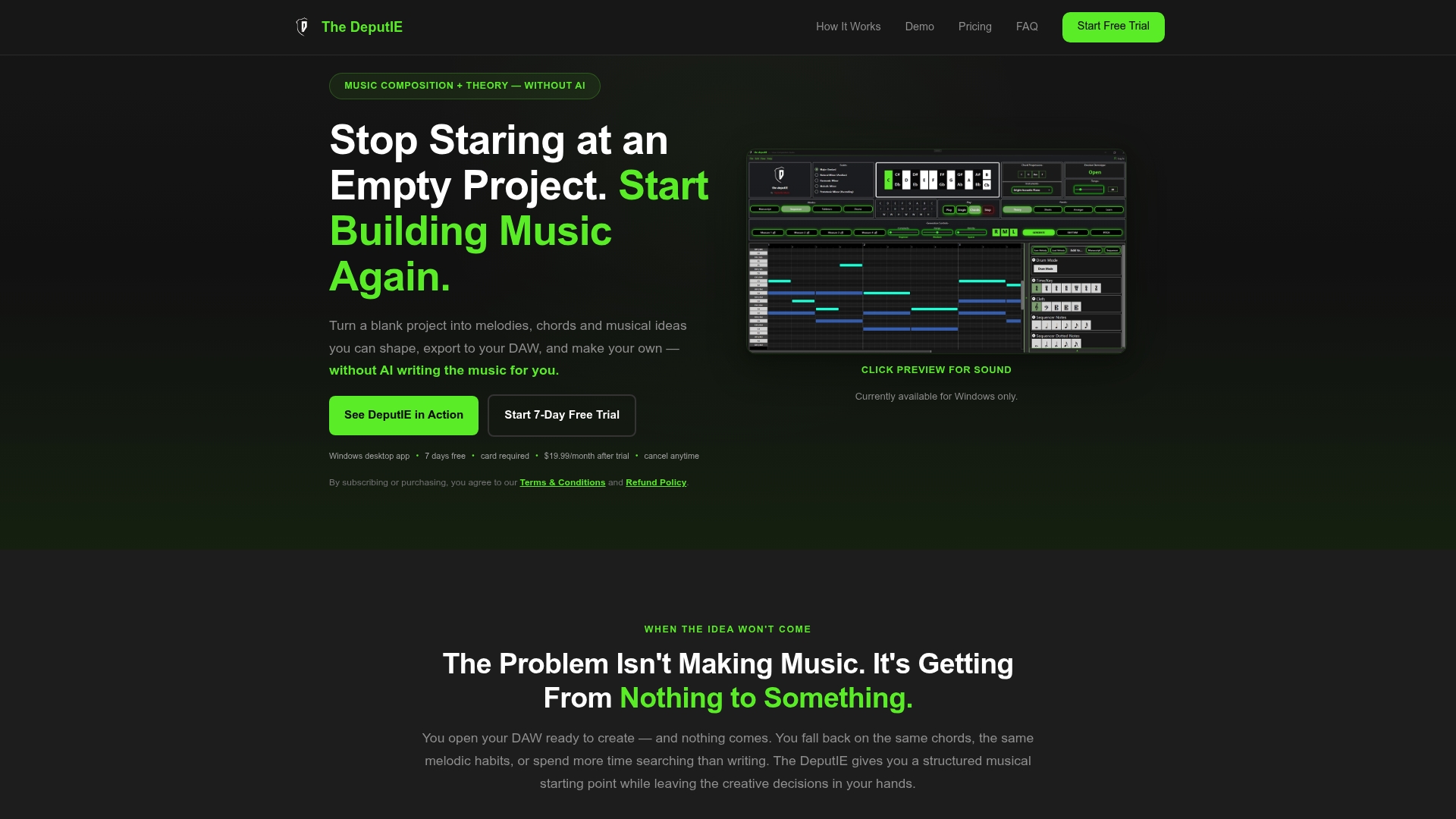
- Chord progression tools let you build and rearrange ii–V–I cycles, Rhythm Changes forms, and turnarounds visually before committing to a take.
- The visual sequencer helps you loop a four-bar phrase while you test substitutions, the same drill described earlier in this article.
- MIDI export sends whatever you build straight into your DAW, so practice sketches can become finished arrangements without retyping anything.
Unlike generic AI generators, DeputIE keeps you in control of the harmonic choices while the software handles the visualization and export. If you want a workspace built specifically for this kind of harmonic experimentation, check out The DeputIE and see how its progression tools fit your practice routine.
Sources
The Open Music Theory chapter on ii–V–I covers the schema, voicings, and tonicization in more depth. Piano.org offers practice routines and standard-tune examples that pair well with the drills above. Readers who want a technical walkthrough of composition software features can consult The DeputIE's user manual.
FAQ
What is the forbidden chord on guitar?
There is no officially recognized "forbidden chord" in jazz theory; the phrase circulates informally online and usually refers to a difficult stretch or an unusual voicing rather than an established musical term. Definitions vary depending on the source, so it's best treated as internet shorthand rather than a real harmonic category.
What is the most famous jazz chord progression?
The ii–V–I progression is widely considered the most foundational and recognizable harmonic movement in jazz, appearing throughout standards and forming the basis for countless substitutions, according to Piano.org. Rhythm Changes, built on I–vi–ii–V, is a close second in terms of how often it shows up across the repertoire.
What is the 2-5-1 progression in jazz music?
The ii–V–I progression moves from the ii chord to the V chord to the I chord, resolving harmonic tension into the tonic. In major keys it runs ii7 to V7 to Imaj7, and in minor keys the ii chord becomes half-diminished, giving iiø7 to V7 to i, as described in the Open Music Theory chapter on the subject.
What are the Holy Trinity of jazz chords?
The phrase generally refers to the seventh chord, the ii–V–I progression, and extended or altered chords that color those basic changes, though the term itself is informal rather than a fixed theoretical category. In practice, most players treat mastery of major and minor ii–V–I, along with shell and extended voicings, as the real foundation everything else builds on.