
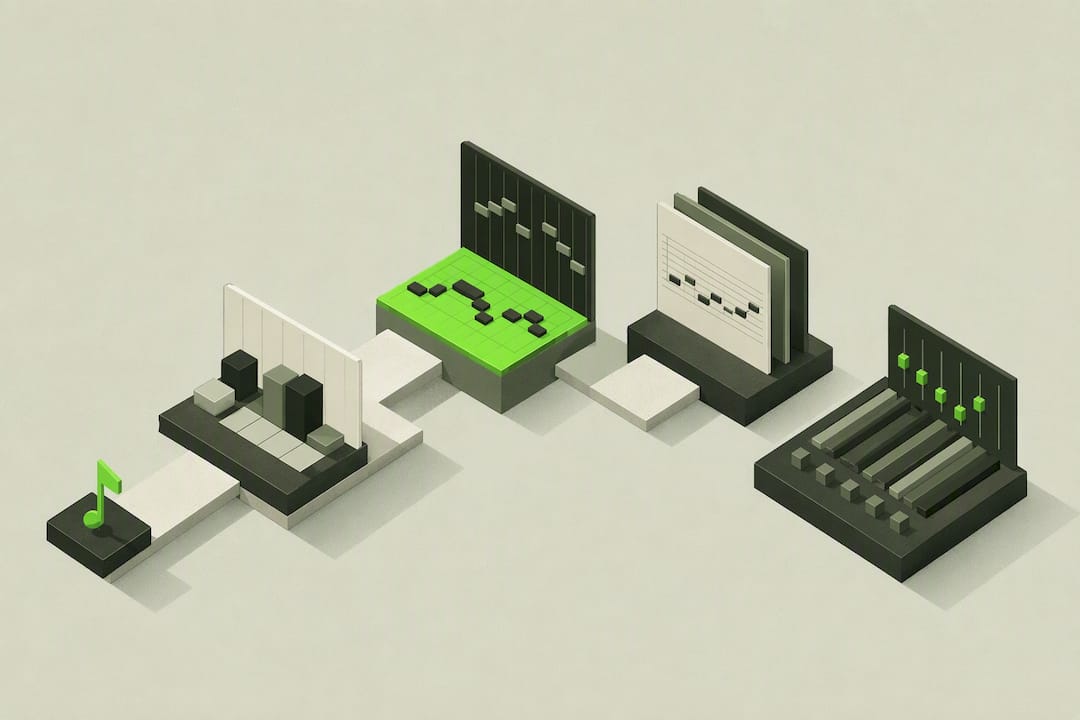
Start with a short motif of two to four notes, play it against a simple chord progression or scale like the pentatonic, and let stepwise motion carry most of the line. Give that phrase a clear rhythm and a breath, then repeat it with small changes until it becomes a hook. Everything else in melody writing is a variation on that one move.
TL;DR:
- Most memorable melodies rely on stepwise motion, with leaps reserved for the high points, and land on strong beats to anchor harmony.
- Starting with a small, repeatable motif or a simple scale-based phrase helps build a complete melody through repetition and variation.
- Rhythm has a greater impact on catchiness than pitch, so creating a strong rhythmic cell and placing rests deliberately enhances memorability.
- Avoid common mistakes such as too many notes, lack of repetition, and awkward leaps by cutting nonessential tones and ensuring comfortable singing ranges.
- Composition software can streamline melody development by enabling easy repetition, visualization of chords, and exporting ideas for testing in a real instrument or voice.
Table of Contents
- What Makes a Melody Memorable?
- How Do I Start Writing a Melody?
- How Do You Develop a Short Idea Into a Full Melody?
- Why Rhythm Matters More Than Pitch for Catchiness
- What Are the Most Common Melody Writing Mistakes?
- Using Composition Software to Speed Up Melody Writing
- Rules Guide You, but Your Ear Still Decides
- Put These Techniques Into a Guided Workspace
- Sources
- FAQ
What Makes a Melody Memorable?
A melody is pitch plus duration, nothing more mysterious than that. The pitches give you the tune's shape, or contour, while the rhythm gives it a pulse a listener can feel before they even notice the notes. Contour matters because the ear tracks direction: rising lines build tension, falling lines release it, and a flat line without much movement tends to feel static fast.
Most strong melodies rely on stepwise motion, moving by seconds and thirds, and save bigger jumps for moments that need emphasis. That's not a rigid law, more a guardrail: a line built entirely from small steps with one well-placed leap toward a peak note reads as intentional, while a melody full of leaps in every direction feels scattered.
- Keep most movement within a second or third.
- Reserve leaps of a fourth or more for the phrase's high point.
- Land chord tones (root, third, fifth) on strong beats to anchor the harmony.
- Use passing tones between chord tones to keep the line moving.
Singable range check: the most workable melodies sit within about one to one-and-a-half octaves, which keeps them within reach for most singers and instrumentalists. Push wider only when you're writing for a specific vocalist's range or want a dramatic, stretched effect.
How Do I Start Writing a Melody?
You don't need a finished chorus to start. You need one small, repeatable idea and a method to grow it. Here are four ways in, pick whichever matches how your brain already works.
- Motif-first. Write a two to four note fragment, sing or play it, then repeat it a step higher or lower. Try inverting it (flip the direction of the intervals) or transposing it into a different key center. A short, repeatable motif that evolves across a section beats constant novelty almost every time.
- Scale-first. Pick a scale, the pentatonic scale is the easiest entry point because it has no awkward half steps to trip over, and limit yourself to five or six notes while you shape a phrase. Fewer choices force better decisions.
- Chord-first. Play a simple progression, something like I-V-vi-IV, and pick out melody notes that land on chord tones during the downbeats. Fill the gaps between with stepwise passing notes.
- Humming or voice-first. Record yourself humming or singing nonsense syllables into your phone with no instrument in hand. Transcribe that recording to a piano roll or your instrument afterward. This method tends to preserve a natural, unforced rhythm that thinking in notation first often kills.
Pro Tip: Record every humming take, even the throwaway ones. The phrase you dismiss in the moment is often the one you come back to a week later because your ear, not your theory brain, picked it.
How Do You Develop a Short Idea Into a Full Melody?

A motif alone isn't a song, it's a seed. Growing it into something complete comes down to phrasing and repetition, not writing more notes.
Plan your phrases in even chunks, two, four, or eight bars, and think in pairs: an antecedent phrase that poses a musical question, followed by a consequent phrase that answers it. This "ask and answer" structure is why AABA and similar patterns show up so often in beginner melody exercises built from just an A phrase and a B phrase.
- Repeat a phrase but change the rhythm slightly before you touch the pitches.
- Once the rhythm variation feels settled, vary the pitches too, maybe raise the ending a step.
- Build toward one clear peak, the hook or highest note, and don't visit it twice in the same section.
- Use a half cadence (an unresolved pause) mid-phrase and a full cadence (a resolved landing) at the section's end.
- Sequence the motif at a new pitch level, or alter its ending contour so it resolves downward instead of up.
Why Rhythm Matters More Than Pitch for Catchiness
Pitch gets the attention in music theory class, but rhythm is often the primary driver of catchiness in a finished song. Clap or tap the rhythm of your phrase before you commit to any specific pitches. If the rhythm alone feels good, the pitches almost always fall into place faster.
- Repeat a rhythmic cell (a short pattern of long and short notes) two or three times before breaking it.
- Add syncopation, landing a note slightly off the beat, to give a phrase forward push.
- Place rests deliberately. A gap right before your hook makes that note hit harder.
- Protect your one clear peak note. Don't crowd it with extra notes on either side.
Pro Tip: Run the hum test. If you can't hum the melody back after one or two listens, the problem is almost never "not enough notes." It's usually too many. Cut first, add later.
What Are the Most Common Melody Writing Mistakes?
Most weak melodies share the same handful of problems, and each one has a fast fix.
- Too many notes. Cut nonessential passing tones. A leaner line almost always sounds more confident than a busy one.
- No repetition. Anchor the whole section to one motif and repeat it at least once before you introduce variation.
- No breathing room. Add rests. A melody without space turns into a wall of sound the ear can't grab onto.
- Unsingable range or leaps. Match the range to whoever performs it, then redistribute any awkward jump across two smaller steps instead of one big one.
Using Composition Software to Speed Up Melody Writing
Every method above works with just your voice, an instrument, or a pencil and staff paper. Structured software just removes some of the friction between idea and finished phrase. In a visual sequencer, motif-first work becomes drag-and-repeat instead of rewriting the same four notes by hand each time you want to try a variation. A chord progression tool lets you build the I-V-vi-IV loop from the chord-first method and see your chord tones laid out, so placing melody notes on strong beats is visual, not guesswork.
- Motif-first and chord-first workflows map directly onto a visual sequencer and chord progression tool.
- Humming ideas can be recorded, then rebuilt note by note in a piano-roll style workspace to preserve the original rhythm.
- MIDI export lets you move a sketch into your DAW to test it against a real singer or instrument's actual range.
The DeputIE's user manual walks through each workspace if you want to see how the pieces connect before trying it yourself.
Rules Guide You, but Your Ear Still Decides
Every rule above is a guardrail, not a verdict. Melodic theory exists to inform decisions, not replace your judgment about what sounds right for your song. Run these exercises often. Instinct builds from repetition, not from reading about it.
— Vigilantie
Put These Techniques Into a Guided Workspace
Every method in this guide, motif-first, chord-first, humming into a recorder, works on paper or at a piano. Where Vigilantiemusic's DeputIE earns its place is in the gap between having an idea and hearing it played back cleanly enough to judge. Instead of rewriting a four-note motif from scratch every time you want to test a variation, you drag and repeat it in the visual sequencer. Instead of guessing which chord tones land where, the chord progression tool shows you.

If you record yourself humming a phrase, you can rebuild it note by note without losing the original rhythm, then export the whole sketch as MIDI to test it in your DAW against a real vocal or instrument range. For readers who want automated idea generation as a starting point instead, a tool like AmmarAI's music generator can complement this manual process too. Check the DeputIE product page for the current trial terms and see whether the workflow fits how you write.
Sources
- How to write a melody - MasterClass
- How to write a melody - Native Instruments blog
- Melody writing - KS3 Music - BBC Bitesize
- How to make a melody - Violet Recording
FAQ
What Is the 80/20 Rule in Songwriting?
There's no single agreed-upon rule in songwriting the way there is in other fields, definitions vary depending on who's teaching.
What Are Some Examples of Melody?
A simple example is a short A phrase repeated with a variation as a B phrase, then returning to A, the AABA structure taught in beginner melody exercises. Nursery rhymes are useful real-world examples because they're built almost entirely from stepwise motion and repeated rhythmic cells.
What Makes Up a Good Melody?
A good melody combines clear pitch contour, a distinct rhythmic identity, mostly stepwise motion with leaps saved for emphasis, and a range most listeners or performers can comfortably sing, generally one to one-and-a-half octaves. Repetition with variation ties it together into something memorable rather than a string of unrelated notes.
How Do You Create a Simple Melody?
Pick a short motif, play it against a scale or a two to four chord progression, keep most movement stepwise, and repeat the motif at least once with a small rhythmic or pitch change. Tools like this kind of music composition software can speed up this loop by letting you sketch, repeat, and export the idea as MIDI without rewriting it from scratch each time.