
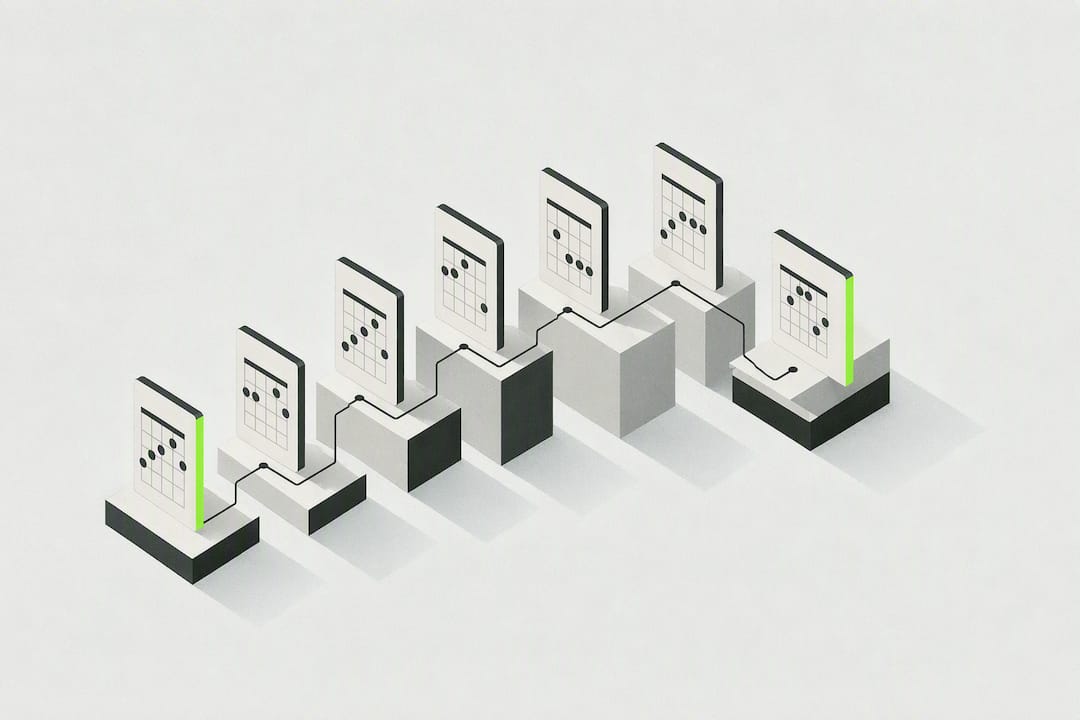
Diatonic chords are chords built only from the notes of one scale, with no notes borrowed from outside it. In a major key, the seven triads follow a fixed quality pattern: I (major), ii (minor), iii (minor), IV (major), V (major), vi (minor), and vii° (diminished). Learn that one formula and you can build harmony in any key without memorizing separate chord shapes for each.
TL;DR:
- Diatonic chords are built solely from notes within a scale, enabling quick transposition and improvisation across all major keys.
- The seven triads in a major key follow a fixed pattern: major, minor, minor, major, major, minor, diminished, with seventh chords adding richer harmony still following the same logic.
- Roman numerals indicate chord quality and position; practicing inversions and progressions helps develop smooth voice leading and functional harmony skills.
- Minor keys alter the pattern with raised seventh notes for dominant functions, affecting the resolution and overall harmonic color of the progression.
- Recognizing borrowed chords and secondary dominants enhances harmonic interest, but understanding the diatonic set is essential before exploring outside-chord substitutions.
Table of Contents
- What Are Diatonic Chords, and How Do You Build Them?
- The Seven Triads in Major Keys (and Their Seventh-Chord Cousins)
- How to Read Roman Numerals in Chord Charts
- Diatonic Chords in Minor Keys: Why the Pattern Shifts
- Common Progressions and How to Voice Them at the Piano
- Three Practice Exercises to Lock In the Pattern
- Building Diatonic Chords in Any Key, Step by Step
- When Chords Break the Rules: Modal Interchange and Secondary Dominants
- Learn the Pattern First, Then the Shapes
- Put the Formula to Work with The DeputIE
- Sources
- FAQ
What Are Diatonic Chords, and How Do You Build Them?
A diatonic chord is stacked entirely from notes that already belong to the scale you're working in. No sharps or flats sneak in from outside the key. If you're playing in C major, every diatonic chord uses only the white keys: C, D, E, F, G, A, and B.
On the piano, building one is almost mechanical. Pick any note of the scale as your starting point, or "root." Then skip a note and add the next scale tone above it (the third). Skip another and add one more (the fifth). That three-note stack is your triad, and it's why this method is often called "building in thirds."
- Choose a scale degree to serve as the root.
- Skip up one scale note and add the third.
- Skip up one more scale note and add the fifth.
- Repeat starting from each of the seven scale degrees.
This matters for more than theory homework. Once you know the pattern, you can transpose a song to a friendlier key for singing, or write a chord progression from scratch in any key without a reference chart. That's the real payoff of thinking in scale degrees instead of memorized shapes.
The Seven Triads in Major Keys (and Their Seventh-Chord Cousins)
Every major key produces the same sequence of chord qualities: Major, minor, minor, Major, Major, minor, diminished. That's the entire formula. Apply it to C major and you get C, Dm, Em, F, G, Am, and B diminished. Swap in any other major scale and the pattern holds; only the letter names change.
Add a fourth note (a seventh) on top of each triad and you get richer, jazzier harmony that still stays diatonic. In C major, that produces Cmaj7, Dm7, Em7, Fmaj7, G7, Am7, and Bm7♭5 (also written as Bø7). Notice that only the fifth chord, the dominant, becomes a plain "7" chord. Everything major stays "maj7," everything minor stays "m7," and the seventh chord built on the seventh degree gets the half-diminished symbol.
| Scale degree | Roman numeral | Triad quality | Seventh chord |
|---|---|---|---|
| 1st | I | Major | Cmaj7 |
| 2nd | ii | minor | Dm7 |
| 3rd | iii | minor | Em7 |
| — | IV | Major | Fmaj7 |
| 5th | V | Major | G7 |
| 6th | vi | minor | Am7 |
| 7th | vii° | diminished | Bm7♭5 (Bø7) |
This pattern of triad qualities holds for every major key, and the seventh-chord extensions follow the same logic no matter which key you're in.
How to Read Roman Numerals in Chord Charts
Roman numerals aren't decoration. They tell you the chord's quality and its position in the key at a glance, which is exactly why they show up in fake books, theory textbooks, and Nashville session charts alike.
The core rule: uppercase numerals mean major chords, lowercase means minor, and a small degree symbol (°) means diminished. A half-diminished seventh gets a slashed circle (ø). From there, seventh chords get standard suffixes: "maj7" for major sevenths, a plain "7" for dominant sevenths, "m7" for minor sevenths, and "ø7" for half-diminished sevenths.
- I, IV, V = major triads (uppercase, no symbol)
- ii, iii, vi = minor triads (lowercase)
- vii° = diminished triad (lowercase with degree symbol)
- Add "7," "maj7," or "ø7" for seventh-chord versions
Inversions get their own notation too. A slash chord like I/3 tells you the third of the I chord is in the bass instead of the root. In figured-bass style, you'll sometimes see V6/5, which tells a trained reader exactly which chord tone sits on the bottom. This same shorthand, adapted slightly, is the backbone of the Nashville Number System that session musicians use to sight-read charts in any key.
Pro Tip: Practice spotting the bass note first when you see a slash chord. Once you can hear that the lowest note isn't the root, inversions stop being a mystery and start being a tool.
Diatonic Chords in Minor Keys: Why the Pattern Shifts
Minor keys complicate the formula slightly, because "minor" isn't one fixed scale. Natural minor gives you a v chord that's minor, which sounds moody but lacks the pull toward the tonic that major keys enjoy. Raise the seventh scale degree, and you're in harmonic minor territory, where that same chord becomes a major V with a sharpened leading tone.
That one-note change matters enormously for how a song resolves. A minor v chord slides into i with less urgency. A major V, borrowed from harmonic minor, snaps back to i with the same strong pull you hear in major-key cadences. Composers often mix minor forms freely, using natural minor for melody and harmonic minor for the cadence chord.
- A minor (natural): Am, B°, C, Dm, Em, F, G
- A minor (harmonic): Am, B°, C, Dm, E (major V), F, G#°
If you're analyzing a minor-key song and a chord looks "wrong" against the key signature, check whether it's borrowing from harmonic minor before assuming a mistake. Nine times out of ten, that raised seventh is intentional.
Common Progressions and How to Voice Them at the Piano
Every diatonic chord has a job. Music theorists group the seven chords into three functions: tonic (home, built on I and vi), predominant (setup, built on ii and IV), and dominant (tension, built on V and vii°). Progressions work because they move through these functions in a predictable order, usually predominant to dominant to tonic.
- ii–V–I: In C major, that's Dm7, G7, Cmaj7. Voice it by keeping your right hand close: play Dm7 as F, A, C (top three notes), slide down to G7 as F, B, D, then resolve to Cmaj7 as E, G, C. Almost nothing moves more than a step.
- I–vi–ii–V: Cmaj7, Am7, Dm7, G7. This loop drives everything from doo-wop to jazz standards, and it works because each chord shares at least one note with its neighbor.
- V–I: G7 to Cmaj7 on its own is the simplest full cadence you can play, and it's worth practicing in isolation until your ear locks onto that release.
The reason these progressions feel satisfying comes down to voice leading. In G7, the note B is your leading tone. It wants to resolve up to C, the root of your tonic chord. Keep that motion in your voicing (B moving to C) and the progression will sound inevitable even played slowly.
Pro Tip: When practicing ii–V–I, keep your right-hand voicings within one octave and let your left hand carry the roots. Minimal hand movement forces you to hear the chord tones resolving instead of just hitting new shapes.

Three Practice Exercises to Lock In the Pattern
Reading about diatonic chords only gets you so far. Your hands need to find the pattern without you thinking through each interval, and that only happens with repetition across different keys.
- Build all seven triads in three keys. Play through C, G, and F major, stacking I through vii° by ear before checking your work. This drills the Major, minor, minor, Major, Major, minor, diminished formula until it's automatic.
- Transpose progressions using Roman numerals. Take ii–V–I and I–vi–ii–V and move them into two keys you didn't pick in advance, say D major and B♭ major. Numerals make this fast because the relationships never change, only the letter names do.
- Drill the V to I voice-leading move. Play G7 in second inversion (D in the bass), then resolve to Cmaj7, watching the leading tone B climb to C. Repeat in five different keys until your hand finds the resolution without hunting for it.
Pro Tip: Set a timer for five minutes and only work on exercise three. Voice leading is a physical habit as much as a mental one, and short, focused reps beat long, unfocused ones.
Building Diatonic Chords in Any Key, Step by Step
The formula never changes, which is the entire point of learning it as a pattern instead of memorizing twelve separate sets of chords. Here's the repeatable process.
First, write out the scale for your chosen key, all seven notes in order. Second, treat each scale degree as a potential chord root, one at a time. Third, stack the third and fifth above that root using only notes from your scale. Fourth, label the result using the Major-minor-minor-Major-Major-minor-diminished formula, so you know immediately whether that chord is major, minor, or diminished without testing every interval by ear.
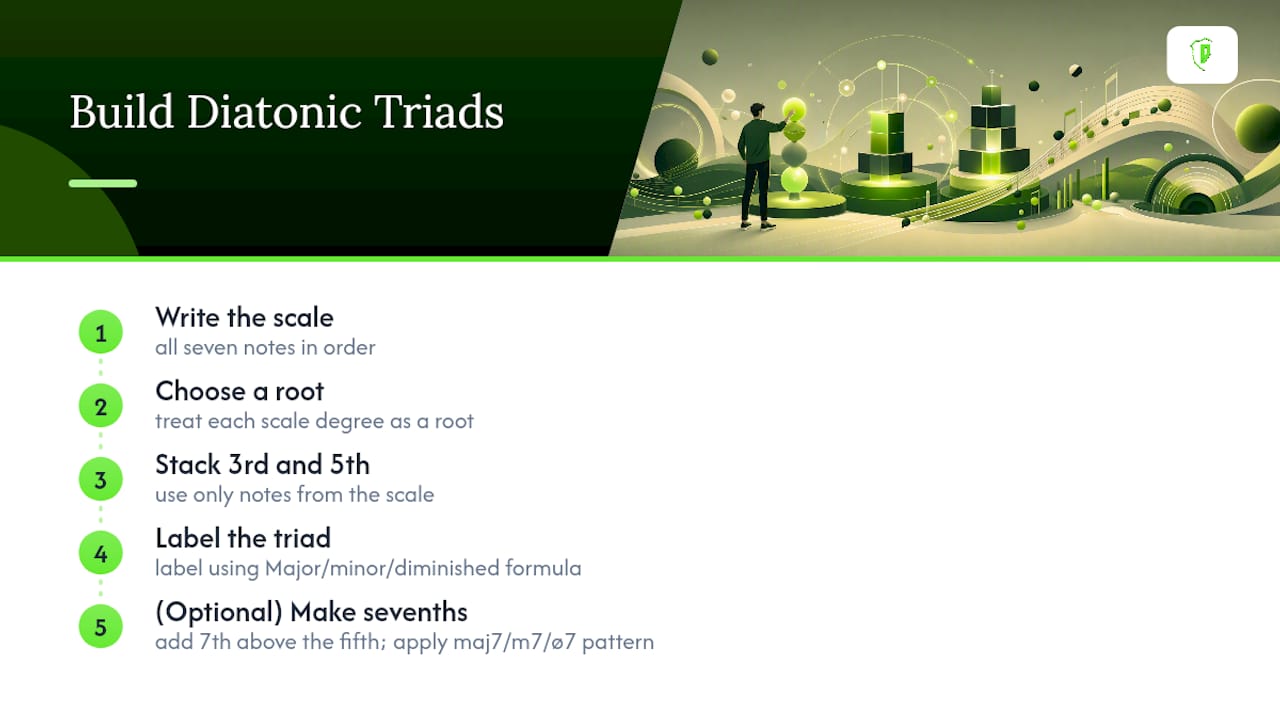
Once you've got triads, sevenths follow the same four steps with one extra note. Stack a third pitch above the fifth, still using only scale notes, and apply the seventh-chord version of the pattern (maj7, m7, m7, maj7, 7, m7, ø7). Try this in E♭ major: the scale is E♭, F, G, A♭, B♭, C, D. Root on the fourth degree (A♭) and stack A♭, C, E♭ for a major IV chord, then add G for A♭maj7.
The advantage of the formulaic approach over memorized shapes is speed under pressure. If a bandmate calls a key change mid-rehearsal, you don't need a chart. You run the scale, apply the pattern, and you're playing the right chords within seconds. That skill separates musicians who can only play what's written from musicians who can generate harmony on demand.
When Chords Break the Rules: Modal Interchange and Secondary Dominants
Diatonic chords are the baseline, not the ceiling. Once you know the seven chords a key naturally produces, you'll start noticing when songs use an eighth chord that doesn't belong, and that's usually intentional, not a mistake in the sheet music.
Modal interchange, sometimes called modal mixture, borrows a chord from the parallel minor or major key. A song in C major might drop in an F minor chord (borrowed from C minor) for a moment of darkness before returning to the diatonic set. It works because the borrowed chord still shares the same root relationships listeners already recognize.
Secondary dominants do something different. Instead of borrowing from another key, they briefly treat one of your diatonic chords as if it were a temporary tonic, then approach it with its own dominant. In C major, that means using D7 (the V of V, written V/V) to lead more forcefully into G, rather than the diatonic Dm7. The chord itself isn't diatonic to C major, but it's built entirely from the logic of the diatonic system, just aimed at a different target.
Understanding the diatonic set first is what makes these choices sound deliberate rather than random. Composers who understand diatonic sets before reaching for borrowed chords tend to use chromatic color with more control, because they know exactly which chord they're deviating from and why.
Learn the Pattern First, Then the Shapes
Most beginners try to memorize chord shapes key by key, which is exhausting and doesn't transfer. Learning the Major-minor-minor-Major-Major-minor-diminished formula instead means every new key becomes an application of something you already know, not a fresh memorization task.
Visual composition tools can shorten that learning curve further, since seeing a full diatonic set laid out reinforces what your ear is starting to notice on its own. Systems beat shapes. Once the formula is automatic, the shapes take care of themselves.
— Vigilantie
Put the Formula to Work with The DeputIE
Running the diatonic formula in your head is one thing. Seeing it laid out as you compose is another. Instead of reaching for a chord chart every time you switch keys, you can use tools that show the diatonic set for your key directly, allowing you to hear common chord progressions before committing them to a track.

Harmonic exploration tools can help audition chord substitutions, including modal interchange and secondary dominant moves, without losing track of the original progression. Once a progression feels right, you can export it as MIDI and continue building in your digital audio workstation. If you want a guided walkthrough of the chord-progression and sequencer workspaces, the DeputIE user manual covers both in detail. Start a free trial on the DeputIE product page and run through this article's practice exercises inside the software itself.
Sources
- Open Music Theory — Triads
- Music Theory for the 21st-Century Classroom — Roman Numeral Chord Symbols
- Piano
FAQ
What Are the 7 Diatonic Chords?
In a major key, the seven diatonic chords follow the pattern I (major), ii (minor), iii (minor), IV (major), V (major), vi (minor), and vii° (diminished). In C major, that's C, Dm, Em, F, G, Am, and B diminished.
Why Is It Called Diatonic?
"Diatonic" describes chords or notes drawn entirely from a single scale, with nothing borrowed from outside that scale's key signature. The term contrasts with "chromatic," which refers to notes or chords pulled from outside the key.
What Is the Forbidden Note in Music?
There's no universally "forbidden" note in music theory; the phrase usually refers to an avoid note in a specific scale or mode, like the fourth degree clashing against a major seventh chord in certain jazz contexts. It's a stylistic caution, not a hard rule.
What Are the Four Types of Chords?
The four basic triad types are major, minor, augmented, and diminished, built from different combinations of major and minor thirds stacked on a root. Diatonic major-key harmony only produces three of these types naturally: major, minor, and diminished.
How Do I Practice Diatonic Chords on Piano?
Build all seven triads in a key by ear, then transpose common progressions like ii–V–I into new keys using Roman numerals instead of memorized shapes. Visual tools like The DeputIE can reinforce this by showing the full diatonic set as you compose.