
Grab any handful of proven templates, apply function-based substitutions and one or two inventive tweaks, and you have a working progression in minutes. This article gives you 10 playable ideas with Roman numerals and C-key examples, quick variation tricks, and exercises to internalize them fast. You'll also see a practical workflow for auditioning and exporting your favorites as MIDI.
TL;DR:
- Most common progressions like I–V–vi–IV and I–vi–IV–V are used in many hits but benefit from variation, such as changing starting points or adding passing chords.
- Understanding diatonic chords and their functions in a major key allows for building adaptable progressions that can be transposed to different keys easily.
- Using techniques like modal interchange, secondary dominants, and inversions can make simple progressions more distinctive and emotionally engaging.
- Speeding up idea testing with tools like MIDI export and transposing shapes helps maintain momentum in songwriting workflows.
- Genre-specific habits, such as the blues 12-bar form or jazz ii–V–I sequences, serve as creative starting points but should be intentionally borrowed across styles for originality.
Table of Contents
- 10 Chord Progression Ideas For Songwriters
- How To Build A Progression From Any Key
- Techniques To Make A Simple Progression Sound Distinctive
- Auditioning Ideas Quickly With Chord Tools
- Applying These Ideas In The DeputIE Workflow
- Genre-Specific Chord Progression Ideas Worth Stealing
- When To Trust A Template And When To Break It
- Try The DeputIE To Audition, Tweak, And Export Your Ideas
- Sources
- FAQ
10 Chord Progression Ideas For Songwriters
Every one of these has been used in hundreds of hit records, and every one is a starting point, not a cage. Play them slow, then speed up, then break one rule on purpose.
-
I–V–vi–IV (the Axis progression). In C: C, G, Am, F. This is the four-chord loop behind a large share of modern pop, and its staying power comes from a mix of familiarity and forward motion the Piano explains well. Try rotating the starting point to vi–IV–I–V (Am, F, C, G) for a moodier open.
-
I–vi–IV–V (doo-wop). In C: C, Am, F, G. This is the 1950s ballad sound, warm and a little nostalgic. Swap the order to vi–IV–I–V for a more contemporary feel without changing a single chord.
-
I–IV–V (the three-chord backbone). In C: C, F, G. Simple, sturdy, and behind countless folk and rock songs. Add a passing vi (Am) between the F and G for extra lift before the turnaround.
-
12-bar blues (I–IV–V pattern). In C: four bars of C, two bars of F, two bars of C, one bar each of G, F, C, G. This structure defines blues, early rock and roll, and a good chunk of country. Try adding a quick IV chord in bar two for the classic "quick change" variation.
-
ii–V–I (the jazz staple). In C: Dm, G, C. This three-chord move creates tension and resolution in a tiny space, which is why jazz players lean on it constantly. Chain two of them back to back (say, Em–A–Dm–G–C) for a longer runway into your tonic.
-
The Pachelbel descending loop. In C: C, G, Am, Em, F, C, F, G. It's an eight-chord walk down the scale that feels cinematic and inevitable. Trim it to just the first four chords for a shorter, punchier version.
-
Modal-interchange lift (borrowed iv or bVII). In C: C, F, G, then swap in Fm or Bb for one bar. Borrowing from the parallel minor injects a bittersweet or unresolved color into an otherwise bright progression, a technique detailed in Audio Sorcerer's guide to writing chord progressions. Try it right before your chorus hits for a dramatic setup.
-
Minor descending loop (i–VII–VI–V). In Am: Am, G, F, E. This is the "epic minor" sound heard in everything from flamenco-influenced pop to metal ballads. Hold the E chord an extra beat to heighten the pull back to Am.
-
Suspended/open progression. In C: C, Csus2, F, Fsus2, G. Suspended chords remove the third, so nothing fully resolves until you want it to. Great for verses that need to feel unsettled before a resolved chorus.
-
Cycle-of-fifths sequence with secondary dominants. In C: C, A7, Dm, G7, C. Each dominant chord (A7, G7) briefly targets the chord after it, pulling the ear forward. This is a compact way to borrow jazz motion for a pop or rock context.
Pro Tip: Practice each progression at a slow, steady tempo with four beats per chord, before speeding up. Then transpose the same shape into additional keys. That combination of slow repetition and transposition is recommended by the piano.org guide for internalizing the Axis progression, and it works well on the other progressions too.
How To Build A Progression From Any Key
Every major key has seven diatonic chords, and knowing their qualities lets you write progressions instead of just copying them. Here's the pattern, using C major as the reference:
- I (C) — major, the tonic, your home base
- ii (Dm) — minor, a common subdominant substitute
- iii (Em) — minor, less common but useful for color
- IV (F) — major, the subdominant, creates movement away from home
- V (G) — major, the dominant, creates tension that wants to resolve
- vi (Am) — minor, the relative minor, often used as a substitute tonic
- vii° (Bdim) — diminished, rarely used on its own in pop and rock
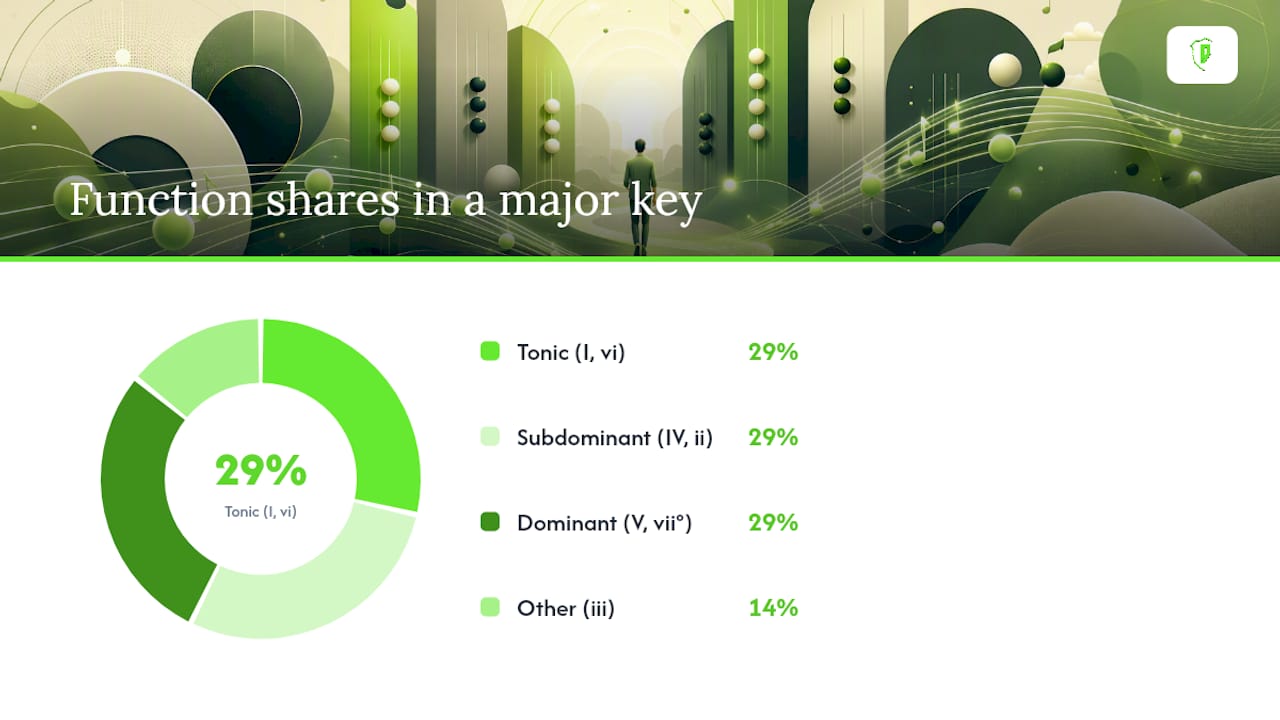
That I, ii, iii, IV, V, vi, vii° quality pattern is consistent across major keys, as Hoffman Academy's rundown of diatonic chords lays out. The functional roles matter more than the individual chords: tonic (I, vi) is home, subdominant (IV, ii) is departure, and dominant (V, vii°) is tension. Arranging a progression as home, away, tension, home is the most common harmonic movement in Western music, and it's why IV–V–I resolves so satisfyingly.
Try this now: pick a key, write out its seven diatonic chords, build a four-bar loop using at least one chord from each function, then transpose that same loop up a whole step. You'll feel the shapes start to stick.
Techniques To Make A Simple Progression Sound Distinctive
A plain I–IV–V gets interesting fast once you start bending it. These are the moves that separate a demo from a finished idea.
- Modal interchange: borrow a chord from the parallel minor key, like swapping F major for F minor in a C major song, to add an unexpected shadow.
- Secondary dominants: insert a dominant chord that targets something other than your tonic, such as A7 leading into Dm, for extra pull. Chaining several of these together into a ii–V–I sequence is standard jazz-influenced songwriting practice.
- Tritone substitution: replace a dominant chord with the dominant a tritone away (G7 becomes Db7) for a jazzier, more chromatic bass line.
- Inversions: flip a chord so a different note sits in the bass, smoothing out the motion between chords that would otherwise jump around.
Pro Tip: Change your harmonic rhythm, how often chords change, instead of always writing new chords. Holding I for two bars then rushing through ii, V in one bar can make a familiar progression feel brand new. Leaning on common tones between chords (notes shared across two chords) also disguises repetition, since the ear tracks the moving notes more than the static ones.
Auditioning Ideas Quickly With Chord Tools
Speed matters when you're chasing an idea. Pick a template, randomize a few chords within it, rotate the starting point, then transpose to your target key, a workflow that generators like the AutoChords progression tool are built around.
- Once a shape feels right, export it as MIDI so you can drop it straight into your DAW instead of retyping notes by hand.
- Try the same progression with two different harmonic rhythms, one chord per bar versus one chord every two bars, before locking in the feel.
- Generators are fastest for auditioning shapes, but pairing that speed with a quick theory check on voice leading keeps the result from sounding generic.
Applying These Ideas In The DeputIE Workflow
The DeputIE gives you chord progression tools, a visual sequencer, and theory-guided suggestions built for exactly this kind of iteration, without handing the writing over to an algorithm. A practical workflow: pick one of the ten templates above, try a modal-interchange swap on one chord, test a couple of inversions for smoother bass motion, then export the result as MIDI to finish arranging in your DAW.
Genre-Specific Chord Progression Ideas Worth Stealing
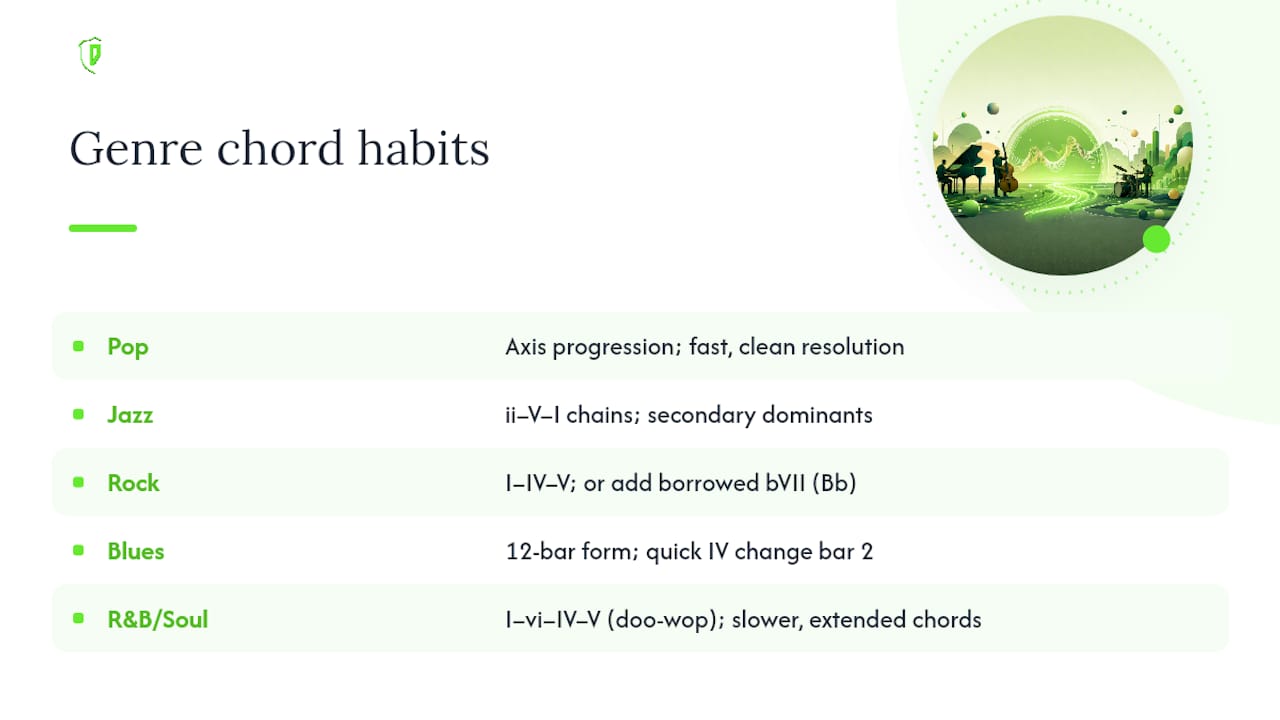
Pop tends to lean on the Axis progression and its rotations because it moves fast and resolves cleanly within a three-minute song. Jazz favors ii–V–I chains and secondary dominants, since the genre's whole vocabulary is built around motion toward a target chord rather than sitting still. Rock often strips things down to I–IV–V or adds a borrowed bVII (in C, that's Bb) for a grittier edge, a trick you'll hear across decades of guitar-driven records.
Blues sticks close to the 12-bar form, with its quick IV-chord change in bar two separating a basic blues from a more seasoned one. Folk tends to favor the plain I–IV–V or I–vi–IV–V, prioritizing lyrics and melody over harmonic surprise, which is part of why those progressions feel so singable. R&B and soul frequently use the doo-wop I–vi–IV–V but slow the harmonic rhythm down and add extended chords like sevenths and ninths for a smoother, more sophisticated color.
None of these genre habits are rules. They're starting points, the same way the ten templates above are starting points. Once you can hear why a jazz chain feels different from a pop loop, you can borrow across genres on purpose instead of by accident.
When To Trust A Template And When To Break It
Templates earn their place: use them for speed, for collaboration, for getting a demo down before the feeling fades. Break them when a section needs to feel unmistakably yours. Before either choice, ask: what's the emotional target, what's playing it, and does this section want to resolve or keep circling?
— Vigilantie
Try The DeputIE To Audition, Tweak, And Export Your Ideas
Vigilantiemusic built The DeputIE for the exact moment this article is about: staring at a promising four-chord loop and needing a fast, structured way to test where it goes next. Instead of leaning on an AI generator that writes the part for you, The DeputIE gives you visual sequencing, chord progression tools, and theory-guided suggestions so you stay in the driver's seat while moving through ideas quickly.
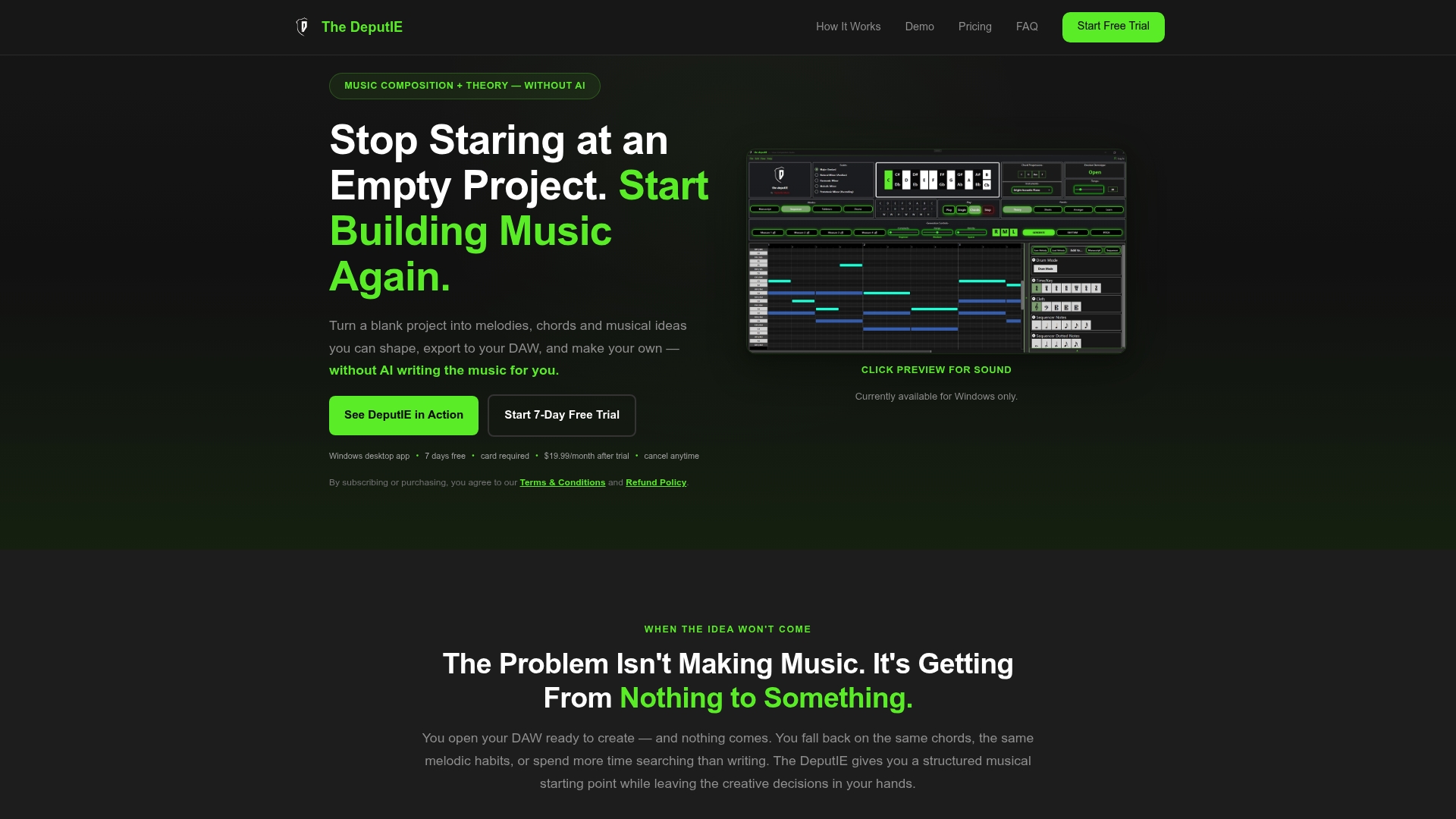
Pick one of the templates from this article, run it through The DeputIE's chord workspace, try a borrowed chord or an inversion, and export the result as MIDI straight into your DAW. If you want to see exactly how the chord tools and visual sequencer work before committing, the DeputIE user manual walks through every workspace in detail. When you're ready to write, the DeputIE landing page has the Monthly plan at $19.99 per month or the Annual plan at $129.99 per year, both starting with a free trial.
Sources
FAQ
What Are 10 Common Chord Progressions?
The most reliable ten include I–V–vi–IV, I–vi–IV–V, I–IV–V, the 12-bar blues pattern, ii–V–I, the Pachelbel descending loop, a modal-interchange lift using a borrowed iv or bVII, the minor i–VII–VI–V loop, a suspended progression, and a secondary-dominant cycle-of-fifths sequence. Each one appears in the numbered list above with a C-key example and a quick variation to try.
What Are Some Beautiful Chord Progressions?
Beauty in a progression usually comes from contrast between tension and resolution rather than any single chord. The Pachelbel descending loop and the minor i–VII–VI–V pattern both create that pull because they walk the ear downward before landing home, and modal interchange (borrowing a chord like Fm in the key of C) adds a bittersweet color many songwriters reach for.
What Makes A Good Chord Progression?
A good progression balances familiarity with at least one small surprise, whether that's a borrowed chord, an unexpected inversion, or a shift in harmonic rhythm. Understanding chord function, tonic, subdominant, and dominant, matters more than memorizing shapes, because it lets you build a path from home to tension and back that feels intentional rather than arbitrary, a point the Study.com lesson on chord function explains clearly.
What Is A Famous 4-Chord Progression?
The most famous four-chord progression is I–V–vi–IV, often called the Axis progression, played as C, G, Am, F in the key of C. It's been used across pop, rock, and country for decades, and rotating its starting point, say to vi–IV–I–V, is a simple way to make the same four chords feel new, as the piano.org guide to the Axis progression demonstrates.
How Much Does The DeputIE Cost?
The DeputIE is available on a Monthly plan for $19.99 per month or an Annual plan for $129.99 per year, both listed on the DeputIE landing page. A free trial lets you test the chord progression tools and MIDI export before subscribing.