
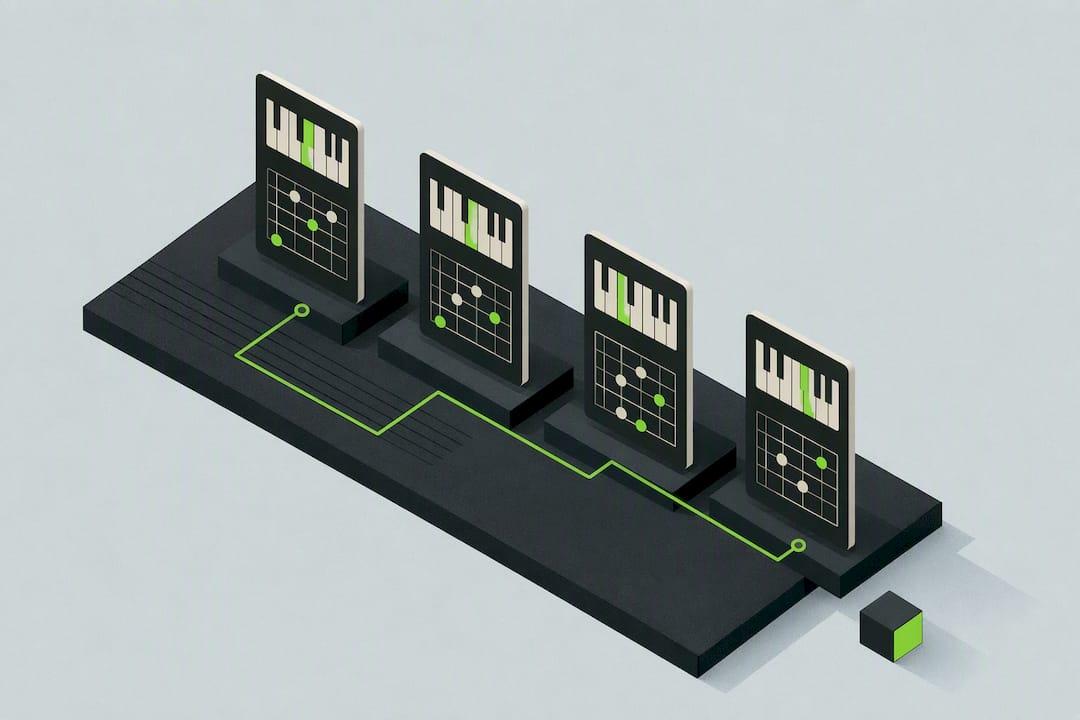
A chord inversion happens when a note other than the root sits in the bass, so the same chord sounds fresh, moves smoothly, and connects to its neighbors without changing what the chord actually is. Triads have two possible inversions; seventh chords have three. Musicians reach for inversions to smooth bass lines, tighten voice leading, and shade the emotional weight of a progression.
TL;DR:
- Inversions allow a chord’s bass note to differ from the root without changing its core identity, helping to smooth bass lines and enhance voice leading.
- Triads have two possible inversions, while seventh chords have three, with each inversion involving different notes in the bass and corresponding figured bass labels.
- Building inversions on piano involves repositioning notes without altering the notes themselves, while guitar voicings rely on movable shapes and slash chords to specify the bass note.
- Using the correct inversion reduces bass jumps in progressions, creating more connected and singable lines, especially useful in both harmonic and melodic context.
- Modern practice is aided by guided tools like visual chord sequencers, which let musicians audition inversions quickly and incorporate them into digital compositions seamlessly.
Table of Contents
- What Are Chord Inversions: Root Position, First, Second, and Third
- How Do You Build Inversions on Piano and Guitar?
- Why Use Inversions for Voice Leading and Bass Motion?
- Piano, Guitar, and Jazz Voicing Strategies
- How Do You Train Your Ear to Recognize Inversions?
- Slash Chords and Figured Bass: Quick Reference
- Practice Progressions and a Quick Cheat Sheet
- How Guided Composition Tools Speed Up Inversion Practice
- Historical Development and Usage of Chord Inversions in Different Musical Styles
- How Inversions Function Differently Across Classical, Jazz, and Pop
- An Editorial Take: Treat Inversions as Expression, Not Just Mechanics
- Practice Inversions Faster With a Guided Workspace
- Sources
- FAQ
What Are Chord Inversions: Root Position, First, Second, and Third
Every chord starts in root position, with the root as the lowest note. Move that same chord's third to the bass and you get first inversion. Put the fifth on the bottom instead, and you get second inversion. Triads stop there because they only have three unique notes to rotate through the bass, but seventh chords carry a fourth note and therefore a third inversion, with the seventh itself sitting at the bottom.
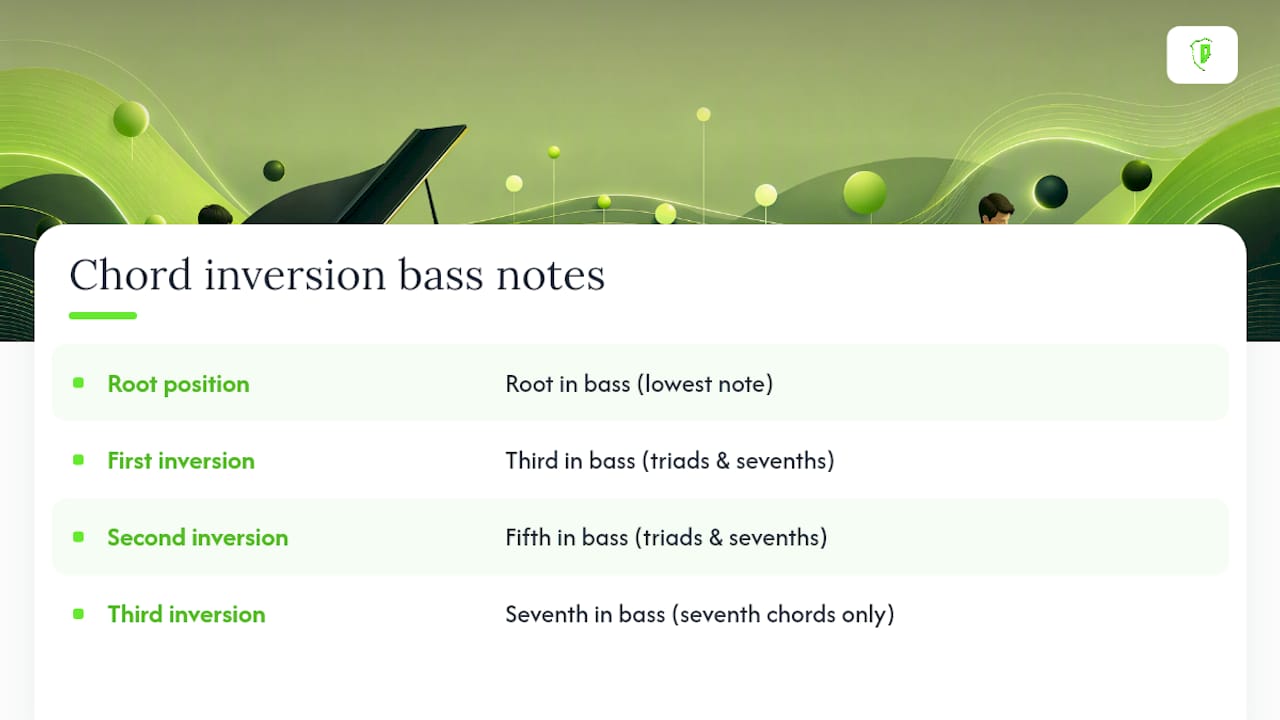
Figured bass gives each inversion a shorthand based on the intervals stacked above the bass note. A root-position triad gets no figure at all, since 5/3 is assumed. First inversion is labeled 6 (a sixth and a third above the bass). Second inversion is 6/4. Seventh chords extend the pattern: root position is 7, first inversion is 6/5, second inversion is 4/3, and third inversion is 4/2. These numbers map directly onto Roman-numeral figures like V6 or ii6/5, which is why you'll see them stacked under Roman numerals in any theory textbook.
None of this changes the chord's identity. A C major triad in second inversion, with G in the bass, is still a C major chord. It shares the same root, the same quality, the same function in a key. What changes is which note carries the weight of the bass, and that single detail reshapes how the chord connects to the ones around it.
How Do You Build Inversions on Piano and Guitar?
On a keyboard, building inversions is almost mechanical once it clicks, and a resource like the Liste des Pianos Synthés - ZenViewStudios Studio enregistrement can help you choose the right instrument to practice on. Start with a C major triad in root position: C, E, G. Take the C and move it up an octave, and you land on E, G, C, which is first inversion. Repeat the process, moving the E up an octave, and you get G, C, E, which is second inversion. The notes never change, only their stacking order.
Spacing and doubling matter more than beginners expect. In a four-voice texture, you'll often double the bass note or the root to fill out the harmony, and how you distribute those doublings between your hands changes the chord's density and weight.
- Keep the bass note isolated in your left hand for clarity, especially in slower passages.
- Double the root or fifth in first inversion; avoid doubling the third, since it's usually the more active voice.
- On guitar, the lowest sounding pitch defines the inversion, not necessarily the lowest string in a diagram.
- Movable shapes (like barre-chord CAGED forms) let you keep the same fingering while sliding to place a different chord tone in the bass.
- Check your tab or chord diagram against a slash chord symbol to confirm which note actually rings lowest.
Slash chords make this readable at a glance. C/E tells you to play a C major chord with E in the bass, which is first inversion. G7/B puts the third of a G7 chord on the bottom. Guitarists sometimes voice a slash chord where the bass note isn't even part of the chord above it, like F/G, which stacks an F triad over a G bass to imply a G9-ish sound without playing every note. A resource like ZenViewStudios' keyboard and piano guide can help if you're shopping for a controller to practice these voicings hands-on.
Why Use Inversions for Voice Leading and Bass Motion?
Inversions exist to solve a problem every arranger runs into: chords that jump around too much sound clunky. Choosing the right inversion lets each voice move the shortest possible distance between chords, which creates smoother transitions and fewer awkward leaps. Instead of your bass line lurching from root to root, an inversion can turn it into something closer to a melody.
Take a simple I to IV move. In root position, the bass jumps a fourth. Slip the IV chord into first inversion, and the bass moves by a single step instead, giving the whole progression a smoother, more connected feel.
- Minimize movement in the upper voices by choosing an inversion that shares common tones with the previous chord.
- Use inversions to build a stepwise, singable bass line under a static or repetitive melody.
- Reach for first inversion when you want a chord to feel lighter or less final, since it softens the harmonic weight compared to root position.
- Save second inversion and seventh-chord inversions for moments where you want tension, since the added instability pulls the ear forward.
Pro Tip: Try writing your bass line first as if it were its own melody, then figure out which inversions make the chords above it work. It flips the usual process and often produces bass lines you wouldn't have found by defaulting to root position every time.
Piano, Guitar, and Jazz Voicing Strategies
Each instrument handles inversions a little differently, and knowing the shortcuts saves real practice time.
On piano, fingering determines whether an inversion feels natural or awkward. For a Cmaj7 in first inversion (E, G, B, C), most pianists find 1-2-3-5 comfortable in the right hand, though redistributing the top note to the left hand works fine in slower tempos. Dominant seventh inversions get used constantly in blues and gospel piano, where the 6/5 voicing (third in the bass) creates that rolling, walking quality under a melody.
Guitarists need to double check the actual bass pitch, since a chord shape that looks like root position on a diagram might ring out a different note as the lowest pitch depending on which strings you mute. Common inversion shapes worth memorizing:
- Open-position C/E and D/F#, both staples in singer-songwriter and folk voicings.
- Movable major and minor triad shapes on the top three strings, useful for sliding through inversions during a solo.
- Drop-D tuned inversions, which put unusual bass notes within easy reach.
Jazz players lean on shell voicings (root, third, seventh, with the fifth omitted) and drop-2 or drop-3 voicings, where a note from a close-position chord gets dropped an octave to spread the harmony across a wider range. Comping pianists and guitarists often favor inversions that keep the guide tones (third and seventh) in a comfortable middle register, while soloists use inversions higher up the neck or keyboard to access brighter colors.
How Do You Train Your Ear to Recognize Inversions?
Recognizing an inversion by ear comes down to one habit: find the bass note before you try to name anything else. Once you've locked onto the bass, listen for the chord quality stacked above it, and the inversion usually becomes obvious.
- Isolated bass drill. Play a triad in random inversions on a piano or DAW, and try to sing or name the bass note before naming the chord.
- Chord-with-melody drill. Play short two-chord progressions (like I to V6) and identify whether the bass moved by step or by leap.
- Progression spotting. Loop a four-chord pop progression and mark, on paper, which chords sound like they're in root position versus inverted, based on how "settled" or "floaty" each one feels.
Fifteen minutes a day, three or four times a week, beats an hour once a week for building this skill.
Pro Tip: Slow the tempo down to half speed for the first few reps of any drill. Your ear needs time to isolate the bass before it can track the harmony above it, and rushing this step is the most common reason ear training stalls.
Slash Chords and Figured Bass: Quick Reference
Slash chord notation dominates in pop, rock, and lead sheets because it's fast to read. C/E means a C major triad with E in the bass. G7/B means a G dominant seventh with its third, B, on the bottom. Figured bass does the same job with more precision, which is why classical scores and theory textbooks favor it.
The numbers are simple once memorized: 6 marks a first-inversion triad, 6/4 marks second inversion, and 6/5, 4/3, and 4/2 mark the three seventh-chord inversions in order. Use slash chords when writing for guitarists, bassists, or anyone reading a lead sheet on the fly. Use figured bass when you're analyzing a score or writing for classically trained musicians who expect Roman-numeral analysis under the staff.
Practice Progressions and a Quick Cheat Sheet
Three short exercises will get inversions under your fingers faster than any amount of reading theory.
- Pop progression: Play I, then V6, then vi, then IV6. The V6 puts the third of the V chord in the bass, and IV6 does the same for the IV chord, giving you a bass line that walks mostly by step instead of jumping around.
- Classical or jazz progression: Try ii6, V6/5, I. Voice the V6/5 as a dominant seventh with its third in the bass, and resolve it into a root-position tonic for a satisfying cadential pull.
- Ear-training drill: Record yourself playing five random inversions a day, and log which ones you missed on a simple cheat sheet with three columns: chord, inversion, and whether you identified the bass correctly.
Keep that cheat sheet running for two or three weeks. Patterns in what you consistently miss will tell you exactly where to focus next, whether that's second-inversion triads or seventh-chord third inversions.
How Guided Composition Tools Speed Up Inversion Practice
Testing inversions by ear and hand takes time, and that's exactly where a guided workspace earns its keep. Visual sequencers and chord-progression tools can let you drag a chord into different inversions and hear the result immediately, without re-voicing it manually every time. Export to MIDI once you land on a voicing you like, and drop it straight into your DAW.
Historical Development and Usage of Chord Inversions in Different Musical Styles
Inversions weren't always common vocabulary. Renaissance and early Baroque composers relied heavily on root-position triads, and figured bass notation itself emerged in the early 1600s as a shorthand for keyboard players realizing harmony from a bass line during continuo playing. As tonal harmony matured through the Baroque and Classical periods, first inversion became a workhorse for smoothing bass motion in chorales and sonatas, while second inversion got reserved for specific, almost ceremonial roles, like cadential progressions right before a dominant chord resolves.
Romantic-era composers pushed inversions further, using seventh-chord inversions to stretch harmonic tension across longer phrases. By the time jazz emerged in the twentieth century, inversions had shifted from a voice-leading tool into a coloristic one. Bebop and post-bop pianists used drop-2 and drop-3 inversions to voice complex extended chords without cluttering the register, and comping styles built entire vocabularies around which inversion sat best under a soloist's line.
Pop and rock music borrowed the classical habit of using first inversion to smooth bass lines, but often stripped away the stricter rules classical harmony placed on second inversion. Singer-songwriters in particular lean on slash chords constantly, since they let a bassist or guitarist read the intended voicing without needing formal theory training. What started as a notation convenience for Baroque keyboardists is now baked into how nearly every genre handles harmony.
How Inversions Function Differently Across Classical, Jazz, and Pop
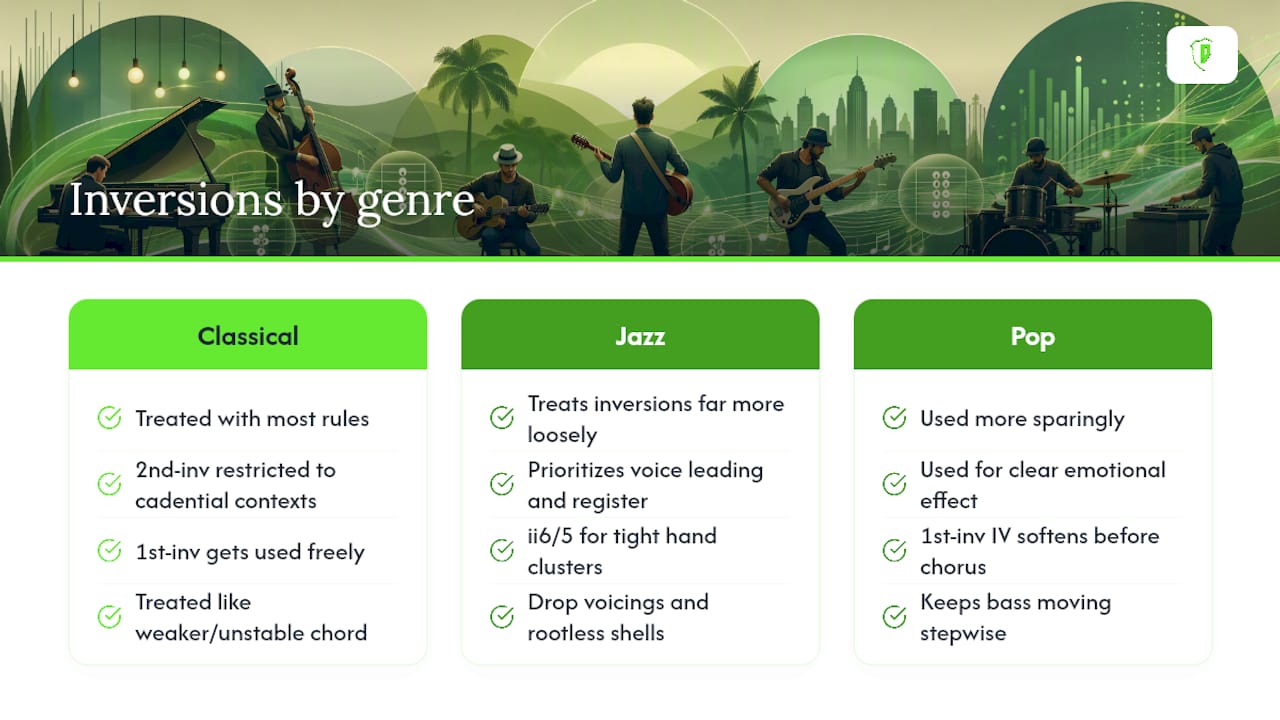
Classical harmony treats inversions with the most rules. Second-inversion triads, in particular, are restricted mostly to cadential contexts or passing motion, treated almost like a "weaker" or unstable version of the chord rather than a stable harmony in its own right, a distinction rooted in how AP Music Theory curricula frame first and second inversion. First inversion, by contrast, gets used freely throughout a piece, functioning almost like a lighter version of the tonic or subdominant.
Jazz treats inversions far more loosely, prioritizing voice leading and register over strict functional rules. A ii6/5 might show up simply because it lets the pianist keep their hand in a tight cluster while comping, not because of any cadential requirement. Drop voicings and rootless shells, both built from inverted thinking, dominate jazz piano and guitar precisely because they let players avoid muddy low-register clashes with a bassist.
Pop and rock use inversions more sparingly but for clear emotional effect. A first-inversion IV chord under a chorus can soften a moment right before a big root-position hook lands. Producers also lean on inversions to keep a bass line moving stepwise under a repetitive vocal melody, since a smooth, singable bass line often does more to make a chorus feel satisfying than any change in the chords themselves. The chord doesn't change identity in any of these genres. What changes is the philosophy behind when and why you'd bother inverting it.
An Editorial Take: Treat Inversions as Expression, Not Just Mechanics
Most explanations of inversions stop at mechanics: move this note, label it 6/4, done. That misses the actual point. Inversions are where harmony starts to feel composed rather than assembled, because the same four chords can sound anonymous or personal depending entirely on which notes you put in the bass.
Try this: pick any progression you've already written, and swap one root-position chord per phrase for an inversion. Listen to what the bass line does. That single change often reveals more about your harmonic instincts than an hour of chord-theory reading.
— Vigilantie
Practice Inversions Faster With a Guided Workspace
Reading about inversions only gets you so far. You need to hear a chord shift shape in real time, try three different inversions back to back, and keep the one that actually moves your bass line the way you wanted. The DeputIE's visual sequencer and chord-progression workspace let you audition first, second, and third inversions on the fly, without stopping to manually re-voice each chord by hand.

Once you land on a voicing that works, export it straight to MIDI and drop it into your existing DAW to keep building the arrangement. If you want to see the full workflow before diving in, the DeputIE user manual walks through the chord-progression tools step by step. Ready to try it on your own progression? Start with the DeputIE composition software and audition your next chord change in minutes instead of guessing at the keyboard.
Sources
- First inversion — Wikipedia
- Chord inversions 101: How to create smooth movement in your music | Native Instruments Blog
- First Inversion — AP Music Theory Definition & Guide | Fiveable
FAQ
What Are First, Second, and Third Inversions?
First inversion places a chord's third in the bass, second inversion places the fifth in the bass, and third inversion (which only applies to seventh chords) places the seventh in the bass. Triads only have two inversions because they have three notes total, while seventh chords get a third inversion thanks to their extra note.
What Is the "Forbidden Chord" on Piano?
There's no single universally recognized "forbidden chord," but the term usually points to the tritone or certain unresolved seventh-chord voicings that classical harmony traditionally treated as unstable and requiring resolution. In practice, most modern styles, including jazz and film scoring, use these same sounds deliberately for tension rather than avoiding them.
What Do Cmaj7 Inversions Look Like?
A Cmaj7 chord (C, E, G, B) in root position becomes E, G, B, C in first inversion, G, B, C, E in second inversion, and B, C, E, G in third inversion, with the seventh, B, sitting in the bass. Each inversion keeps the same four notes and the same chord identity, just reordered.
Can You Explain Chord Inversion Simply?
A chord inversion is the same chord with a different note in the bass, so a C major triad remains a C major chord whether C, E, or G sits on the bottom. Musicians use inversions mainly to smooth out bass lines and make chord changes feel less jumpy, a technique you can practice directly inside a workspace like The DeputIE.