
A cadence is the harmonic, melodic, and rhythmic arrival point that closes a musical phrase, working like punctuation in a sentence. Music theory groups them into four main families: the Authentic cadence (V→I, split into perfect and imperfect versions), the Plagal cadence (IV→I), the Half cadence (ending on V), and the Deceptive cadence (V resolving somewhere other than I). Recognizing which one you're hearing tells you whether a phrase has finished, paused, or been deliberately interrupted.
TL;DR:
- Authentic cadences consistently feature a V to I resolution with both chords in root position and the melody ending on the tonic note.
- Plagal cadences move from IV to I and lack the leading tone, offering a softer, more reflective ending often used in hymn music.
- Half cadences stop on V, creating an incomplete feel, especially if the phrase concludes with a rhythmic lengthening before arriving at the dominant.
- Deceptive cadences resolve from V to vi or another chord instead of I, adding surprise and prolonging musical tension at phrase endings.
- Recognizing cadences involves analyzing phrase boundaries, melodic motion toward the tonic, and chord inversions, with tools available for visual and auditory practice.
Table of Contents
- Cadence Types in Music: The Four Main Categories
- Perfect vs. Imperfect Authentic Cadence: How to Tell Them Apart
- How Cadences Shape Phrases and Periods
- How to Identify a Cadence by Ear or in a Score
- Cadence Examples in Music You Can Listen for Today
- Practicing Cadences With a Visual Composition Tool
- How Cadences Changed From Bach to Now
- Cadences Beyond the Concert Hall
- Why Cadences Carry Emotional Weight
- Cadences Outside the Major-Minor System
- Teaching Cadences: What Actually Sticks
- Try Building Cadences Yourself With a Visual Composition Tool
- Sources
- FAQ
Cadence Types in Music: The Four Main Categories
Every tonal phrase eventually has to land somewhere, and that landing spot tells you almost everything about how final or unfinished it feels. Cadences function as the harmonic, melodic, and rhythmic arrival points that conclude a phrase, and theory typically sorts them into four categories based on which chords are involved and how they resolve.
Authentic cadence. This is the strongest and most common resolution in tonal music: a dominant chord (V) moving to the tonic (I). Listen for the bass jumping down a fifth (or up a fourth) into the tonic note, paired with a melody that resolves its tension. This is the cadence that makes a piece, or a phrase within it, sound genuinely done.
Plagal cadence. Built on IV moving to I, this is the "Amen" cadence you've heard at the end of hundreds of hymns. It lacks the leading tone (the raised seventh degree that pulls hard into the tonic), so it sounds softer and less urgent than an authentic cadence. Composers often tack a plagal cadence onto the end of an authentic one for a gentle closing flourish, rather than using it as the primary resolution.
Half cadence. Instead of resolving, a half cadence stops on the dominant (V), leaving the harmony hanging. A half cadence produces an expectant, inconclusive feeling because your ear still wants that dominant chord to resolve somewhere. In minor keys, you'll also run into the Phrygian half cadence, where a iv6 chord slides into V, a favorite device in Baroque slow movements for its melancholy pull.
Deceptive cadence. Here the dominant sets up an authentic cadence, then resolves to something other than the tonic, most often the vi chord. Deceptive cadences create surprise by delaying the expected tonic arrival, which composers exploit to stretch out a phrase or build tension right when you thought things were wrapping up.
Quick cues for spotting each one:
- Authentic: bass moves V to I; melody usually resolves down or up into the tonic note.
- Plagal: bass moves IV to I; the sound feels warm but not decisive, no leading-tone pull.
- Half: the phrase simply stops on a dominant chord, often with a slight rhythmic lengthening beforehand.
- Deceptive: you expect V to I but get V to vi (or another substitute), producing an audible jolt.
One caveat worth internalizing early: not every instance of V moving to I inside a piece counts as a cadence. A progression only functions as a cadence when it marks an actual phrase ending, not just any moment the dominant happens to resolve mid phrase. Context and phrase position matter as much as the chords themselves.
Perfect vs. Imperfect Authentic Cadence: How to Tell Them Apart
The authentic cadence splits into two versions, and the difference between them shows up in the voicing, not just the chord symbols. A Perfect Authentic Cadence (PAC) requires V moving to I with both chords in root position and the tonic note sitting in the highest voice of the final chord. Miss any one of those three conditions and you have an Imperfect Authentic Cadence (IAC) instead, still a resolution, just a softer one.
Here's the checklist, in order:
- Check the bass. Both the V and I chords need to be in root position, meaning the root of each chord sits in the bass. An inverted dominant or inverted tonic disqualifies the cadence from PAC status.
- Check the top voice. The soprano (or melody line) must land on scale degree 1, the tonic pitch, in the final chord. If the melody ends on the third or fifth of the tonic chord instead, you're looking at an IAC.
- Check the approach. A PAC typically approaches that final tonic by step, either from scale degree 2 or from scale degree 7 (the leading tone). This stepwise motion reinforces the sense of finality.
Common IAC scenarios include a V6 chord (dominant in first inversion) resolving to I, a melody ending on scale degree 3 over an otherwise correct V to I motion, or vii° substituting for V entirely. All three still resolve to the tonic and still count as authentic cadences, just imperfect ones.
Pro Tip: When you're marking up a score, circle the soprano note of the final chord first. If it's not scale degree 1, you already know it can't be a PAC, no matter what the bass is doing.
How Cadences Shape Phrases and Periods
Cadences don't just end individual phrases. They organize larger chunks of music into recognizable shapes, the way a comma and a period organize a paragraph differently. The most common of these shapes is the period, made of two phrases: an antecedent and a consequent.

The antecedent phrase typically closes on a weaker cadence, a half cadence or an IAC, leaving the music sounding like a question. The consequent phrase then answers with a stronger cadence, usually an IAC or a PAC, giving the pair a sense of resolution. This question-and-answer relationship is one of the clearest structural patterns in tonal music, and once you can hear it, you'll notice it everywhere from Mozart sonatas to folk melodies.
A few complications worth knowing:
- Elision happens when the final chord of one phrase doubles as the first chord of the next, so the cadence and the new phrase overlap rather than sitting back to back.
- Cadential extension occurs when a composer delays the expected arrival, often by inserting extra measures or repeating a harmonic gesture before finally resolving.
- Extension in course is closely tied to deceptive cadences: because a deceptive resolution avoids the tonic, composers frequently use it to prolong a phrase and generate suspense before eventually reaching a genuine authentic cadence.
- Not every cadence-like moment inside an extension is a true structural cadence. Phrase overlap can complicate labeling, so analysts weigh whether a harmonic arrival is actually functioning as a phrase boundary before calling it one.
Understanding this structural layer matters for composers as much as analysts. If you're writing a period and want the second phrase to feel conclusive, put your strongest cadence there and save the half cadence or IAC for the first phrase. That contrast is what makes the pair sound balanced instead of repetitive.
How to Identify a Cadence by Ear or in a Score
Finding cadences gets much easier once you break it into a repeatable sequence instead of trying to spot everything at once.
- Scan for phrase boundaries first. Look for a held note, a rest, or a noticeably longer rhythmic value. Composers almost always signal "the phrase is ending" with some kind of rhythmic lengthening before the actual cadence chord arrives.
- Check the harmonic goal. Once you've found a likely boundary, ask what chord the harmony is aiming toward. If it's heading to V and stopping there, you've got a half cadence. If it continues to I, you're looking at some form of authentic cadence, unless it lands on vi or another chord instead, which flags a deceptive cadence.
- Read the melody and voicing. For an authentic cadence, check whether the top line approaches the tonic by step, either 2 to 1 or 7 to 8. For a half cadence, the melody commonly sits on scale degree 2 or 7 right as the harmony reaches V. This melodic behavior is often faster to spot by ear than working out the full chord symbols.
Practice on material with clean, obvious phrase structure before tackling anything harmonically dense. Hymn tunes are ideal because nearly every phrase ends in a textbook cadence. Folk melodies and simple classical excerpts, like early Mozart minuets, work well too. Once you can identify cadences in root-position, clearly voiced examples, go back through the same pieces and look for inversions or substituted chords that turn a PAC into an IAC, so your ear gets used to the subtler versions.
Pro Tip: Play just the last two chords of a phrase in isolation, away from the rest of the piece. Stripped of context, your ear will pick up the cadence type faster because you're not distracted by everything happening around it.
Cadence Examples in Music You Can Listen for Today
Hearing cadences in real repertoire beats memorizing definitions, so here's one clear reference point for each type.
- Authentic cadence: The final phrase of almost any Bach chorale ends this way, dominant resolving to tonic with the soprano landing squarely on scale degree 1. That clean V to I motion, voiced in root position, is the textbook PAC sound.
- Plagal cadence: The "Amen" that closes traditional hymns is the clearest example available, IV moving to I with none of the leading-tone tension an authentic cadence carries. Many gospel and pop ballads borrow this same IV to I motion for a warm, settled ending.
- Half cadence: Listen to the first phrase of a Classical-period minuet, Haydn is full of them, where the music pauses on V before the second phrase answers. That pause is exactly what creates the antecedent's "question" feeling described earlier.
- Deceptive cadence: Handel's Messiah and countless Baroque arias use V resolving to vi to stretch a climactic moment right when a listener expects resolution. The jolt of that unexpected chord is the entire point.
Practicing Cadences With a Visual Composition Tool
Reading cadences on a page is one skill. Building them yourself is another, and it's often what makes the theory click. A chord-progression workspace like the DeputIE lets you map out V to I, IV to I, and V to vi motions visually, then hear them immediately.
- Build each of the four cadence types in the visual sequencer and compare how they sound back to back.
- Try inverting the chords or moving the soprano note to different scale degrees to hear a PAC collapse into an IAC.
- Export the result as MIDI and drop it into your DAW to test the cadence inside an actual arrangement.
How Cadences Changed From Bach to Now
Cadence language hasn't stayed fixed. Each period bent the rules in ways that reflect its broader harmonic priorities.
In the Baroque era, cadences were often formulaic, built on predictable sequences that reinforced a strong tonal center. Composers like Bach used authentic cadences constantly at phrase endings, but also leaned on the Phrygian half cadence to close movements in a minor key with an unresolved, searching quality.
The Classical period, roughly Haydn and Mozart's lifetimes, is where the antecedent-consequent period became a defining structural habit. Composers used half cadences and IACs deliberately to create the question-and-answer phrasing that gives Classical melodies their balanced, symmetrical feel.
Romantic composers started stretching and disguising cadences. Chromaticism blurred the line between dominant and tonic, and composers like Wagner delayed resolution for entire passages, sometimes avoiding a clean cadence altogether to keep harmonic tension unresolved across long stretches of music.
By the Modern era, cadences in the traditional harmonic sense became optional. Composers working in extended tonality, jazz harmony, or atonal systems often replace functional V to I motion with other markers of closure: rhythmic stability, textural thinning, or a return to a home pitch center without any traditional dominant-tonic relationship at all.
Cadences Beyond the Concert Hall
Western classical theory didn't invent the idea of a musical ending, it just gave it formal names. Jazz harmony reworks the authentic cadence into the ii-V-I progression, which does the same structural job, signaling arrival, while adding extended chord tones that soften the resolution. Blues music often resolves phrases with a IV to I motion that echoes the plagal cadence's character, even though blues harmony developed largely outside the classical tradition.
Traditional musics built on modal or non-tempered scales use different tools entirely. Many South Asian classical traditions rely on the return to the tonic pitch (sa) rather than a chord progression to signal closure, since the music is melodic and drone-based rather than built on functional harmony. Some West African and Middle Eastern traditions use rhythmic cadential patterns, a specific drum figure or melodic cadence formula, to mark the end of a section instead of a chord change. The underlying need, telling a listener "this is where the phrase ends," shows up in nearly every musical tradition. The tools for doing it just differ.
Why Cadences Carry Emotional Weight
A cadence isn't just a technical checkpoint, it's where a composer decides how you're supposed to feel at that exact moment. An authentic cadence delivers certainty and closure, which is why film scores save PACs for triumphant or resolute moments. A half cadence keeps you suspended, which composers exploit constantly in film and game music to signal "more is coming" without ever telling you outright.
The deceptive cadence carries the most obvious emotional charge because it works by breaking a promise your ear already made. You hear the dominant, your brain predicts the tonic, and then the music goes somewhere else. That small betrayal is why deceptive cadences show up so often at emotionally loaded moments, a text setting a moment of grief, a pop song delaying its final chorus resolution by one more bar.
Plagal cadences, by contrast, tend to read as gentle or reflective, which explains their long history closing hymns and prayers. None of this emotional coding is arbitrary. It comes directly from the voice-leading mechanics: how strongly the leading tone pulls, whether the bass resolves by a strong interval, and whether the melody actually lands on the tonic or just implies it.
Cadences Outside the Major-Minor System
Not every convincing musical ending relies on functional harmony at all. Modal composition, common in folk music, film scoring, and a lot of contemporary concert music, often signals closure through a return to the modal center rather than a V to I resolution, since many modes simply don't generate a strong dominant-tonic pull in the first place.
Improvisers, particularly in jazz and modal jazz, frequently treat cadence as a melodic event rather than a purely harmonic one: a phrase resolves because the improvised line lands on a stable scale degree and settles rhythmically, even when the underlying chord isn't a textbook tonic. Minimalist and ambient composers sometimes abandon cadential language almost entirely, favoring gradual textural shifts instead of a defined arrival point. Studying traditional cadences still pays off here, because knowing what a strong resolution sounds like gives you the vocabulary to deliberately avoid one, which is often exactly the effect a modal or ambient piece is going for.
Teaching Cadences: What Actually Sticks
Cadences click fastest when you build the sequence backward from how ears actually learn: hear it first, then see it on the page, then try writing one yourself. Students who start with chord labels alone tend to memorize formulas without ever connecting them to sound.
The most common mistake I see is labeling any V to I moment as a cadence, even mid-phrase, without checking whether it's actually a structural arrival point. A close second is fixating on Roman numerals while ignoring the melody and rhythm, which are often the faster giveaways. Five minutes a day spent annotating a single hymn or folk phrase beats an hour of chord-symbol drilling once a week.
— Vigilantie
Try Building Cadences Yourself With a Visual Composition Tool
A workspace for exactly the kind of experimentation this article walks through lets you hear a V to I resolve, then test what happens when you invert it or swap the melody note. Instead of relying on an AI generator to write chords for you, it gives theory-guided suggestions and lets you shape the progression yourself, keeping your creative decisions in your hands.
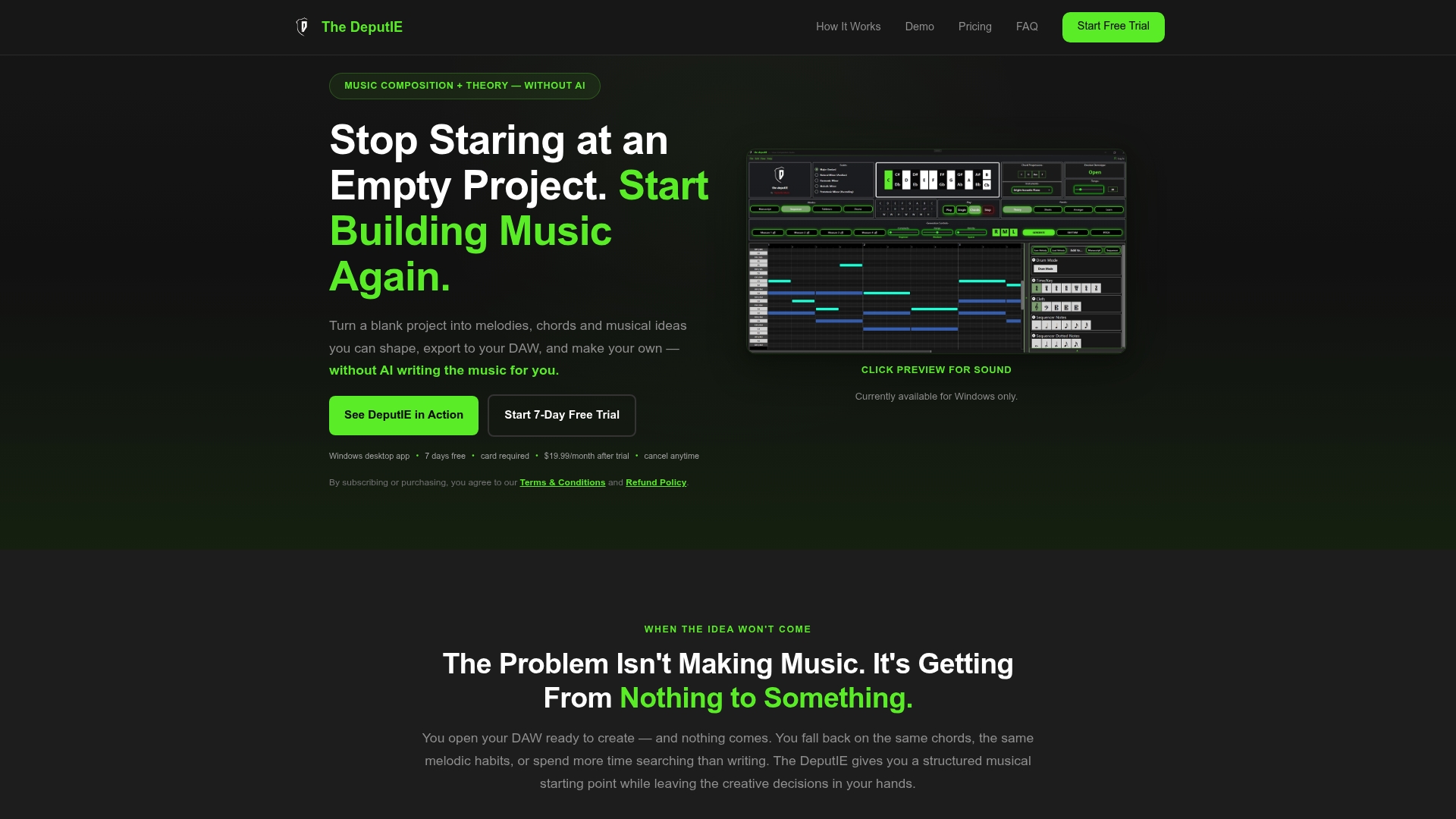
The chord progression tools and visual sequencer make cadence motion visible on screen, root position versus inversion, tonic in the melody versus buried in a lower voice, so you can see exactly why a PAC sounds different from an IAC. Once you've built a cadence you like, export it as MIDI and drop it straight into your DAW to develop further. A 7 day free trial gets you into the workspace immediately, and if the tool earns a place in your regular routine, the Monthly plan runs $19.99 per month or $129.99 per year if you commit annually. Start with the DeputIE manual for a walkthrough of the chord tools before you dive in.
Sources
FAQ
What are the four types of cadences?
The four main harmonic cadences are Authentic (V to I, either perfect or imperfect), Plagal (IV to I), Half (ending on V), and Deceptive (V resolving to a chord other than I, usually vi). Each one signals a different degree of closure at the end of a phrase.
What are some examples of cadence in music?
A Bach chorale ending on a root-position V to I with the melody on scale degree 1 is a classic Perfect Authentic Cadence. The "Amen" at the close of a hymn is a textbook Plagal cadence, while a Handel aria that resolves V to vi instead of I demonstrates a Deceptive cadence.
Is there a better word for cadence?
In everyday language, people sometimes use "resolution" or "ending" to describe what a cadence does, though neither term captures the precise harmonic and melodic criteria theorists use. "Cadence" remains the standard term because it specifically refers to a phrase's harmonic and rhythmic arrival point, not just any conclusion.
How do you find the cadence of a song?
Scan for phrase boundaries marked by held notes or rhythmic lengthening, then check where the harmony resolves, to V for a half cadence, to I for an authentic cadence, or to vi for a deceptive one. Cross-check the melody: a stepwise approach to the tonic (2 to 1 or 7 to 8) confirms an authentic cadence, while a workspace like the DeputIE lets you build and test these progressions visually if you want to hear the difference directly.