
Borrowed chords are chords pulled from a parallel key or mode and dropped into music that otherwise stays in one key, coloring a progression without pushing it into a full modulation. The effect is instant contrast: a chord that sounds slightly off from where you expect it, yet still resolves like it belongs. Songwriters reach for them when a plain diatonic progression needs an emotional turn without losing the thread of the tonic.
TL;DR:
- Borrowed chords generally come from the parallel minor or modal interchange, adding emotional contrast while maintaining their original harmonic function.
- The most common borrowed triads in major keys include ♭III, ♭VI, ♭VII, iv, and iiø7, all of which can be integrated into various progressions for different effect.
- Identifying a borrowed chord involves checking for lowered scale degrees relative to the key, verifying the chord's function, and ensuring the tonic remains stable.
- Smooth voice leading and strategic placement, such as in pre-choruses or bridges, enhance the emotional impact of borrowed chords without disrupting song flow.
- Practice with familiar progressions and ear training helps internalize the sound of borrowed chords, making their use more instinctive and effective in songwriting.
Table of Contents
- Parallel modes, altered scale degrees, and why the function stays put
- Common borrowed chords you can spell and play right now
- How do you identify and label a borrowed chord correctly?
- Building progressions, voicing them smoothly, and placing them in a song
- Practice exercises that make borrowed chords stick
- When borrowed chords help, and when they get in the way
- Auditioning borrowed-chord ideas without losing momentum
- Sources
- FAQ
Parallel modes, altered scale degrees, and why the function stays put
Borrowed chords, sometimes called modal mixture or modal interchange, come from borrowing notes out of the parallel key, most often a major key reaching into its parallel natural minor. In C major, that means swapping in notes from C minor while the tonic itself, C, never moves. The result is a chord that sounds like it belongs to a different emotional world while the song stays anchored.
Three scale degrees do almost all the work, according to the modal mixture chapter in Open Music Theory:
- The third drops from E to E♭, turning bright major harmony minor.
- The sixth drops from A to A♭, the note behind the classic "sad" iv and ♭VI colors.
- The seventh drops from B to B♭, the note that gives ♭VII its rock and blues character.
What makes this trick durable rather than gimmicky is that the borrowed chord usually keeps doing the job its diatonic version was doing. IV moving to iv is a clear case: both are predominant chords that lead toward the dominant or back to the tonic, but iv carries a minor third that darkens the color without changing the chord's role in the progression. You get a new mood with the same map.
Common borrowed chords you can spell and play right now
Most borrowed-chord vocabulary in major keys comes from a short list of triads, and they transfer to any key once you know the pattern. In C major, the Puget Sound analysis guide and related mixture resources point to these as the workhorses:
- ♭III: E♭, G, B♭, borrowed from Aeolian, giving a moody lift between tonic and subdominant.
- ♭VI: A♭, C, E♭, the lowered sixth chord, arguably the single most common mixture chord in pop and rock harmony.
- ♭VII: B♭, D, F, borrowed from Mixolydian, famous for the backdoor cadence into the tonic.
- iv: F, A♭, C, the minor subdominant, a predominant with a darker cast than IV.
- iiø7: D, F, A♭, C, a half-diminished seventh that adds tension before resolving down.
To hear them, try short loops: C, B♭, A♭, B♭ (I, ♭VII, ♭VI, ♭VII) for a cinematic rock sound, C, Fm, C (I, iv, I) for a melancholic turn, or C, Am, Fm, G (I, vi, iv, V) for a progression that briefly darkens before lifting back into the dominant.
How do you identify and label a borrowed chord correctly?
Spotting a borrowed chord in a score or a recording comes down to a short, repeatable process. The Puget Sound guide lays out the core steps analysts use to tell mixture apart from other chromatic moves.
- Stack the notes in thirds to find the root and quality of the chord.
- Check which note sits in the bass to confirm whether the chord is inverted.
- Compare the chord to the diatonic key: if a note is lowered or raised relative to the key signature, mark that accidental directly before the Roman numeral, as in ♭VI or ♭III.
- Note the chord's case, since a lowercase numeral signals a minor triad and an uppercase numeral a major one, with added symbols such as ø for half-diminished qualities.
- Confirm the tonic is still the anchor of the passage rather than displaced, since mixture colors a key while modulation changes it.
Pro Tip: If the chord resolves like a temporary color change and the original tonic reasserts itself within a phrase or two, you're almost certainly looking at a borrowed chord rather than a modulation.
A quick diagnostic separates borrowed chords from secondary dominants: a secondary dominant almost always has a major quality and functions as a V of something else, while a borrowed chord takes its quality from the parallel mode and keeps the home key's function intact.
Building progressions, voicing them smoothly, and placing them in a song
Borrowed chords earn their place in a progression when they create a specific emotional pivot rather than just decorating a chord chart. Three patterns come up constantly in songwriting: I to ♭VII to ♭VI to ♭VII for a widescreen, slightly unresolved rock sound, I to iv to I for a brief shadow that passes quickly, and I too vi to iv to V for a progression that darkens before the dominant pulls it back into the light. The Wikipedia overview of borrowed chords notes that ♭VII to I acts as a well-known backdoor substitute for the usual V to I cadence.
Smooth voice leading keeps these moves from sounding clumsy:
- Hold onto any common tones between the diatonic chord and its borrowed replacement.
- Move the altered note by step rather than by leap, since a half-step resolution sells the color change.
- On guitar, favor voicings that keep the altered tone on an adjacent string from its diatonic neighbor; on keyboard, keep the altered note in an inner voice rather than the melody unless you want it exposed.
Pro Tip: Save your favorite borrowed chord for a pre-chorus or a bridge rather than the verse, since holding it back makes the moment it finally appears land harder.
Placement matters as much as the chord choice itself. A ♭VI dropped into a cadence reads as cinematic tension, the same chord in a verse can feel like a passing mood, and a iv chord right before a final I often works as a quiet, understated goodbye.

Practice exercises that make borrowed chords stick
Theory only sticks once your ear and your hands agree on what a borrowed chord sounds like, so these drills are short by design.
- Take a familiar loop like I, V, vi, IV and swap in iv or ♭VI somewhere in the cycle, then listen for exactly where the mood shifts.
- Sing the lowered scale-degree move, such as A down to A♭, before finding it on your instrument, since hearing the interval first trains recognition faster than reading it.
- In a DAW, alternate IV and iv over the same bass note with two different voicings, export both as MIDI, and compare the textures side by side.
When borrowed chords help, and when they get in the way
Borrowed chords work best as a controlled contrast, not a constant seasoning. The most common student mistake is stacking altered tones without any stepwise resolution, which turns a striking moment into noise. Use restraint, let the tonic stay the anchor, and record every experiment so you can judge the effect with fresh ears later.
— Vigilantie
Auditioning borrowed-chord ideas without losing momentum
Testing a ♭VI substitution or a backdoor cadence usually means stopping to notate, replay, and second-guess yourself, which is exactly the kind of friction The DeputIE was built to cut down. Its chord workspace and chord-progression tools let you drop in a borrowed chord, hear it against the surrounding progression instantly, and adjust the voicing without losing your original idea.
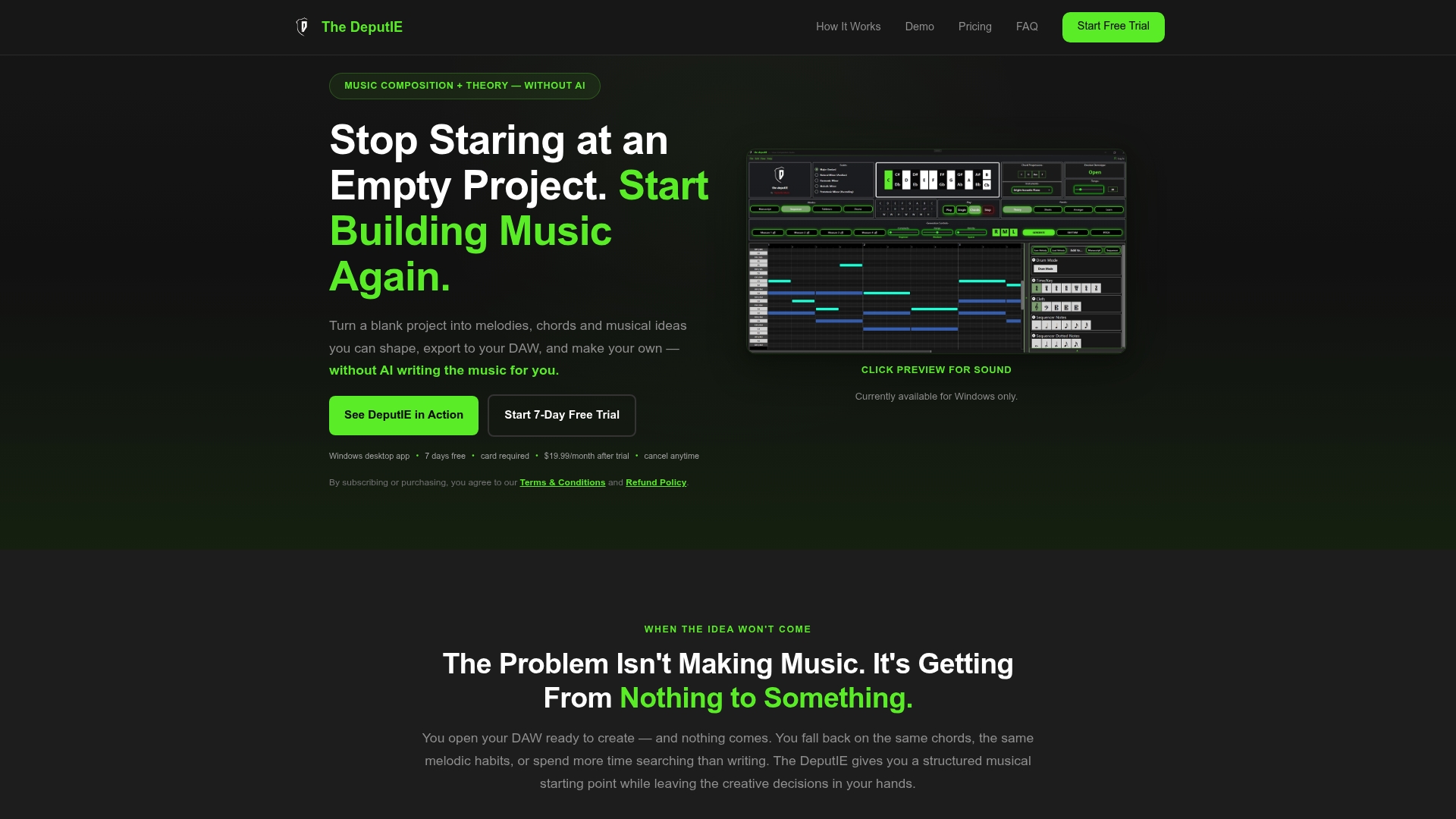
The visual sequencer keeps the harmonic structure visible while you experiment, and once a reharmonization earns its place, MIDI export sends it straight into your DAW for arranging and mixing. The user manual walks through the chord workspace step by step for anyone who wants a guided start. Plans run $19.99 per month or $129.99 per year, with a free trial available before you commit to either.
Sources
- Modal mixture – Open Music Theory
- Analyzing and Writing Borrowed Chords — Puget Sound Music Theory
- Borrowed chord — Wikipedia
FAQ
What are borrowed chords in music?
Borrowed chords are chords taken from a parallel key or mode, most often a major key borrowing from its parallel minor, and inserted into a progression to add color without changing the home key. They alter a chord's quality while usually keeping its harmonic function, so a borrowed iv still acts as a predominant the way IV does.
What is the forbidden chord on guitar?
There is no single chord formally labeled "forbidden" in music theory, and the phrase is informal rather than a recognized term. It often refers colloquially to dissonant or unusual-sounding chords like certain diminished or tritone-heavy voicings that players avoid until they understand how to resolve them.
What is the forbidden note in music?
This is another informal phrase rather than an established theory term, and definitions vary depending on who uses it. It most commonly points to the tritone, an interval historically associated with instability and tension in Western harmony.
What's the scariest chord?
No music-theory source defines a single "scariest" chord, but diminished and half-diminished chords, including the iiø7 borrowed chord discussed above, are frequently cited for their unresolved, tense character. Composers often use these qualities deliberately to create suspense before resolving to a stable chord.