
A bass groove is a repeating rhythmic phrase that outlines the harmony and anchors the beat, usually holding steady through a section before shifting to mark a new one. Start with a straight 4/4 rock pattern, then add walking eighths, a funk sixteenth-note feel, a 12/8 shuffle, and a 6/8 groove. Pick one, set a metronome to a slow, comfortable tempo, loop a single bar, and don't move on until it locks.
TL;DR:
- Most basic grooves should be anchored on beats one and three, with note choices and subdivisions tailored to the specific rhythm style.
- Locking the root notes to the kick drum pattern creates the strongest groove, especially in funk and pop, and is key to tight rhythm section playing.
- Adding dynamics, rests, and subtle variations enhances groove feel and prevents performance from sounding mechanical or monotonous.
- Practicing grooves slowly with a metronome and breaking them into short chunks improves timing more effectively than rushing to memorize full patterns.
- Using visual sequencing tools can speed up the process of generating, testing, and locking in groove ideas before committing them into muscle memory.
Table of Contents
- Core Bass Guitar Grooves You Can Play Today
- How Are Bass Grooves Built? Rhythmic Weight and Note Choice
- What Techniques Give a Bass Groove More Feel?
- How Should You Practice Bass Grooves With a Metronome?
- How Do You Expand a One-Bar Groove Into a Full Phrase?
- How Do You Memorize Bass Lines Fast?
- Using Composition Workspaces to Generate and Practice Groove Ideas
- Why Bass Grooves Matter to Song Structure and the Rhythm Section
- Common Bass Groove Styles Across Genres
- How to Listen to and Analyze Bass Grooves in Recordings
- How Do You Add Variation and Dynamics to a Groove?
- How Do Bass Grooves Interact With Drum Patterns?
- Tips for Improvising and Writing Original Bass Grooves
- Bass Groove Learning: Start Small, Stay Consistent
- Turn Groove Ideas Into Practice Loops With The DeputIE
- Sources
- FAQ
Core Bass Guitar Grooves You Can Play Today
Five common patterns cover many typical gig or jam scenarios. Learning these in order builds a solid foundational vocabulary.
- Straight rock 4/4. Root notes on beats 1 and 3, with an eighth-note push into beat 4, sit at 80 to 120 BPM. Try: root, root, fifth, root (quarter notes), then vary by holding beat 1 for a full measure every other bar.
- Walking eighths (blues and jazz). Constant eighth-note motion between chord tones, typically 90 to 140 BPM. The trick is targeting the next chord's root or third on the "and" of beat 4, so your ear pulls forward into the change.
- Funk sixteenth groove. Sparse root and fifth hits punctuated by ghost notes, usually 90 to 110 BPM. Leave space on beat 2 and let a muted sixteenth note fill the gap instead of another pitched note.
- Shuffle or 12/8. Triplet subdivision with accents landing on the first and third partials of each triplet group, around 85 to 110 BPM. Keep the middle triplet note quiet so the swing doesn't flatten out.
- 6/8 groove. Phrase in two groups of three rather than six even eighths, typically 70 to 100 BPM. A simple pattern: root, rest, fifth, root, rest, third, repeated with a slight lean into beat 4.
A single note set can produce very different feels depending on how you subdivide it, which is why mastering subdivisions matters more early on than memorizing dozens of separate patterns.
How Are Bass Grooves Built? Rhythmic Weight and Note Choice
Every beat in a bar doesn't carry the same weight. Beat 1 is the strongest, beat 3 is the second strongest in 4/4, and the "and" counts are the weakest. That hierarchy tells you where to put which notes.
- Place root notes and other chord tones on beats 1 and 3 to define the harmony clearly.
- Save scale tones, passing tones, and chromatic notes for the weaker "and" counts, where they add movement without confusing the ear.
- StudyBass calls this the rhythmic weight principle: strong beats get chord tones, weak beats get connective tissue.
- Test it yourself: play a two-chord vamp using only roots on 1 and 3, then add a chromatic approach note on the "and" of 4 leading into the next chord.
- Change the subdivision (quarter notes, then eighths, then sixteenths) on that same two-chord vamp and notice how the feel shifts even though the harmony hasn't moved.
Get this right and your lines will sound intentional even when they're simple. Get it backward, chord tones buried on weak beats, passing tones landing hard on beat 1, and even a technically correct line will sound unsettled.
What Techniques Give a Bass Groove More Feel?
Notes get you the harmony. Feel gets you the groove. Ghost notes, syncopation, and deliberate timing choices separate a line that sounds programmed from one that sounds played.
- Ghost notes (muted, rhythmic thumps with no clear pitch) fill space in funk and R&B grooves, typically landing on off beats between your main notes.
- Syncopation, accenting a note where you'd expect silence, creates tension that resolves when the next strong beat arrives.
- Playing slightly behind the beat, a hair after where a metronome click would land, is central to a relaxed funk pocket and separates mechanical playing from a groove that breathes.
- Use these tools sparingly. A groove packed with ghost notes and syncopation on every beat loses the contrast that makes those techniques work in the first place.
Pro Tip: Before you add another note to a groove, ask whether a rest or a dead note would serve the pocket better. Space is a technique, not an absence of one.
How Should You Practice Bass Grooves With a Metronome?
Build timing before you build vocabulary. A groove played slightly out of time will always sound worse than a simpler one played dead in the pocket.
- Warm up with long tones: hold a single root note for four beats, then eight, matching subdivisions on the metronome (quarters, then eighths, then sixteenths).
- Loop your groove for one bar at a slow tempo until it's automatic, then stretch it to four bars, adding a question-and-answer phrase to keep it from feeling static.
- Practice the same groove across different subdivisions, and try displacing it by a single sixteenth note to sharpen your sense of where the beat actually falls.
- Use slowed backing tracks: start funk grooves around 70 to 80 BPM and rock grooves around 60 to 70 BPM before working up to performance tempo. Looped timing drills at fixed tempos sharpen your internal pulse more reliably than adding new notes to a line you haven't locked in yet.
How Do You Expand a One-Bar Groove Into a Full Phrase?
The A-B-A-C structure turns a single bar into a phrase that breathes instead of looping into monotony. A is your core motif. B contrasts it, maybe with a rhythmic shift or a melodic answer. You return to A, then close with C, a fill or variation that signals the phrase is ending.
- Write A: a one-bar motif using root and fifth on the strong beats.
- Write B: the same rhythmic shape but with a note a third or fourth away, creating a question-and-answer feel.
- Return to A exactly as written, then write C as a two-beat fill leading into the next section.
This Q&A phrasing is one of the fastest ways to stretch a simple idea into something that sounds composed rather than repeated on a loop.
How Do You Memorize Bass Lines Fast?
Break the groove into two-beat chunks rather than trying to absorb the whole bar at once. Practice each chunk slowly, then test recall by singing the line without touching your instrument. If you can sing it, your fingers will follow more easily.
- Increase tempo in small increments, five BPM at a time, and revisit the line the next day rather than drilling it once and moving on.
- Record yourself playing the groove, then play it back and try to answer it, a simple call-and-response drill that cements the phrase.
- Vocalizing a bass line before you play it is one of the more overlooked memorization tools, and it works because it forces you to internalize rhythm separately from finger position.
Using Composition Workspaces to Generate and Practice Groove Ideas
Coming up with new groove ideas by ear works, but it's slow when you're stuck. A visual sequencer lets you sketch a motif, map it against a chord progression, and hear it immediately instead of guessing at intervals on the fretboard.
- Sketch a one-bar motif in a visual sequencer, then drop it against a chord progression to hear how it sits harmonically.
- Export the result as MIDI into your DAW, loop it, and slow the tempo down for practice the same way you would a backing track.
- The DeputIE's visual sequencer lets you test rhythmic variations quickly and generates practice-ready loops at whatever tempo you need, which is useful when you want five versions of the same groove to compare before committing one to memory.
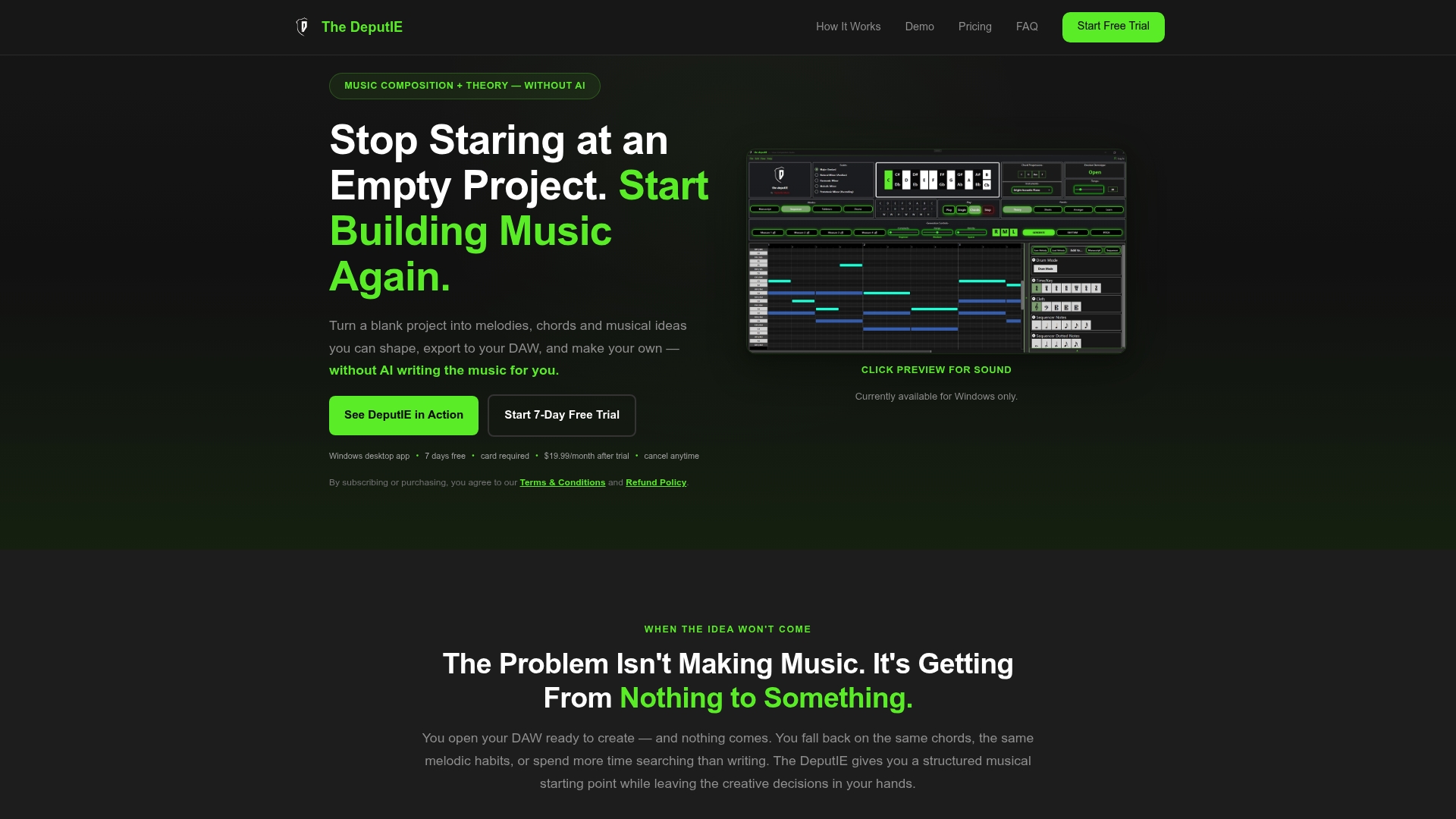
This workflow doesn't replace ear training. It gives you a faster way to generate raw material, then you take that material to your instrument and do the slow work of locking it into your hands.
Why Bass Grooves Matter to Song Structure and the Rhythm Section
A bass groove is the connective tissue between the drummer's rhythm and the harmony everyone else is playing over. Take the bass out of most recordings and the song loses its low-end pulse and its harmonic anchor at the same time, which is a heavier job than most other instruments carry alone.
Bass lines also signal structure. A groove that stays locked through a verse and then opens up, adding movement, changing register, dropping to a sparser pattern, tells the listener a new section has arrived before the vocal or the chorus even lands. Producers count on this. A bassist who plays the exact same pattern through a verse, chorus, and bridge without any variation flattens the arrangement, even if every note is technically correct.
The rhythm section works because the bass and drums agree on where the beat lives. When a bassist and drummer both emphasize the same subdivision, whether that's the "and" of 2 in a funk tune or the triplet pulse in a shuffle, the groove locks in a way that makes the rest of the band's job easier. Guitarists and keyboardists can take more rhythmic liberty precisely because the bass and kick drum are holding the foundation steady underneath them.
This is also why simple grooves so often outperform complex ones in a live setting. A line that's easy to lock in with the drummer supports the song. A technically impressive line that fights the kick drum pattern undermines it, no matter how many notes it contains.
Common Bass Groove Styles Across Genres
Different genres lean on different rhythmic feels, and recognizing the pattern behind each one speeds up how fast you can adapt to a new style.
| Genre | Characteristic feel | Typical note choice |
|---|---|---|
| Funk | Sixteenth-note subdivision, heavy ghost notes, syncopated accents | Root and fifth dominate, with chromatic approach notes |
| Rock | Straight eighth or quarter-note pulse, strong downbeats | Root-heavy, occasional fifth or octave for lift |
| Jazz | Walking quarter or eighth notes connecting chord changes | Chord tones on strong beats, chromatic passing tones elsewhere |
| Reggae | Emphasis on beats 2 and 4 (the "one drop"), space on beat 1 | Root and fifth, often with a melodic lift on the offbeat |
| Blues (shuffle) | Triplet subdivision, swung eighth notes | Root, fifth, and sixth in a repeating shuffle pattern |
Funk and reggae both rely on space as much as notes, just in different places: funk leaves gaps mid-bar filled with ghost notes, while reggae leaves beat 1 nearly empty to emphasize the offbeat. Jazz and blues share a reliance on chord-tone targeting, but jazz walks continuously while blues shuffle grooves repeat a shorter rhythmic cell. Recognizing which category a song falls into before you start playing saves you from applying a rock approach to a tune that needs a one-drop feel.
How to Listen to and Analyze Bass Grooves in Recordings
Most bassists listen to a song and hear the vocal or the guitar first, because those parts sit higher in the mix and carry the melody. Training yourself to isolate the bass takes deliberate effort, and it pays off fast.
Start by listening on headphones and following the bass line through an entire verse, ignoring everything else. Note where it holds steady and where it moves, then check whether those changes line up with a new section, a fill, or a change in the drum pattern. Bass lines almost always shift in tandem with the drums, so once you can hear the kick and snare pattern clearly, the bass line's logic becomes easier to follow.
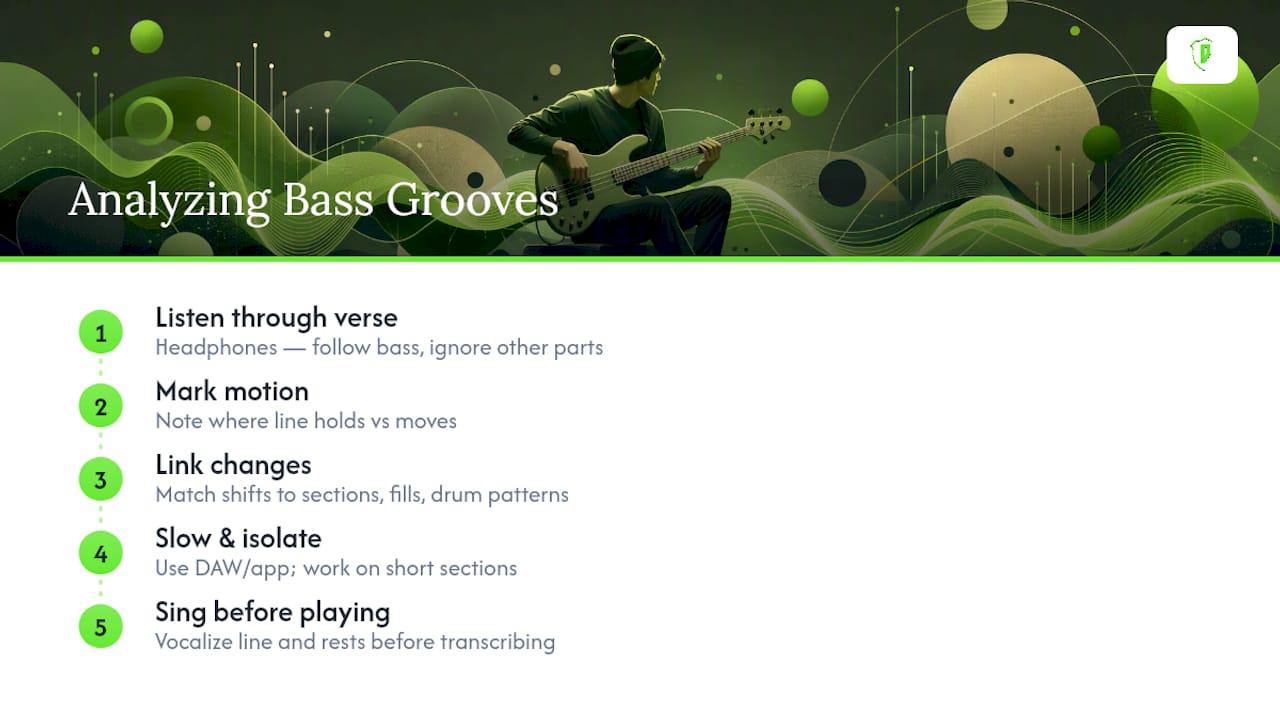
Slow the track down using a DAW or a slowdown app and isolate short sections at a time. Try to sing the bass line back before you pick up your instrument. If you can't sing it, you haven't fully internalized the rhythm yet, and reaching for the bass at that point usually leads to guessing instead of transcribing.
Pay attention to what the bassist doesn't play as much as what they do. The rests, the spots where a note is left out to let the drums or vocal breathe, are often the most instructive part of a well-constructed groove. A line that's technically simple but rhythmically precise will teach you more than a busy one that's hard to parse by ear.
How Do You Add Variation and Dynamics to a Groove?
A groove that never changes for four minutes puts a listener to sleep, even if it's locked perfectly with the drummer. The skill isn't inventing a new pattern for every section. It's knowing when to hold steady and when to shift.
Small variations work better than wholesale changes. Add a passing note on the "and" of 4 leading into the chorus. Drop to just root notes during a quiet verse, then add the fifth and an octave jump when the chorus opens up. Octave displacement, jumping a note up or down an octave rather than changing which note you play, is one of the simplest ways to add ear-catching movement to a groove without abandoning its core identity.
Dynamics matter as much as note choice. Playing the same pattern softer under a verse and harder under a chorus creates a sense of build even when the notes themselves haven't changed. Muting strings slightly for a verse and letting them ring more openly for a chorus is a subtle trick many bassists overlook because it doesn't show up in tab notation at all.
The goal is contrast, not constant change. Pick one or two moments per song where the groove shifts noticeably, and let the rest of the pattern stay consistent enough that those shifts actually register as change.
How Do Bass Grooves Interact With Drum Patterns?
The bass and drums form a rhythmic partnership, and the strongest grooves come from a bassist who's actively listening to the kick drum rather than just keeping their own time. When your root notes align with the kick drum hits, the groove feels unified. When they diverge, even slightly, the whole rhythm section can sound disjointed.
Study where the kick drum falls in a given pattern. In a lot of rock and pop, the kick lands on beats 1 and 3, and matching your root notes to those hits creates an immediate, obvious lock. In funk, the kick often syncopates around the beat, and a bassist who matches those syncopations, rather than defaulting to a straight pattern, locks in far more convincingly.
The snare matters too. Many bassists leave space on the beat where the snare hits, letting that drum carry the accent instead of competing with it. This is part of why ghost notes work so well in funk: they fill rhythmic space without stepping on the snare's role as the primary accent.
When you're jamming with a real drummer, listen more than you play for the first few bars of any new groove. Match their kick pattern first, then build your note choices around that foundation. A bassist who locks with the kick drum will sound tighter than one who's technically faster but rhythmically independent.
Tips for Improvising and Writing Original Bass Grooves
Improvising a groove from scratch is less about inventing something new and more about recombining techniques you've already practiced. Start with a familiar rhythmic template, straight eighths, a funk sixteenth feel, whatever you know best, and change the notes rather than the rhythm.
Limit your note choices at first. Restricting yourself to root, fifth, and one passing tone forces you to focus on rhythm and placement instead of getting lost hunting for interesting pitches. Once that constrained version feels solid, open up the note choices gradually.
Borrow the A-B-A-C structure from earlier and apply it on the fly: play a motif, answer it with a variation, return to the original, then improvise a short fill before repeating the cycle. This keeps improvised grooves from wandering aimlessly, which is the most common failure mode for bassists who try to improvise without any rhythmic anchor.
Recording yourself is the fastest feedback loop available. Loop a chord progression, hit record, and play through several takes without stopping to judge each one. Listen back afterward and identify the two or three moments that actually locked in. Those moments usually point to a rhythmic idea worth developing further, and building future grooves around what already worked beats starting from a blank slate every time.
Bass Groove Learning: Start Small, Stay Consistent
Every strong bass line traces back to a simple idea played with conviction. Start with one groove, nail the feel before adding notes, then stretch it with question-and-answer phrasing. Short daily practice beats occasional marathon sessions, every time.
— Vigilantie
Turn Groove Ideas Into Practice Loops With The DeputIE
Most bassists hit the same wall: an idea sounds good in your head, but turning it into something you can loop and slow down for practice takes longer than the idea itself deserves. The DeputIE's visual sequencer gives you a faster middle step between imagining a groove and actually drilling it, without handing over the creative decisions to an algorithm.
Sketch a motif, map it against a chord progression in the chord workspace, and export the result as MIDI straight into your DAW. From there you can loop it, slow the tempo down, and practice the exact idea you just wrote instead of hunting for a backing track that happens to match what you had in mind. Reach for this when you want to test five variations of a groove before committing one to memory, and keep working purely by ear when you're focused on transcription or live improvisation. The DeputIE product page walks through the sequencer and chord tools, and the user manual covers MIDI export setup for your specific DAW. Start a trial and sketch your next groove idea today.
Sources
- Rhythmic weight — StudyBass
- Bass groove basics: Build better lines with Q&A technique — Berklee Online Take Note
- How to build a funk bass groove from a simple idea — No Treble
FAQ
What Is the 3 Fret Rule on Bass?
It's a fretboard shortcut suggesting you can often find a needed note within three frets of your current hand position, reducing unnecessary shifting during a groove. It's a practice guideline rather than a strict rule, and skilled players break it constantly for tone or phrasing reasons.
Why Do Bassists Play So Low?
Bass instruments are tuned an octave below guitar to occupy the low-frequency range that anchors a song's harmony and gives drums something to lock rhythmically against. That low register lets the bass define the root of each chord without clashing with higher instruments carrying melody.
What Is the Most Famous Bass Riff?
There's no single definitive answer since fame varies by genre and era, but riffs built on simple, repeatable motifs, often just a few notes played with strong rhythmic conviction, tend to be the ones that stick in listeners' memory longest.
How Do You Memorize Bass Lines?
Break the line into short chunks, practice each slowly, and test yourself by singing the phrase before playing it. Increasing tempo gradually and revisiting the line across multiple days works better than one long repetitive session.
Can Composition Software Help Me Write Bass Grooves?
Yes. A tool like The DeputIE lets you sketch a groove motif visually, test it against a chord progression, and export it as MIDI for looped practice, which speeds up the idea-generation stage without replacing ear training.